WHO EMRO
  • Regions
WHO EMRO
WHO Regional websites
Africa Africa
Americas Americas
Asie du Sud-Est Asie du Sud-Est
Europe Europe
Méditerranée orientale Méditerranée orientale
Pacifique occidental Pacifique occidental
  • Home
  • Health topics
  • Health topics
  • Data and statistics
  • Media centre
  • Information resources
  • Countries
  • Programmes
  • About Us
Search Search

Search

- All words: Returns only documents that match all words.
- Any word: Returns documents that match any word.
- Exact Phrase: Returns only documents that match the exact phrase entered.
- Phrase Prefix: Works like the Exact Phrase mode, except that it allows for prefix matches on the last term in the text.
- Wildcard: Returns documents that match a wildcard expression.
- Fuzzy query: Returns documents that contain terms similar to the search term. For example: If you search for Kolumbia. It will return search results that contain Columbia or Colombia.
  • Global
  • Regions
    WHO Regional websites
    Africa Africa
    Americas Americas
    Asie du Sud-Est Asie du Sud-Est
    Europe Europe
    Méditerranée orientale Méditerranée orientale
    Pacifique occidental Pacifique occidental
Search Search

Search

- All words: Returns only documents that match all words.
- Any word: Returns documents that match any word.
- Exact Phrase: Returns only documents that match the exact phrase entered.
- Phrase Prefix: Works like the Exact Phrase mode, except that it allows for prefix matches on the last term in the text.
- Wildcard: Returns documents that match a wildcard expression.
- Fuzzy query: Returns documents that contain terms similar to the search term. For example: If you search for Kolumbia. It will return search results that contain Columbia or Colombia.

Select your language
  • اللغة العربية
  • Français
WHO EMRO WHO EMRO
  • Home
  • Health topics
    • All Topics »
    • A
    • B
    • C
    • D
    • E
    • F
    • G
    • H
    • I
    • J
    • K
    • L
    • M
    • N
    • O
    • P
    • Q
    • R
    • S
    • T
    • U
    • V
    • W
    • X
    • Y
    • Z
  • Health topics
  • Data and statistics
  • Media centre
  • Information resources
  • Countries
  • Programmes
  • About Us
  1. EWARN
  • EWARN
  • Latest updates
  • Information resources
  • Related links

EWARN

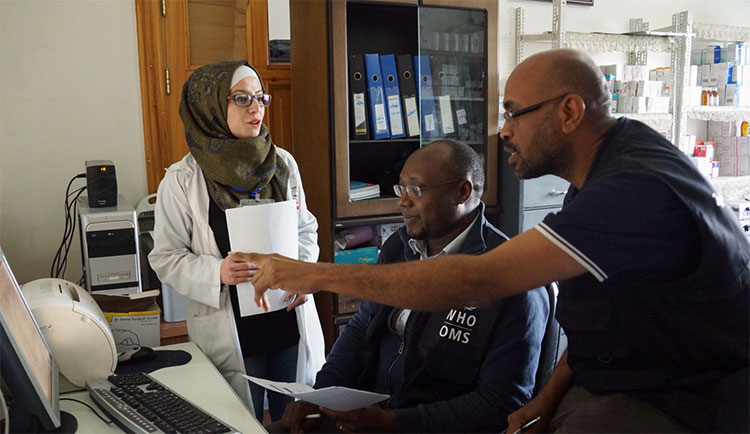
WHO early warning experts assess Syria’s early warning disease surveillance system (Photo: WHO, 2017)WHO early warning experts assess Syria’s early warning disease surveillance system (Photo: WHO, 2017)

Early warning systems for disease outbreaks are surveillance systems that collect information on a selected list of epidemic-prone diseases in order to trigger prompt public health interventions. They function in humanitarian emergency situations when the routine public health surveillance systems of a country are underperforming, disrupted or non-existent. Early warning systems are often set up to fill such temporary gaps, while the routine systems recover from the effects of the disaster or a crisis. During humanitarian emergencies, detecting and responding swiftly to epidemics is key in order to reduce unecessary illness and death, especially among refugees and displaced people.

An Early Warning, Alert and Response Network (EWARN) is a network of health partners that collect and report surveillance data on selected epidemic-prone diseases, as part of establishing an early warning system for disease outbreaks in humanitarian situations. It is usually a so-called ‘syndromic surveillance system’ whereby any unusual event or disease occurrence is monitored and rapidly investigated.

In such surveillance systems, each disease is diagnosed on the basis of case definition. For each of the epidemic diseases, a threshold value for ‘alert” of an outbreak is set. Whenever the threshold is passed, the system flags the event for rapid investigation.

To ensure timely detection and verification of outbreaks, as well as effective monitoring of disease patterns, an EWARN has two main components. An immediate alert component signals the early stages of an outbreak, which requires an immediate investigation for verification, while a weekly reporting component aggregates data from health facilities to provide information on disease trend, for prioritiy health conditions.

WHO, health partners and Ministries of Health implement EWARN together in countries that face humanitarian crises. Currently, seven countries in the Region which are facing protracted emergencies have established a functioning EWARN system: Afghanistan, Iraq, Libya, Somalia, Sudan, Syria and Yemen.

When security constraints limit mobility, members of an EWARN can often not share data manually and EWARN coverage decreases as a result. However, recent experiences with real-time innovative electronic solutions prove that these systems can be maintained even in difficult situations, facilitatling its key functions of early detection and effective monitoring of disease trends.

Latest updates

EWARN

Somalia EWARN bulletins

Information resources

EWARN quick reference handbook

Peer-reviewed articles 

Early Warning Alert And Response Network in emergencies: evaluation protocol

Epidemiological Data Analysis for EWARN - A Quick Reference Handbook

Technical guidance

Related topics

EWARN_training

Early warning systems

Pandemic- and epidemic-prone diseases

International Health Regulations

Health emergencies

Interactive applications and databases

  • 1
  • 2
  • 3
  • 4
  • Site map
    • Home
    • Data and statistics
    • Health Topics
    • Media centre
    • Information Resources
    • Countries
    • Programmes
    • About Us
  • Help and services
    • Careers
    • Copyright
    • Privacy
    • Contact us
  • WHO Offices
    • WHO Headquarters
    • WHO African Region
    • WHO Region of the Americas
    • WHO European Region
    • WHO South-East Asia Region
    • WHO Western Pacific Region
WHO EMRO

Privacy policy

© WHO 2025