 1–11 March update
The health needs in Mosul are fast evolving; more areas are becoming accessible,leading to an influx of internally displaced persons (IDPs) to safer areas with basic social services, including health. To respond to the immense primary health care needs, WHO is working with health authorities and implementing partners to scale up its support. During this reporting period:
- WHO delivered 4 fully furnished and equipped caravans to 4 transit sites near west Mosul to offer primary health cares services for IDPs fleeing from west Mosul on arrival.
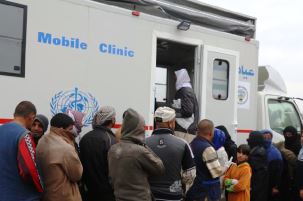
- Through its implementing partner Dary, WHO established and operationalized a primary health care centre in Hammam Aleel 1 camp to provide health to new arrivals, those living in Hamam Aleel 1 IDP camp and in the nearby transit sites. In addition, WHO prepositioned 5 mobile medical clinics in different locations in Hammam Aleel area to ensure easy and timely quick access to health services for the IDPs.
- In Dibaga 2 IDPs, WHO together with the Erbil Directorate of Health opened a primary health care centre that will serve the needs of 6500 IDPs. The centre commenced operations on 16 March 2017 offering comprehensive primary health care services to IDPs, including those from Qayara and Hawija. The facility is run by 27 health providers from the Erbil Department of Health.
- A total of 10 736 consultations, including 2649 children under the age of 5 years were recorded through WHO supported mobile medical clinics and static primary health facilities run by WHO implementing partners. Twenty five per cent of all the total consultations were due to acute respiratory tract infections. A total of 597 complicated cases were referrals to specialized health facilities through ambulances donated by WHO to the Directorate of Health in Ninewa.
WHO special situation report, Mosul crisis, Iraq, Issue No 10, 12–28 March 2017 [pdf 560kb]
Mosul reports
WHO special situation report, Mosul crisis, Iraq, Issue No 9, 1–11March 2017 [pdf 560kb] | Arabic [pdf 659kb]
WHO special situation report, Mosul crisis, Iraq, Issue No 8, 19–28 February 2017 [pdf 478kb] | Arabic [pdf 616kb]
WHO special situation report, Mosul crisis, Iraq, Issue No 7, 12–18 February 2017 [pdf 517kb] | Arabic [pdf 352]
WHO special situation report, Mosul crisis, Iraq, Issue No 6, 5–11 February 2017 [pdf 788kb]
WHO special situation report, Mosul crisis, Iraq, Issue No 5, 29 January–4 February 2017 [pdf 663kb] | Arabic [pdf 962]
WHO special situation report, Mosul crisis, Iraq, Issue No 4, 22–28 January 2017 [pdf 707kb]
WHO special situation report, Mosul crisis, Iraq, Issue No 3, 15–21 January 2017 [pdf 760kb]
WHO special situation report, Mosul crisis, Iraq, Issue No 2, 7–14 January 2017 [pdf 631kb] | Arabic [pdf 477kb]
WHO special situation report, Mosul crisis, Iraq, Issue No 1, 1–7 January 2017 [pdf 639kb] | Arabic [pdf 459kb]
Related link
All situation reports
1–11 March update
The health needs in Mosul are fast evolving; more areas are becoming accessible,leading to an influx of internally displaced persons (IDPs) to safer areas with basic social services, including health. To respond to the immense primary health care needs, WHO is working with health authorities and implementing partners to scale up its support. During this reporting period:
- WHO delivered 4 fully furnished and equipped caravans to 4 transit sites near west Mosul to offer primary health cares services for IDPs fleeing from west Mosul on arrival.
- Through its implementing partner Dary, WHO established and operationalized a primary health care centre in Hammam Aleel 1 camp to provide health to new arrivals, those living in Hamam Aleel 1 IDP camp and in the nearby transit sites. In addition, WHO prepositioned 5 mobile medical clinics in different locations in Hammam Aleel area to ensure easy and timely quick access to health services for the IDPs.
- In Dibaga 2 IDPs, WHO together with the Erbil Directorate of Health opened a primary health care centre that will serve the needs of 6500 IDPs. The centre commenced operations on 16 March 2017 offering comprehensive primary health care services to IDPs, including those from Qayara and Hawija. The facility is run by 27 health providers from the Erbil Department of Health.
- A total of 10 736 consultations, including 2649 children under the age of 5 years were recorded through WHO supported mobile medical clinics and static primary health facilities run by WHO implementing partners. Twenty five per cent of all the total consultations were due to acute respiratory tract infections. A total of 597 complicated cases were referrals to specialized health facilities through ambulances donated by WHO to the Directorate of Health in Ninewa.
WHO special situation report, Mosul crisis, Iraq, Issue No 10, 12–28 March 2017 [pdf 560kb]
Mosul reports
WHO special situation report, Mosul crisis, Iraq, Issue No 9, 1–11March 2017 [pdf 560kb] | Arabic [pdf 659kb]
WHO special situation report, Mosul crisis, Iraq, Issue No 8, 19–28 February 2017 [pdf 478kb] | Arabic [pdf 616kb]
WHO special situation report, Mosul crisis, Iraq, Issue No 7, 12–18 February 2017 [pdf 517kb] | Arabic [pdf 352]
WHO special situation report, Mosul crisis, Iraq, Issue No 6, 5–11 February 2017 [pdf 788kb]
WHO special situation report, Mosul crisis, Iraq, Issue No 5, 29 January–4 February 2017 [pdf 663kb] | Arabic [pdf 962]
WHO special situation report, Mosul crisis, Iraq, Issue No 4, 22–28 January 2017 [pdf 707kb]
WHO special situation report, Mosul crisis, Iraq, Issue No 3, 15–21 January 2017 [pdf 760kb]
WHO special situation report, Mosul crisis, Iraq, Issue No 2, 7–14 January 2017 [pdf 631kb] | Arabic [pdf 477kb]
WHO special situation report, Mosul crisis, Iraq, Issue No 1, 1–7 January 2017 [pdf 639kb] | Arabic [pdf 459kb]
Related link
All situation reports