For this year’s World Diabetes Day, the World Health Organization, the International Diabetes Federation and the International Council of Nurses have come together to call for more investment in nursing to help people with diabetes – which is the focus of this year’s Day.
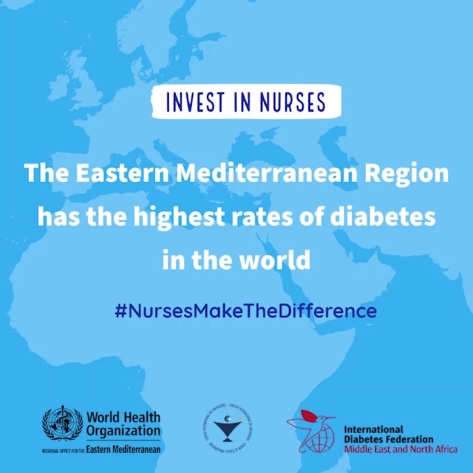
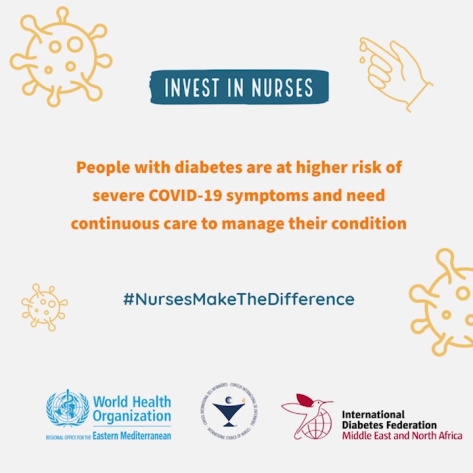
Diabetes affects millions of people. It can debilitate or cut lives short. The Eastern Mediterranean Region has the highest rates of diabetes in the world. And now, with the COVID-19 pandemic, people with diabetes are at higher risk of developing severe COVID-19 symptoms and need continuous care to manage their condition.
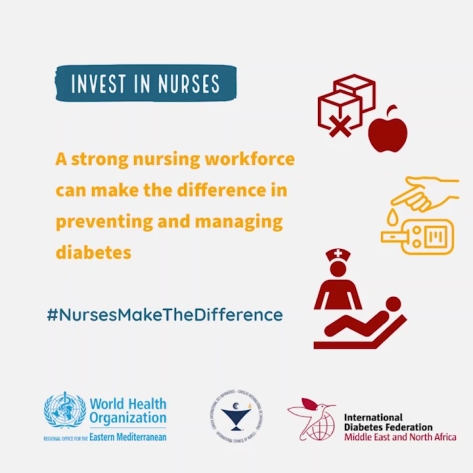
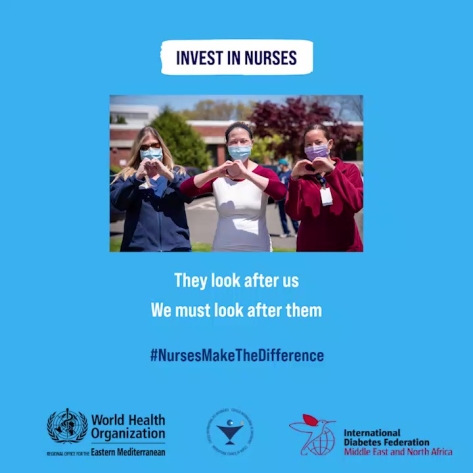
Nurses can make the difference for people living with diabetes or those at risk of developing it.
Nurses are at the core of the health system.
Nurses are the first point of contact, and close to their communities.
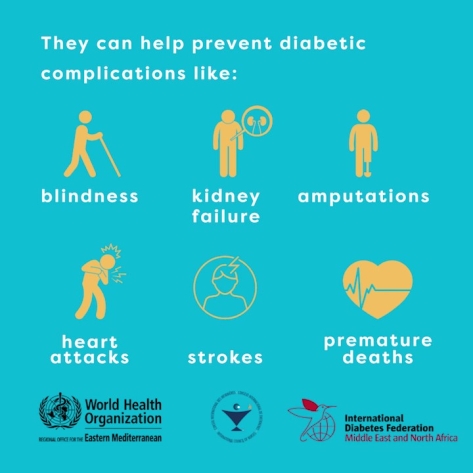
Nurses can help prevent diabetic complications like blindness, kidney failure, amputations, heart attacks, strokes and premature death.
Nurses play a crucial role in health promotion, health literacy, and the management of diabetes and other chronic conditions, including screening and providing primary health care services and specialized treatment services.
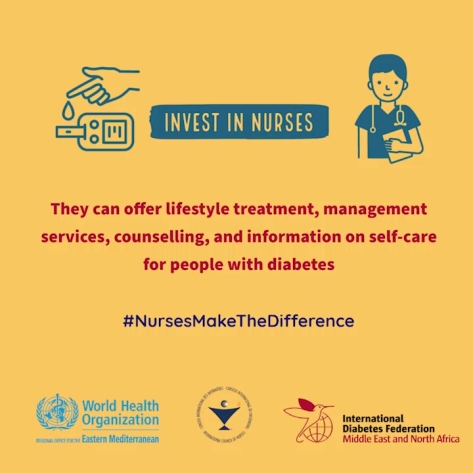
Nurses can offer lifestyle treatment, counselling, information and education.
Nurses are ideally placed to help detect and manage diabetes.
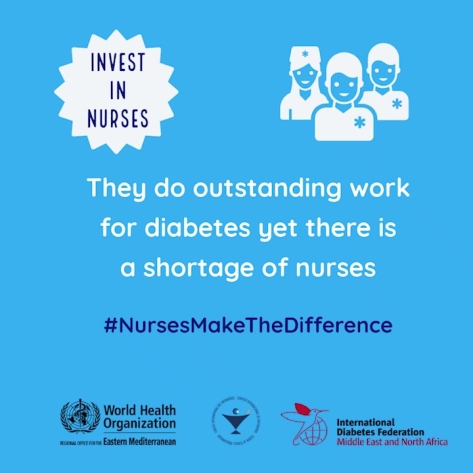
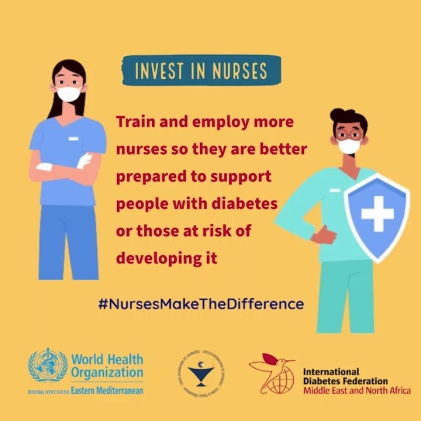
Yet we are facing shortages of nurses. We are calling on health care providers and governments to train and employ more nurses so that they are better prepared to support people affected by diabetes, and help maintain essential health services and rising health care demands during the COVID-19 pandemic and beyond. With the right expertise, nurses can make the difference in the fight against diabetes.
On World Diabetes Day, WHO announced the Global Diabetes Compact, a comprehensive and inclusive approach to support countries in implementing effective programmes for the prevention and management of diabetes. The Compact brings together in one package all WHO materials available for the prevention and management of diabetes, both existing and new. On the prevention side, particular focus is given to reducing obesity, especially among young people. On the treatment side, emphasis is on improving access to diabetes medicines and technologies, in particular in low- and middle-income countries. Key to the success of the Compact will be alignment and united action across all sectors ̶ public, private and philanthropic.
The Lancet Commission on diabetes: using data to transform diabetes care and patient lives
Over 460 million people worldwide have diabetes, with around 80% of them living in low-income and middle-income countries. Despite high-level commitments to accelerate global action against noncommunicable diseases (NCDs), the world is not on-track to reach Sustainable Development Goal 3.4 to reduce premature mortality from major NCDs by 30% between 2015 and 2030. Ahead of World Diabetes Day, this Lancet Commission on diabetes provides a blueprint for closing gaps in diabetes prevention, care, professional knowledge, and data that could save millions of lives. Modelling done by the Commission shows that use of a data-driven, multicomponent, integrated strategy could avert up to 800 000 premature deaths in the top 10 low- and middle-income countries with the highest populations of people with diabetes. Implementing this Commission’s recommendations will require a whole-of-society approach to transform ecosystems and care environments.
For this year’s World Diabetes Day, the World Health Organization, the International Diabetes Federation and the International Council of Nurses have come together to call for more investment in nursing to help people with diabetes – which is the focus of this year’s Day.
Diabetes affects millions of people. It can debilitate or cut lives short. The Eastern Mediterranean Region has the highest rates of diabetes in the world. And now, with the COVID-19 pandemic, people with diabetes are at higher risk of developing severe COVID-19 symptoms and need continuous care to manage their condition.
Nurses can make the difference for people living with diabetes or those at risk of developing it.
Nurses are at the core of the health system.
Nurses are the first point of contact, and close to their communities.
Nurses can help prevent diabetic complications like blindness, kidney failure, amputations, heart attacks, strokes and premature death.
Nurses play a crucial role in health promotion, health literacy, and the management of diabetes and other chronic conditions, including screening and providing primary health care services and specialized treatment services.
Nurses can offer lifestyle treatment, counselling, information and education.
Nurses are ideally placed to help detect and manage diabetes.
Yet we are facing shortages of nurses. We are calling on health care providers and governments to train and employ more nurses so that they are better prepared to support people affected by diabetes, and help maintain essential health services and rising health care demands during the COVID-19 pandemic and beyond. With the right expertise, nurses can make the difference in the fight against diabetes.
On World Diabetes Day, WHO announced the Global Diabetes Compact, a comprehensive and inclusive approach to support countries in implementing effective programmes for the prevention and management of diabetes. The Compact brings together in one package all WHO materials available for the prevention and management of diabetes, both existing and new. On the prevention side, particular focus is given to reducing obesity, especially among young people. On the treatment side, emphasis is on improving access to diabetes medicines and technologies, in particular in low- and middle-income countries. Key to the success of the Compact will be alignment and united action across all sectors ̶ public, private and philanthropic.
The Lancet Commission on diabetes: using data to transform diabetes care and patient lives
Over 460 million people worldwide have diabetes, with around 80% of them living in low-income and middle-income countries. Despite high-level commitments to accelerate global action against noncommunicable diseases (NCDs), the world is not on-track to reach Sustainable Development Goal 3.4 to reduce premature mortality from major NCDs by 30% between 2015 and 2030. Ahead of World Diabetes Day, this Lancet Commission on diabetes provides a blueprint for closing gaps in diabetes prevention, care, professional knowledge, and data that could save millions of lives. Modelling done by the Commission shows that use of a data-driven, multicomponent, integrated strategy could avert up to 800 000 premature deaths in the top 10 low- and middle-income countries with the highest populations of people with diabetes. Implementing this Commission’s recommendations will require a whole-of-society approach to transform ecosystems and care environments.