

Select your language
Communicable disease surveillance systems
Surveillance is the ongoing systematic collection, analysis, and interpretation of outcome specific data for use in planning, implementing and evaluating public health policies and practices. A communicable disease surveillance system serves two key functions; early warning of potential threats to public health and programme monitoring functions which may be disease specific or multi-disease in nature. The early warning functions of surveillance are fundamental for national, regional and global health security. Recent outbreaks such as coronavirus disease (COVID-19) pandemic, the severe acute respiratory syndrome (SARS) and avian influenza, and potential threats from biological and chemical agents, demonstrate the importance of effective national surveillance and response systems.
Framework for action to improve national institutional capacity for the use of evidence in health policy-making in the Eastern Mediterranean Region 2020-2024
The "Framework for action to improve national institutional capacity for the use of evidence in health policy-making in the Eastern Mediterranean Region 2020-2024" was developed in response to a request by the Regional Committee for the Eastern Mediterranean and endorsed in 2019 in resolution EM/RC66/R.5. It proposes a framework to help countries improve their national institutional capacity for evidence-informed policy-making and provides practical actions that Member States can take to build their national institutional capacity and outlines the support WHO can provide to facilitate this process.
To ensure that health policies are appropriate, effective and cost-effective, they need to be based on sound evidence. Evidence-based policy-making is therefore essential to achieve the Sustainable Development Goals and universal health coverage, and its importance is emphasized repeatedly in WHO’s Thirteenth General Programme of Work 2019–2023 (GPW 13).
Countries’ needs, priorities and capacities vary, and the proposed framework is designed to be flexible to accommodate such variations. The framework should be followed up with a strategy for action to guide WHO support for countries in selecting and adopting the institutional settings that are most suited to their national needs.
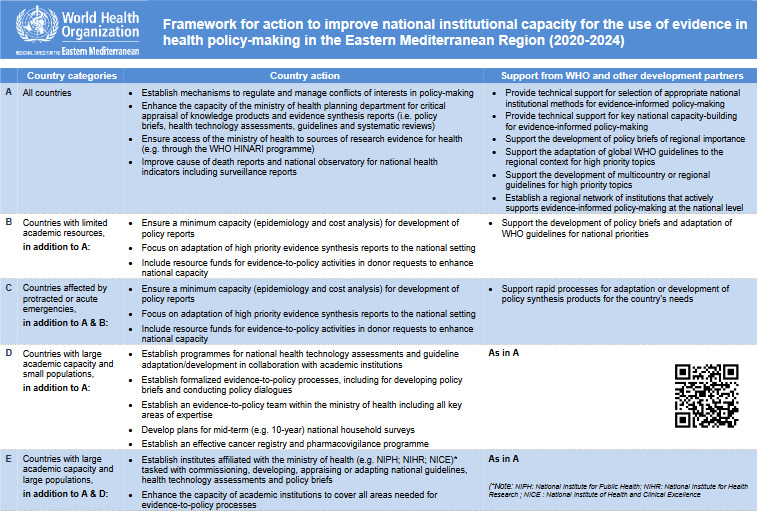
Framework for action to improve national institutional capacity for the use of evidence in health policy-making in the Eastern Mediterranean Region (2020-2024)
Arabic | French
Experts meet to discuss priority national population-based surveys for better reporting of regional core health and SDG 3 indicators
10 January 2018 – Regional and international experts, including selected representatives from Member States, met in Cairo from 11 to 12 December 2017 to:
- discuss modalities and capacity to report on WHO regional core indicators, Sustainable Development Goal (SDG) 3 indicators and other SDG health-related indicators; and
- review the recommended modules and plans for national-population based surveys and needed resources for improving the reporting and quality of health indicators in the Region.
Experts also discussed current initiatives and future plans by WHO and other agencies to improve health statistics in the Region. The outcome of the consultative meeting will also help countries in the Region to develop national survey plans and prioritize the conduct of population-based surveys, which are one of the key sources of data for national health information systems (HIS). The expert consultative meeting was inaugurated by Dr Arash Rashidian, Director, Information, Evidence and Research.
During the opening session, he informed the experts that the consultative meeting was held in response to recommendations from Member States during an intercountry meeting on core indicator reporting in 2016. During the 2016 meeting, Member States asked WHO to provide guidance on priority population-based surveys to be conducted to generate data for the core health and SDG health-related indicators. He also reiterated the commitment of WHO in supporting countries to strengthen their national HIS and enhancing reporting on the regional core health indicators to monitor progress towards universal health coverage; and that strengthening national HIS was part of the overarching agenda of implementing the regional framework for HIS and improvement of civil registration and vital statistics (CRVS) systems. Referring to efforts made by WHO and the Member States in strengthening health information and CRVS systems, he noted that the Region has demonstrated commitment and political support by endorsing the framework for HIS; and countries have started to reliably report on the core indicators since 2014.
During the meeting, experts were briefed on the:
- HIS framework for policy making in the Region;
- recommendations from the intercountry meeting on country capacity to report on core health indicators;
- current HIS strengthening activities in the Region.
Experts discussed current initiatives to improve quality and coverage of global population-based surveys and initiatives to improve quality of health statistics using population-based surveys. Experts also discussed challenges and successes in implementing population-based surveys in the Region and identified means and mechanisms to address the current needs. During the meeting experts also discussed the results of work conducted by international consultants in response to WHO request on prioritizing survey modules and making them applicable to countries of the Region.
In working groups, experts discussed the following key areas related to the implementation of population-based surveys:
- recommended list and time table for population-based surveys for better reporting of core health indicators;
- main survey modules to be considered as part of survey plans;
- the number of recommended surveys to be conducted and ideal inter-survey period; and
- survey and data needs for countries in humanitarian emergencies. At the end of the meeting, experts recommended a number of follow-up activities in order to enhance the capacity of countries to generate data for the health-related indicators and monitor progress towards universal health coverage.