





Select your language
National Stop TB Partnership launched in Iraq, 27 June 2012
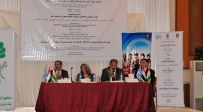 At the launch of the National Stop TB Partnership: from left to right: H.E Dr Majeed Hamad Amin, Minister of Health of Iraq, H.E Mrs Hero Ibrahim Ahmed, First Lady of Iraq, H.E Dr Rekawt Hama Rasheed, Minister of Health of the Kurdistan Regional Government, and Dr Syed Jaffar Hussain, WHO Representative27 June 2012 – “Tuberculosis (TB) causes loss of human life and poses a threat to the development process in Iraq. It is a curable disease from which no one in Iraq should die. To ensure this, a range of partners from the public and private sector, civil society and the media, have come together to mobilize capacity, driven by their determination to stop the spread of TB,” stated H.E. Mrs Hero Ibrahim Ahmed, the First Lady of Iraq and the WHO Patron for TB, in her welcoming remarks during the launch of the Iraq National Stop TB Partnership in Sulaimaniyah, Iraq.
The event was attended by high-level representatives of the Government, civil society leaders, representatives of public and private health sectors and UN agencies, including WHO and the United Nations Development Programme.
H.E. Mrs Hero Ibrahim Ahmed said that establishment of the National Stop TB Partnership was based on close collaboration between partners in implementing innovative, unconventional ways to fight TB at the national level. She praised the efforts of ministries of health and WHO in implementing the global Stop TB Strategy, which ensures universal access to treatment and care services for all TB patients.
In his speech, H.E. the Minister of Health of Iraq, Dr Majeed Hamad Amin, said, “The Iraq National Stop TB Partnership will provide a platform for the launch of creative activities to reach as many persons affected by TB as possible. It aims to effectively stop the spread of TB in Iraq and achieve the Millennium Development Goals by 2015.”
Sixth steering committee meeting on specialized medical services, Iraq
 Participants of the meeting on specialized medical services
Erbil, 25 June 2012 – The Ministry of Health of Iraq and the Ministry of Health of the Kurdistan Regional Government, Iraq, in collaboration with the WHO country office in Iraq, organized from 25 to 26 June 2012 in Erbil, the sixth steering committee meeting of the 13 million Euro (€) European Union (EU)-funded programme to support specialized medical services in Iraq focusing on emergency medical services and blood transfusion services.
Dr Mohammed Khazal Ibrahim, on behalf of H.E Dr Majeed Hamad Amin, the Minister of Health of Iraq stated, “The SMS programme focuses on improving the quality, efficiency and standards of emergency medical services and blood transfusion services,” and added that, “we are working to minimize the health consequences of emergencies, crises and conflicts and reduce the number of avoidable deaths and the long-term impact of disabilities”.
Advanced health managerial skills training for health professionals in Iraq
 20 April 2012 – Twenty (20) health care managers and decision-makers from different senior departments in the Ministry of Health and Ministry of Health of the Kurdistan Regional Government received diplomas on advanced health managerial skills from the American University of Beirut on 20 April 2012 in Beirut.
The six-month diploma programme aims to strengthen the health management skills of a core group of health professionals in strategic planning, health care financing, hospital reform, decentralization and change management. This core team of health professionals will conduct evidence-based analysis of organizational and institutional functioning and governance in order to streamline service delivery structures, procedures and decision-making as part of overall modernization efforts in the development of the national health policy and revision of the national health strategy.
The governance and leadership role of the Ministry of Health will be strengthened at both national and governorate levels, facilitating the establishment of an effective health system responsive to current and emerging health care needs of the Iraqi population.