

Select your language
Mobile clinics: providing health services to those most in need
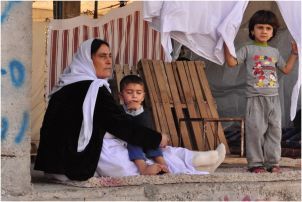
 Sardina’s mother, speaks to WHO about the assistance that she received from the mobile clinic team. Photo credit: WHO/P Ajello13 November 2014 – Ensuring access to basic health services for internally displaced people (IDP) in the Kurdistan region is a critical pillar of WHO’s support.
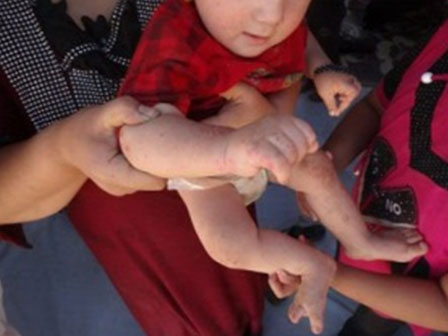
Twenty-four mobile medical teams in Duhok currently provide consultations and medicines to treat common illnesses while ensuring referral of cases requiring specialized care. Thirteen-year-old Sardina Gazwan an IDP from Bashiqa is one of the thousands of the displaced persons who received medical care from the mobile team. Sardina was treated for an ulcer in her hand as a result of an abscess due to unknown cause. Subsequently she developed a fever and occasional chills which worried her mother.
Thankfully for Sardina’s mother, the mobile medical team made a timely outreach visit, “I am glad for the medical services that this mobile team has provided to treat my daughter’s ulcer,” she said.
Thousands of people like Sardina are living in unfinished buildings, under road bridges and schools in Duhok, Erbil and Suleimaniya. Many are benefiting from the services of mobile medical teams and clinics. An average of 150 people are seen in one visit; majority of patients are women and children. The most common diseases reported are upper respiratory tract infections, followed by acute watery diarrhoea and skin rashes. The mobile medical teams in Duhok work six days a week and are seriously overstretched.
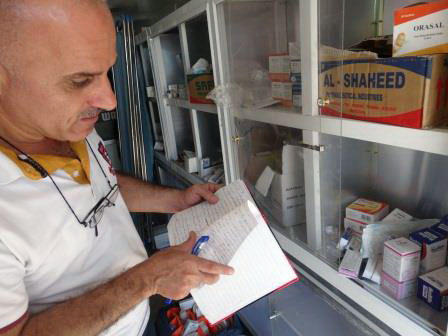
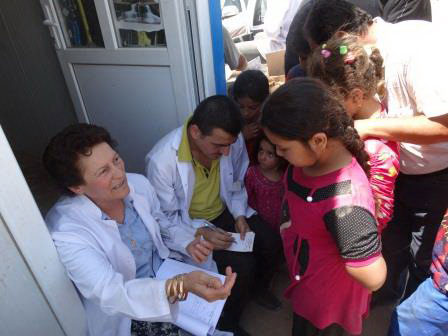
 A mother receives medicine for her baby from mobile pharmacy team during a visit by the mobile clinic team to Sararm school in Duhok. Photo credit: WHO/P Ajello In Duhok, a mobile team consists of four medical staff: medical doctor, nurse, a pharmacy assistant, and driver. Other partners are also supporting mobile clinics in the governorate. Partners include: UNICEF, Médecins Sans Frontières, International Medical Corps and International Federation of Red Cross and Red Crescent Societies.
Currently in Duhok, there are 21 mobile clinics supported by health partners covering over 1600 locations. WHO would like to see an expansion in the number of mobile teams and their frequency of visits to one site of at least twice a month, however, due to limited resources this has not been possible. More funding would enable the expansion of the number of mobile clinic teams to deliver the much needed health care support to more displacement sites.
In light of these emerging needs, WHO is appealing for U $ 187 million to support health interventions but has only received US$ 54 million, representing a funding gap of 71%. In the coming month, the health situation is expected to deteriorate further among the displaced people and host communities due to winterization.
Related links
UNICEF
Médecins Sans Frontières
International Medical Corps
International Medical Corps and International Federation of Red Cross and Red Crescent Societies
WHO visits camps for internally-displaced persons in Duhok, 29–30 Sept 2014
13 October 2014 – Five months have passed since the most recent internally displaced population (IDP) crisis in Iraq started. More than 860 000 IDPs moved out of their war-torn towns and cities in Ninewa and Salah Al Din governorates to the Kurdistan region of Iraq and the majority of them are now living in Duhok governorate often under untenable conditions, particularly for those who are not in organized camps.
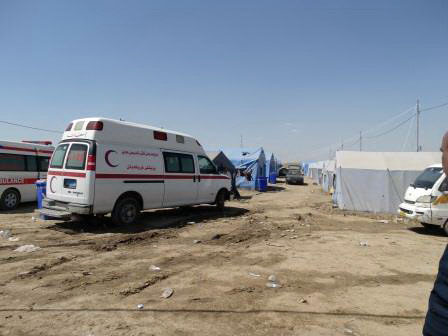
In Duhok governorate, only 4 out of 14 planned camps are operational. An estimated 543 000 IDPs are scattered in 1678 sites, including schools, unfinished buildings and under bridges. Primary health care services are provided by mobile clinics visiting some of the sites, while some IDP patients are accessing health care centres in Duhok.
Photo gallery
 37 families sheltered in an unfinished building within Duhok City.
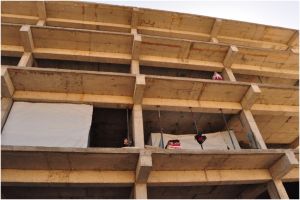 People have to use sheets of cloth in lieu of doors or walls to protect their children from injuries that could be caused by falling objects.
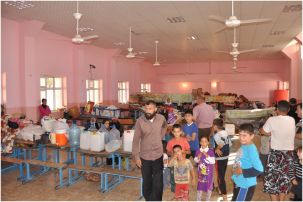 A total of 72 families were found living in an urban school in the centre of Duhok city.They share teaching halls and are living in very poor conditions without access to adequate water, food and sanitation.
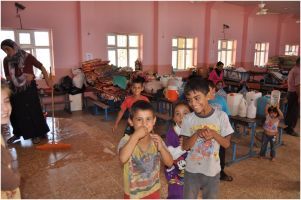 Despite the ongoing tragedy, children appear to be happy with the open space for playing. All children under five have been vaccinated against polio and measles during the September 2014 immunization campaign. Five national and subnational immunization rounds have been conducted since April 2014.
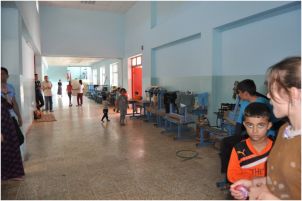 Students’ desks serving as cupboards and laundry drying strands.
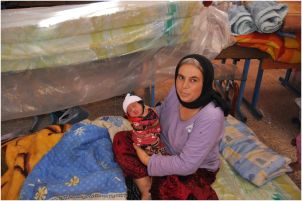 A lady has given birth to a baby girl two days before the day of the visit to the school. It was explained that she was taken by her husband to the closest hospital in Duhok where she delivered. She complained that her milk is not enough to feed the baby due to poor nutrition.
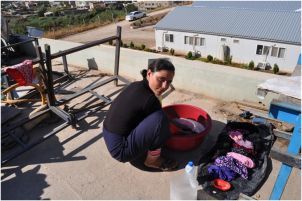 Even the roof of the school is in use as a space where many daily activities are performed. The risk of injuries occurring while children and women are performing basic daily household tasks is high.
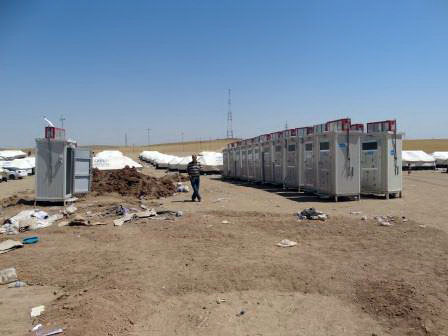
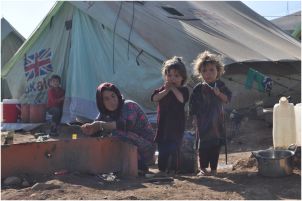 Dalal camp, an informal settlement located in Zakho city, about 60 km north of Duhok, accommodates 4018 IDPs mostly from Sinjar. Polio and measles vaccines were administered to all the 260 children under five in the camp.
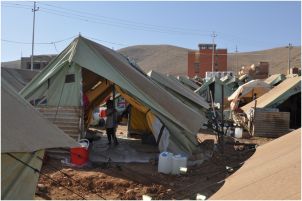 Other medical services are provided by Médecins Sans Frontière from 9.00 till 13:00 hours. This camp is another example of difficult living conditions with unhygienic sanitary conditions, a shortage of clean water and insufficient availability of food.
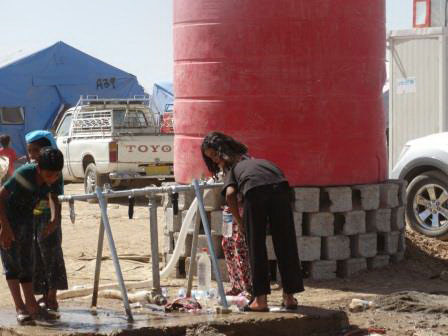
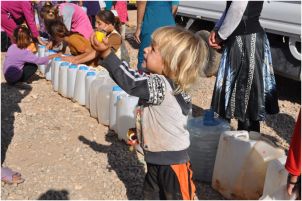 Queues of young women and girls wait their turn to fill their water buckets. Water is supplied to the camp by tankers.
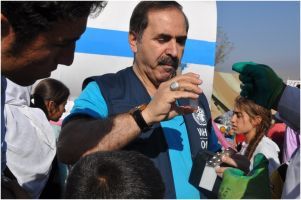 A WHO water and sanitation expert tests the water to check chlorine levels.
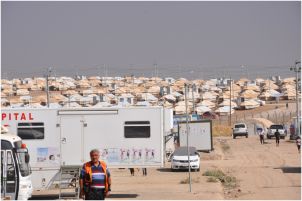 This picture was taken in Bajid Kandala transit camps 1 and 2, located in Zakho city and accommodating a population of 8000 IDPs. The camp residents receive food rations and have access to primary health care services provided by Première Urgence - Aide Médicale Internationale, an international nongovernmental organization that is a WHO implementing partner.
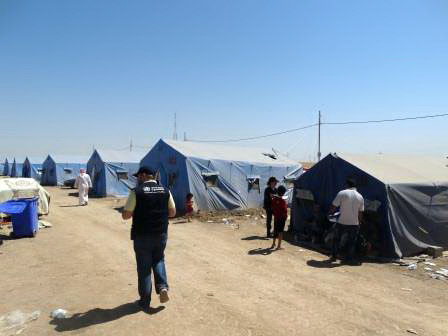
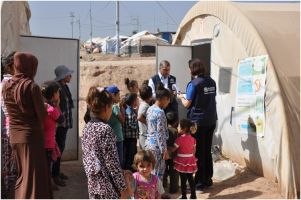 Khanke camp, 20 km from Duhok city is situated in Khanke, a town with a population of 23 000. About 60 000 IDPs are currently accommodated in the camp, mostly from Sinjar. Health services are provided by the local primary health care services. Full immunization against polio and measles has been achieved in the camp.
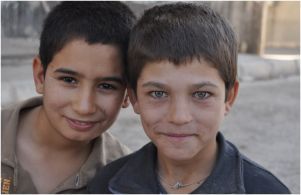 The construction of adequate shelters is of paramount importance to host the populations who are currently occupying schools and unfinished buildings and living under trees and bridges, suffering from a lack of water, hygiene and sanitation. Improving living conditions of IDPs, particularly the most vulnerable, can help bring some hope and even a smile.
WHO's response to the deteriorating humanitarian situation in Iraq
19 June 2014 – The humanitarian situation in Iraq has deteriorated dramatically in the past week, with more than 300 000 people fleeing their homes in Mosul and surrounding areas and moving to Erbil, Solimaniyah and Dohuk in the Kurdistan Region of Iraq. While 80% of these internally-displaced persons (IDPs) live among the host communities, the remainder are living in four camps established by the Kurdistan Regional Government – three camps in Dohuk and one in Erbil. New camps are being established to accommodate the increasing numbers of IDPs who require accommodation.
On June 17 WHO visited Al-Khazar transit camp in Erbil to assess the health conditions and needs of the population.