

Select your language
World Cancer Day 2015
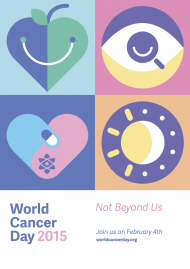 4 February 2015 – World Cancer Day is observed every year by the World Health Organization, the International Agency for Research on Cancer and the Union for International Cancer Control on 4 February. The 2015 campaign aims to take a positive stance through optimistic messaging of what can be done to accelerate the fight against the disease. The tagline of this year’s Day is “Not beyond us”, which highlights the solutions that exist and are accessible to affect and reduce the global cancer burden.
Cancer is already ranked among the top four leading causes of death in the Eastern Mediterranean Region. The incidence is expected to almost double in the next two decades, from an estimated 456 000 new cases in 2010 to nearly 861 000 in 2030, the highest relative increase among all WHO regions.
The above estimates are based only on the effect of population growth and ageing, but the additional effect of increasing exposures to cancer risk factors, such as smoking, unhealthy diet and physical inactivity, and environmental pollution, will lead to an even bigger rise in the burden of cancer. The prevalence of these risk factors is likely to increase due to socioeconomic and cultural changes, placing significant strains on health programmes and causing substantial human suffering.
The epidemic of lung cancer in men in many countries in the Region is a potent warning of the urgent need for action. The UN Political Declaration on the Prevention and Control of Non-communicable Diseases (NCDs) and the regional framework for action to implement the UN Political Declaration, create opportunities for accelerating action on cancer prevention and control.
Related links
World Cancer Day2015 campaign material
Union for International Cancer Control
UN Political Declaration on the Prevention and Control of Non-communicable Diseases (NCDs)
Cancer Country Profile in the Eastern Mediterranean Region, 2014
Regional meeting on strengthening the integration and management of Noncommunicable diseases in primary health care Cairo, Egypt 8–10 September
Objectives of the meeting
- Review the current regional situation of the provision of essential health care for people with noncommunicable diseases using a health systems approach, with particular emphasis on primary health care.
- Review international and regional experiences and lessons learned in integrating the management of common noncommunicable diseases into primary health care.
- Agree on a way forward and next steps for implementing evidence-based recommendations to strengthen health care for noncommunicable diseases.
Inputs to the meeting
- A regional situation analysis of the integration and management of noncommunicable diseases in primary health care.
- International and regional case studies submitted by countries concerning the integration and management of noncommunicable diseases in primary health care.
- Working papers and briefing notes on key issues concerning the integration and management of noncommunicable diseases in primary health care
Outcomes of the meeting
- A synthesis of 1) the current status of integration and management of noncommunicable diseases in primary health care, and 2) of international and regional experiences, best practices and lessons learned in integrating noncommunicable diseases in primary health care based on a health system approach.
- Endorsed long term vision for strengthening the integration and management of noncommunicable diseases in primary health care within a health system approach and a framework with key interventions for strengthening integration and management of noncommunicable diseases in primary health care.
- Next implementation steps with specific roles for various partners based on a mechanism for coordination to strengthen service delivery platforms.
Meeting report
other documents
EM/RC59/R.2 The Political Declaration of the United Nations General Assembly on the Prevention and Control of Non-Communicable Diseases: commitments of Member States and the way forward Arabic | French
Framework for action to implement the United Nations Political Declaration on noncommunicable Diseases: annex to resolution EM/RC59/R.2 | Arabic | French
NCD Global Monitoring Framework
Global action plan for the prevention and control of NCDs 2013-2020
World Diabetes Day 2014
 Enabling healthy food choices to prevent diabetes
World Diabetes Day is observed every year on 14 November. WHO and the International Diabetes Federation are calling on:
individuals to make healthy food choices, starting with breakfast
countries to take immediate action to create environments and conditions to enable such choices
the media, professionals, professional associations and civil society to support public health actions to promote healthy diets as a key approach to prevent diabetes and reduce complications in those living with diabetes.
Unhealthy diet is one of the four main risk factors for noncommunicable diseases, which are the leading cause of death in the WHO Eastern Mediterranean Region. They account for over 2.2 million deaths annually, over 51% of which are premature. Diabetes, one of the four main noncommunicable diseases, is closely linked to unhealthy lifestyles, especially diet, which in turn is linked to environments that promote unhealthy choices.
Over 14% of the population in the Eastern Mediterranean Region has diabetes, which is a critical challenge for countries. Rising diabetes prevalence in the Region is closely related to the rising prevalence of overweight and obesity. New 2014 WHO estimates indicate that over 17% of people in the Eastern Mediterranean Region are obese.
The rapid acceleration in the rates of overweight, obesity and noncommunicable diseases related to diet, such as diabetes, over the past few decades reflects the profound changes in lifestyles, particularly food intake patterns, in populations. With increasing urbanization, globalization and economic improvements, dietary habits have become less healthy and people more sedentary. Increasingly, diets are high in saturated fats, cholesterol, salt and refined carbohydrates, and low in polyunsaturated fats, fiber, fruits and vegetables. An insufficient policy and public health response has exacerbated the situation.
On World Diabetes Day, we need to send the message that healthy eating and healthy lifestyles can prevent diabetes and other noncommunicable diseases.
Related links
World Diabetes Day 2014 campaign material
International Diabetes Federation