

Select your language
Global status report on noncommunicable diseases 2014
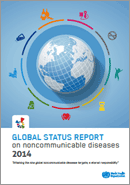 Image of cover for the Global status report on noncommunicable diseases 20144.The latest WHO Global status report on noncommunicable diseases 2014 is now available. The report, framed around the nine voluntary global targets provides data on the current situation, identifying bottlenecks as well as opportunities and priority actions for attaining the targets. The report also provides the latest available estimates on NCD mortality (2012) and risk factors, 2010-2012.
This year, countries will begin setting their national targets. National progress on achieving the voluntary global targets by 2025 will be measured on the 2010 baseline provided in the report, and will be reviewed at the Third High-Level Meeting of the United Nations General Assembly in 2018.
Web-cast on second WHO Global Status Report on NCDs
The Noncommunicable Diseases (NCD) programme would like to invite you to join the web-cast covering the launch of the second WHO Global Status Report on NCDs.
Date: Monday, 19 January 2015
Time: 11:00 am to 12:30 pm (Geneva time)
The link to join the meeting is:
https://who-meeting.webex.com/mw0401l/mywebex/default.do?service=1&siteurl=who-meeting&nomenu=true&main_url=%2Fmc0901l%2Fe.do%3Fsiteurl%3Dwho-meeting%26AT%3DMI%26EventID%3D362443662%26UID%3D2146119862%26Host%3D887c1b0a241e4810%26FrameSet%3D2%26MTID%3Dm7e527cccdf2a7092428f63c69b8fcd95
The second report is framed around the nine global targets for NCDs to be attained by 2025. It will:
- provide guidance on how ministries of health can set national NCD targets, and lead the development and implementation of policies and interventions to attain them.
- identify bottlenecks, as well as opportunities and priority actions for attaining national targets, taking into account the WHO Global NCD Action Plan 2013-2020, the 2011 UN Political Declaration on NCDs and the 2014 UN Outcome Document on NCDs.
- provide the 2010 baseline estimates on NCD mortality and risk factors, against which progress will be measured, as well as the latest available estimates on NCD mortality (2012) and risk factors (2010/2012).
Speakers during the launch event will include the WHO Director-General, Ambassadors from Permanent Missions in Geneva, and panellists from civil society academia and the UN System who will discuss what countries can learn from the second Report. Participants following the web-cast will also be able to ask questions.
Due to technical reasons, the web-cast will be available in English only.
WHO calls on individuals and countries to reduce salt and improve health
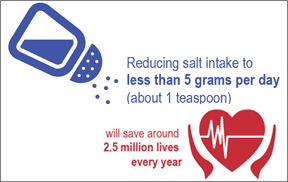 29 September 2014 – On World Heart Day, 29 September, the World Health Organization (WHO) calls on countries to implement population salt reduction measures, on communities to support public health efforts to reduce salt intake, and on individuals to consume less salt to avoid high blood pressure and heart disease.
High salt intake is a key contributor to the increase in noncommunicable diseases (NCDs) worldwide. NCDs account for over 2.2 million deaths, or over 57% of mortality, in the Eastern Mediterranean Region annually. Cardiovascular diseases alone, in which high salt intake plays a major role, cause almost half of these deaths.
The scientific evidence linking high blood pressure to high salt intake, and conversely reduced salt intake to improve health outcomes, is conclusive. In countries where salt intake was reduced by 1 gram per person per day, deaths from stroke and heart attack are expected to be reduced by more than 7%.
“Data from the Eastern Mediterranean Region shows that the average salt consumption in most countries is around 10 grams per person per day”, says WHO Regional Director for the Eastern Mediterranean Dr Ala Alwan, “which is double the amount recommended by WHO”. Salt is a natural ingredient in foods. Excess salt intake comes from salt added during processing and preparation of food.
“Reducing salt intake to less than 5 grams per person per day” affirms Dr Alwan “can prevent cardiovascular disease, which is the number one killer in the Eastern Mediterranean Region and in the world today”.
“Salt reduction is one of the strategic interventions in the regional framework for action on noncommunicable diseases , endorsed by ministers of health in this region,” explains Dr Alwan. “Implementing salt reduction programmes can help countries achieve the global target for salt reduction” he continues, referring to the global voluntary target, endorsed by the World Health Assembly in May 2013, to reduce salt intake by 30% by the year 2025.
Salt reduction is a proven measure “best buy” for combating noncommunicable diseases, with a cost of about US$ 0.40-0.50 per person per year. Best buys are interventions that are very cost-effective, cheap, culturally acceptable and feasible to implement in all countries.
This World Heart Day, governments, the food industry, civil society groups, families and individuals are urged to take action to reduce salt intake and improve heart-health.
In consultation with Member States and international experts, WHO has developed a policy guidance and recommended actions to reduce salt intake; several countries are in the process of implementing this guidance. A key measure is setting national standards for the amount of salt in various food items. Bread is the first priority for action since up to over 25% of people’s salt intake in the region comes from salt in bread. Cheese, processed tomato products and meats, and the salt added during cooking or at the table are the next targets.
Related link
Read the factsheet on salt reduction
For more information on cardiovascular disease prevention, please contact:
Dr Ibtihal Fadhil
WHO Regional Adviser for Noncommunicable Diseases Prevention
Tel: +202 22765235
email:
For more information on salt intake and nutrition, please contact:
Dr Ayoub Al Jawaldeh
WHO Regional Adviser for Nutrition
Tel: +202 22765324
email:
#lesssalt
#WorldHeartDay