
Policy recommendations

Nutrition profile for countries of the Eastern Mediterranean Region with different income levels: an analytical review

Nutrition profile for countries of the Eastern Mediterranean Region with different income levels: an analytical review

Publication date: 2023

A recent analytical review of the WHO's EMR reveals a persistent double burden of malnutrition, with undernutrition coexisting with increasing overweight and obesity rates. The review, which divides EMR countries into four income groups, examines trends in key nutrition indicators over the past 20 years, including stunting, wasting, overweight, obesity, anemia, and breastfeeding practices. Findings indicate a decrease in stunting and wasting across all income groups, but a rise in overweight and obesity in most age groups. The review emphasizes the need to address data scarcity and support countries in implementing effective policies and programs to combat the double burden of malnutrition in the EMR.
English

enabling_food_environment_in_kindergartens_and_schools_in_iran_for_promoting_healthy_diet_is_it_on_the_right_track

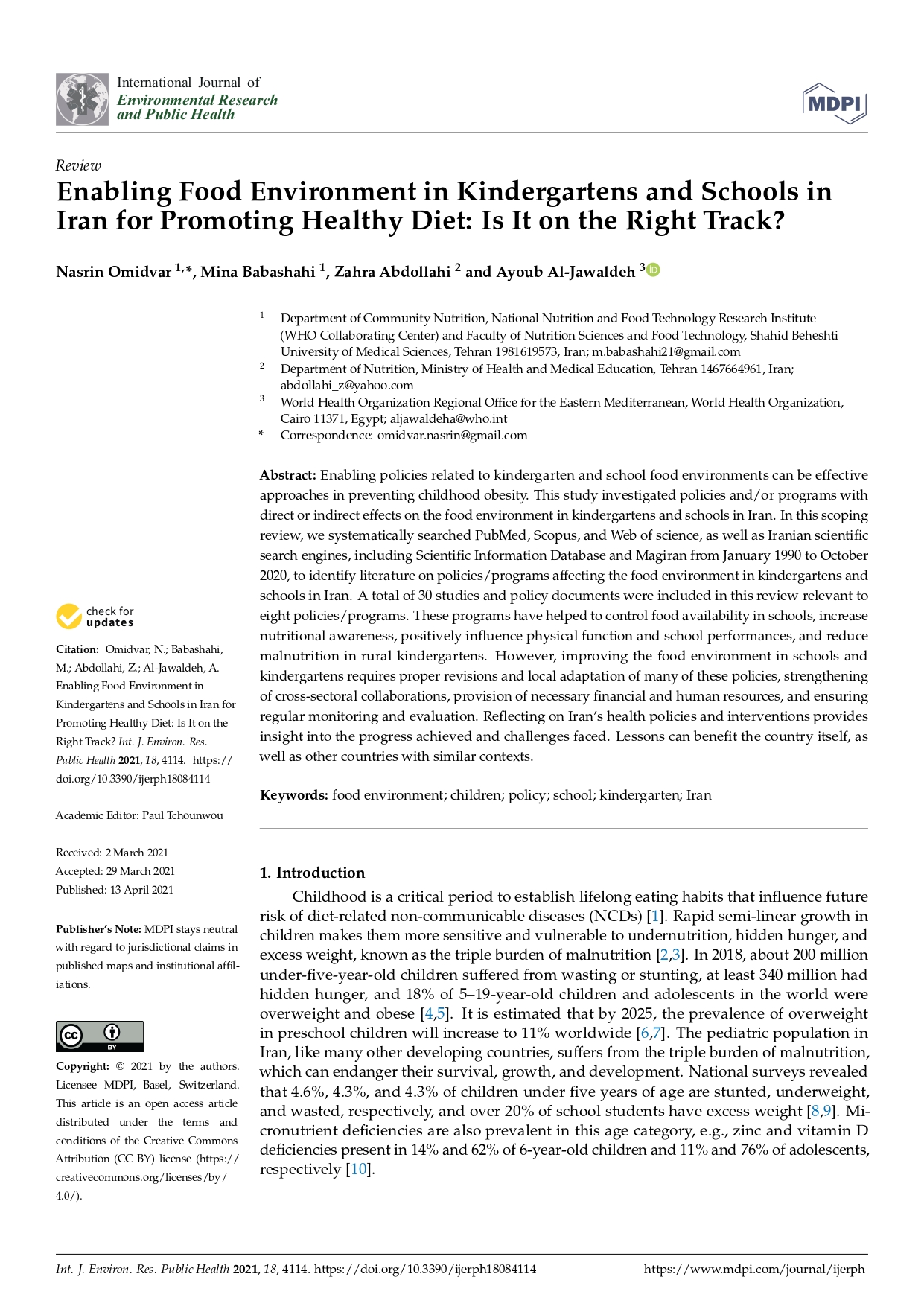
Enabling food environment in kindergartens and schools in Iran for promoting healthy diet: is it on the right track?

Publication date: 2021

Enabling policies related to kindergarten and school food environments can be effective approaches in preventing childhood obesity. This study investigated policies and/or programmes with direct or indirect effects on the food environment in kindergartens and schools in Iran. These programmes have helped to control food availability in schools, increase nutritional awareness, positively influence physical function and school performances, and reduce malnutrition in rural kindergartens. However, improving the food environment in schools and kindergartens requires proper revisions and local adaptation of many of these policies, strengthening of cross-sectoral collaborations, provision of necessary financial and human resources, and ensuring regular monitoring and evaluation.     
English

implementation_of_who_recommended_policies_and_interventions_on_healthy_diet_in_the_countries_of_the_eastern_mediterranean_region_from_policy_to_action_page

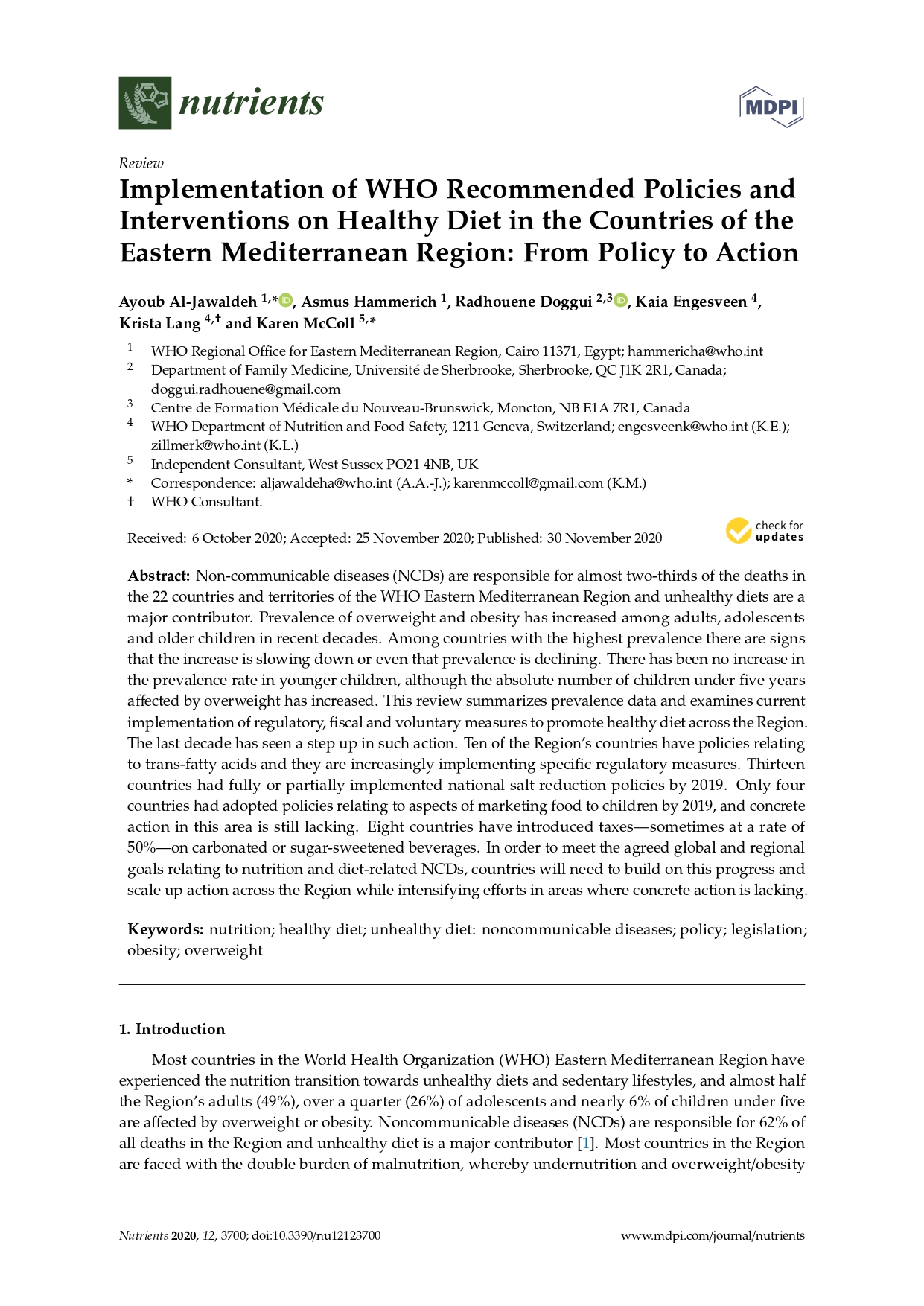
Implementation of WHO recommended policies and interventions on healthy diet in the countries of the Eastern Mediterranean Region: from policy to action

Publication date: 2020

Noncommunicable diseases are responsible for almost two-thirds of the deaths in the 22 countries and territories of the WHO Eastern Mediterranean Region and unhealthy diets are a major contributor. Prevalence of overweight and obesity has increased among adults, adolescents and older children in recent decades. This review summarizes prevalence data and examines current implementation of regulatory, fiscal and voluntary measures to promote healthy diet across the Region and highlights where further progress in implementation is still needed.   
English

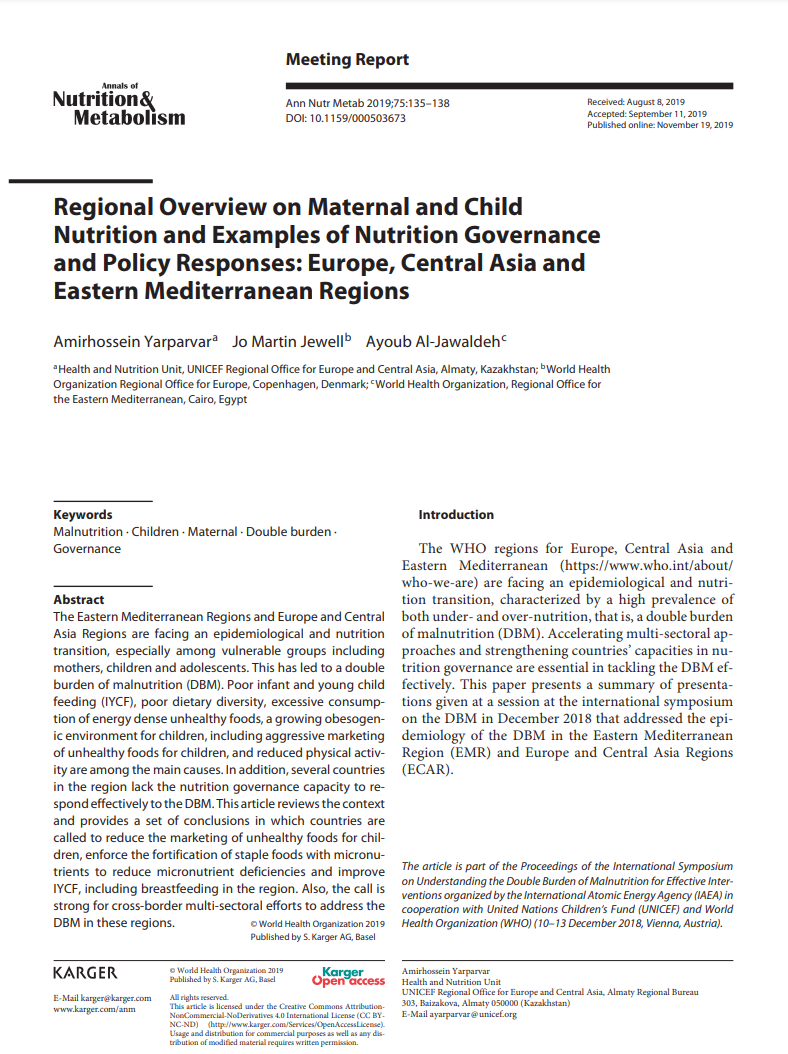
regional_overview_on_maternal_and_child_nutrition_and_examples_of_nutrition_governance_and_policy_responses

Regional overview on maternal and child nutrition and examples of nutrition governance and policy responses: Europe, Central Asia and Eastern Mediterranean Regions

Publication date: 2019

Many regions are facing an epidemiological and nutrition transition. This has led to a double burden of malnutrition (DBM). This paper presents a summary of presentations given at a session at the International Symposium on the DBM in December 2018 that addressed the epidemiology of the DBM in the Eastern Mediterranean Region, Europe and Central Asia Regions (ECAR). The paper reviews the context and provides a set of conclusions in which countries are called to act in several ways. 
English

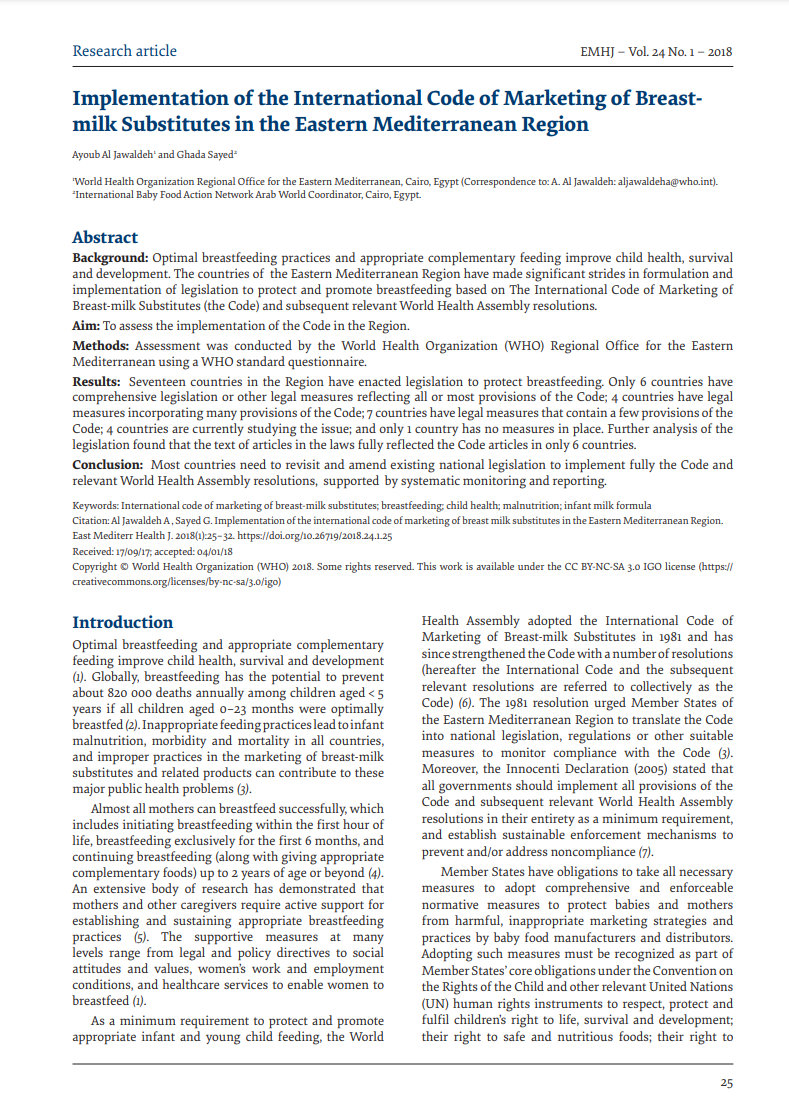
implementation_of_the_international_code_of_marketing_of_breastmilk_substitutes_in_the_emr

Implementation of the International Code of Marketing of Breastmilk Substitutes in the Eastern Mediterranean Region

Publication date: 2018

Recognizing that optimal breastfeeding practices and appropriate complementary feeding improve child health, survival and development, this review assessed the implementation of The International Code of Marketing of Breast-milk Substitutes in the countries of the Eastern Mediterranean Region. Assessment was conducted by the WHO Regional Office for the Eastern Mediterranean using a WHO standard questionnaire. The review revealed that most countries need to revisit and amend existing national legislations to implement fully the Code and relevant World Health Assembly resolutions, supported by systematic monitoring and reporting.
English

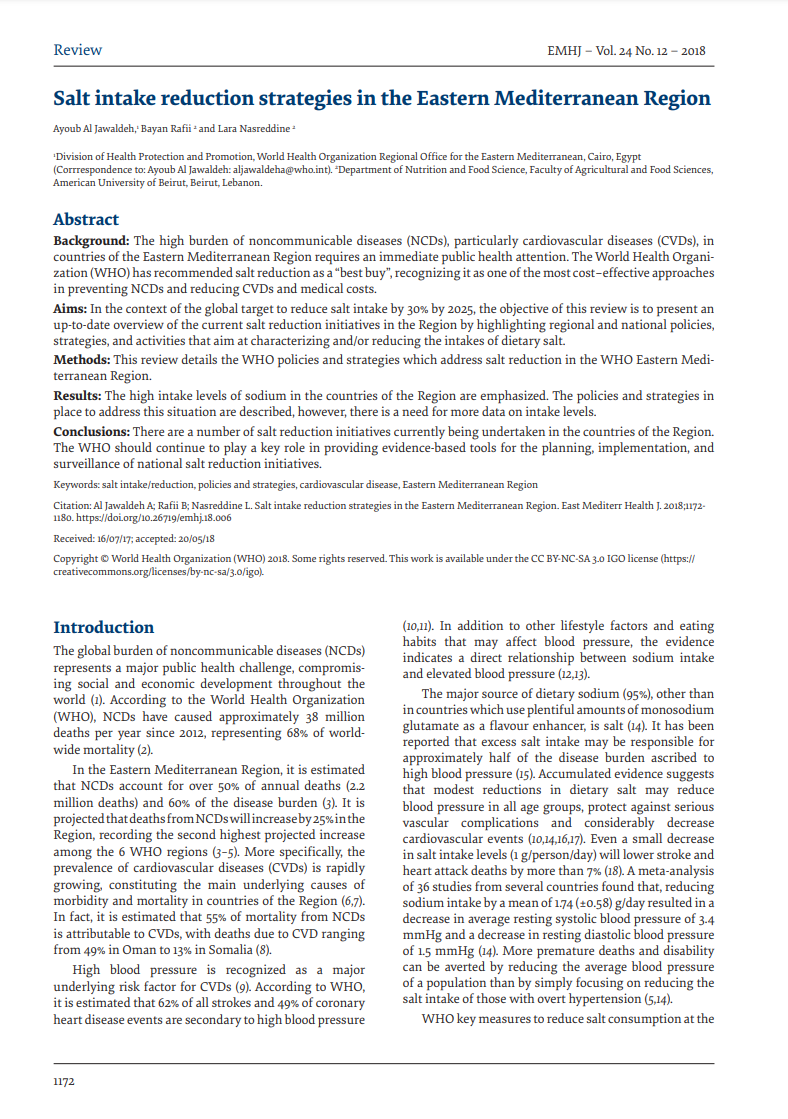
salt_intake_reduction_strategies_in_the_emr

Salt intake reduction strategies in the Eastern Mediterranean Region

Publication date: 2018

The World Health Organization has recommended salt reduction as a “best buy”, recognizing it as one of the most cost–effective approaches in preventing noncommunicable diseases and reducing cardiovascular diseases and medical costs. In the context of the global target to reduce salt intake by 30% by 2025, this review presents an up-to-date overview of the current salt reduction initiatives in the Region by highlighting regional and national policies, strategies, and activities that aim at characterizing and/or reducing the intakes of dietary salt.
English

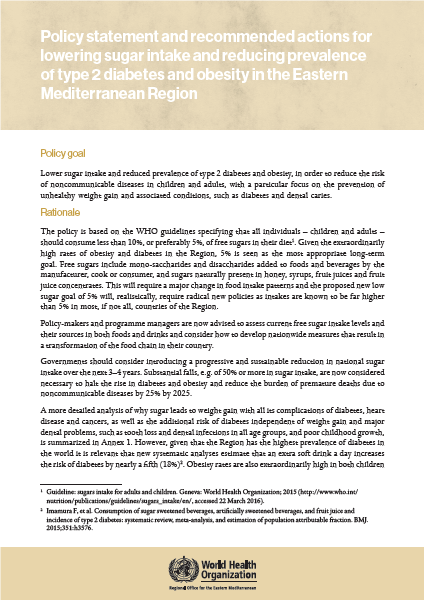
policy_statement_lowering_sugar_intake

Policy statement and recommended actions for lowering sugar intake and reducing prevalence of type 2 diabetes and obesity in the Eastern Mediterranean Region

Publication date: 2016

This policy statement and proposed action plan is part of the WHO Regional Office for the Eastern Mediterranean’s effort to reach the global targets of halting the rise in diabetes and obesity and reduce the burden of premature deaths due to noncommunicable diseases by 25% by 2025. Through a four-phased approach, this policy statement provides the steps that countries should follow to reduce sugar intake, which consequently leads to maintaining a normal body weight, avoiding type 2 diabetes and also preventing dental caries in children and adults.   
English

Arabic

French

policy_brief_fat_reduction

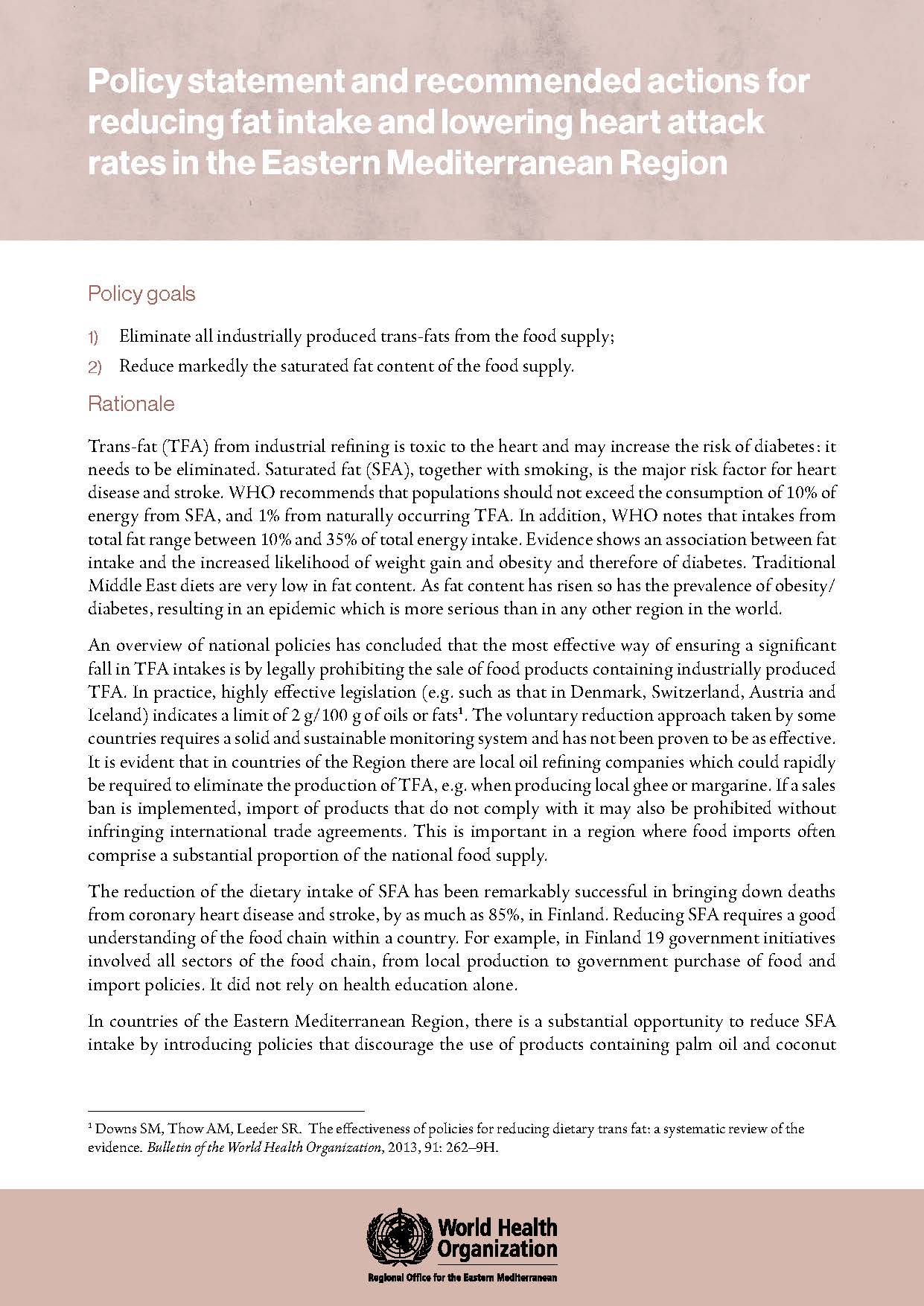
Policy statement and recommended actions for reducing fat intake and lowering heart attack rates in the Eastern Mediterranean Region

Publication date: 2014

This policy statement was published in 2014 with the goal of identifying the priority actions for Member States to eliminate all industrially produced trans-fats from the food supply as well as to reduce markedly the saturated fat content of the food supply. The suggested actions are divided into three phases which span over a period of two-years from 2014 to 2015.   
English

Arabic

French

policy_statement_to_lower_salt_intake_001

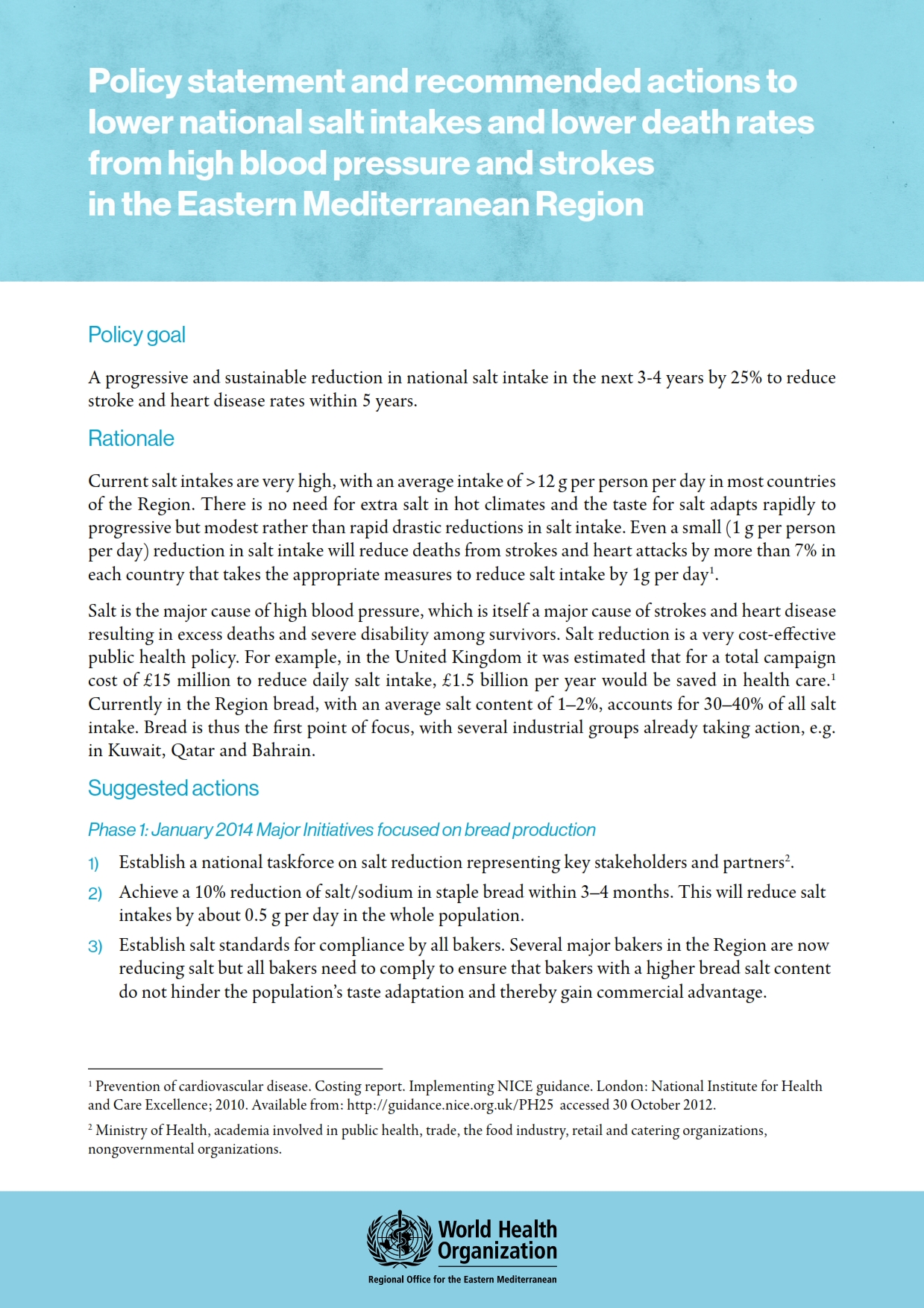
Policy statement and recommended actions to lower national salt intake and death rates from high blood pressure and stroke in the Eastern Mediterranean Region

Publication date: 2014

This policy statement was published in 2014, aiming to achieve progressive and sustainable reduction in national salt intake in the following 3–4 years by 25% to reduce stroke and heart disease rates within 5 years. It addresses the salt intake in countries of the Eastern Mediterranean Region and suggests several country-level actions for achieving salt reduction in three phases.   
English

Arabic

French

policy_brief_breast_milk_substitutes

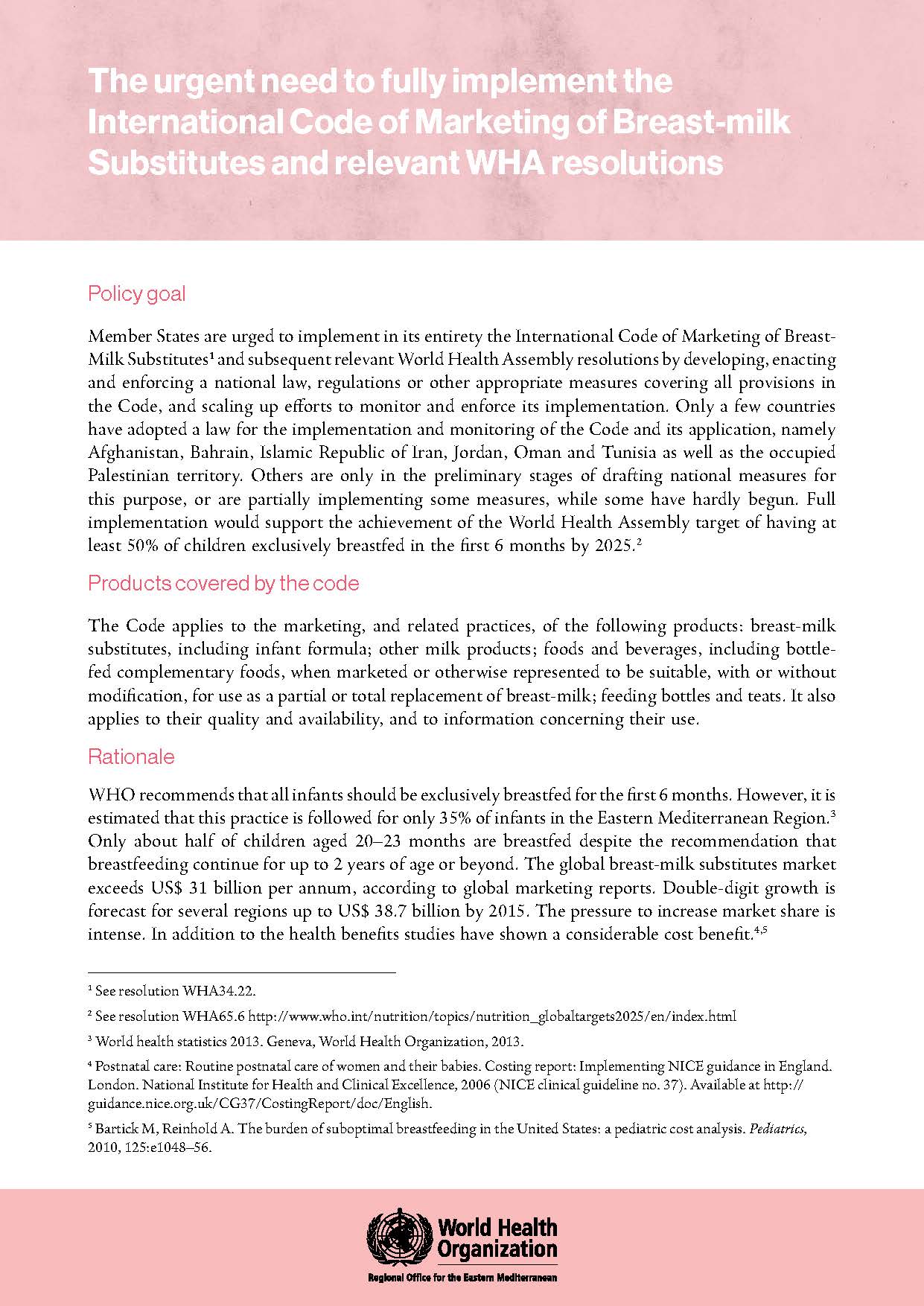
The urgent need to fully implement the International Code of Marketing of Breast-milk Substitutes and relevant WHA resolutions

Publication date: 2014

This policy statement was published in 2014 aiming to urge Member States to implement in its entirety the International Code of Marketing of Breast Milk Substitutes and subsequent relevant World Health Assembly resolutions by developing, enacting and enforcing a national law, regulations or other appropriate measures covering all provisions in the Code, and scaling up efforts to monitor and enforce its implementation.

English

Arabic

French

Related links

Other WHO guidelines on nutrition

WHO publications repository on nutrition

Nutrition profile for countries of the Eastern Mediterranean Region with different income levels: an analytical review

Nutrition profile for countries of the Eastern Mediterranean Region with different income levels: an analytical review

Publication date: 2023

A recent analytical review of the WHO's EMR reveals a persistent double burden of malnutrition, with undernutrition coexisting with increasing overweight and obesity rates. The review, which divides EMR countries into four income groups, examines trends in key nutrition indicators over the past 20 years, including stunting, wasting, overweight, obesity, anemia, and breastfeeding practices. Findings indicate a decrease in stunting and wasting across all income groups, but a rise in overweight and obesity in most age groups. The review emphasizes the need to address data scarcity and support countries in implementing effective policies and programs to combat the double burden of malnutrition in the EMR.

English

enabling_food_environment_in_kindergartens_and_schools_in_iran_for_promoting_healthy_diet_is_it_on_the_right_track

Enabling food environment in kindergartens and schools in Iran for promoting healthy diet: is it on the right track?

Publication date: 2021

Enabling policies related to kindergarten and school food environments can be effective approaches in preventing childhood obesity. This study investigated policies and/or programmes with direct or indirect effects on the food environment in kindergartens and schools in Iran. These programmes have helped to control food availability in schools, increase nutritional awareness, positively influence physical function and school performances, and reduce malnutrition in rural kindergartens. However, improving the food environment in schools and kindergartens requires proper revisions and local adaptation of many of these policies, strengthening of cross-sectoral collaborations, provision of necessary financial and human resources, and ensuring regular monitoring and evaluation.     

English

implementation_of_who_recommended_policies_and_interventions_on_healthy_diet_in_the_countries_of_the_eastern_mediterranean_region_from_policy_to_action_page

Implementation of WHO recommended policies and interventions on healthy diet in the countries of the Eastern Mediterranean Region: from policy to action

Publication date: 2020

Noncommunicable diseases are responsible for almost two-thirds of the deaths in the 22 countries and territories of the WHO Eastern Mediterranean Region and unhealthy diets are a major contributor. Prevalence of overweight and obesity has increased among adults, adolescents and older children in recent decades. This review summarizes prevalence data and examines current implementation of regulatory, fiscal and voluntary measures to promote healthy diet across the Region and highlights where further progress in implementation is still needed.   

English

regional_overview_on_maternal_and_child_nutrition_and_examples_of_nutrition_governance_and_policy_responses

Regional overview on maternal and child nutrition and examples of nutrition governance and policy responses: Europe, Central Asia and Eastern Mediterranean Regions

Publication date: 2019

Many regions are facing an epidemiological and nutrition transition. This has led to a double burden of malnutrition (DBM). This paper presents a summary of presentations given at a session at the International Symposium on the DBM in December 2018 that addressed the epidemiology of the DBM in the Eastern Mediterranean Region, Europe and Central Asia Regions (ECAR). The paper reviews the context and provides a set of conclusions in which countries are called to act in several ways. 

English

implementation_of_the_international_code_of_marketing_of_breastmilk_substitutes_in_the_emr

Implementation of the International Code of Marketing of Breastmilk Substitutes in the Eastern Mediterranean Region

Publication date: 2018

Recognizing that optimal breastfeeding practices and appropriate complementary feeding improve child health, survival and development, this review assessed the implementation of The International Code of Marketing of Breast-milk Substitutes in the countries of the Eastern Mediterranean Region. Assessment was conducted by the WHO Regional Office for the Eastern Mediterranean using a WHO standard questionnaire. The review revealed that most countries need to revisit and amend existing national legislations to implement fully the Code and relevant World Health Assembly resolutions, supported by systematic monitoring and reporting.

English

salt_intake_reduction_strategies_in_the_emr

Salt intake reduction strategies in the Eastern Mediterranean Region

Publication date: 2018

The World Health Organization has recommended salt reduction as a “best buy”, recognizing it as one of the most cost–effective approaches in preventing noncommunicable diseases and reducing cardiovascular diseases and medical costs. In the context of the global target to reduce salt intake by 30% by 2025, this review presents an up-to-date overview of the current salt reduction initiatives in the Region by highlighting regional and national policies, strategies, and activities that aim at characterizing and/or reducing the intakes of dietary salt.

English

policy_statement_lowering_sugar_intake

Policy statement and recommended actions for lowering sugar intake and reducing prevalence of type 2 diabetes and obesity in the Eastern Mediterranean Region

Publication date: 2016

This policy statement and proposed action plan is part of the WHO Regional Office for the Eastern Mediterranean’s effort to reach the global targets of halting the rise in diabetes and obesity and reduce the burden of premature deaths due to noncommunicable diseases by 25% by 2025. Through a four-phased approach, this policy statement provides the steps that countries should follow to reduce sugar intake, which consequently leads to maintaining a normal body weight, avoiding type 2 diabetes and also preventing dental caries in children and adults.   

English

Arabic

French

policy_brief_fat_reduction

Policy statement and recommended actions for reducing fat intake and lowering heart attack rates in the Eastern Mediterranean Region

Publication date: 2014

This policy statement was published in 2014 with the goal of identifying the priority actions for Member States to eliminate all industrially produced trans-fats from the food supply as well as to reduce markedly the saturated fat content of the food supply. The suggested actions are divided into three phases which span over a period of two-years from 2014 to 2015.   

English

Arabic

French

policy_statement_to_lower_salt_intake_001

Policy statement and recommended actions to lower national salt intake and death rates from high blood pressure and stroke in the Eastern Mediterranean Region

Publication date: 2014

This policy statement was published in 2014, aiming to achieve progressive and sustainable reduction in national salt intake in the following 3–4 years by 25% to reduce stroke and heart disease rates within 5 years. It addresses the salt intake in countries of the Eastern Mediterranean Region and suggests several country-level actions for achieving salt reduction in three phases.   

English

Arabic

French

policy_brief_breast_milk_substitutes

The urgent need to fully implement the International Code of Marketing of Breast-milk Substitutes and relevant WHA resolutions

Publication date: 2014

This policy statement was published in 2014 aiming to urge Member States to implement in its entirety the International Code of Marketing of Breast Milk Substitutes and subsequent relevant World Health Assembly resolutions by developing, enacting and enforcing a national law, regulations or other appropriate measures covering all provisions in the Code, and scaling up efforts to monitor and enforce its implementation.

English

Arabic

French

Related links

Other WHO guidelines on nutrition

WHO publications repository on nutrition