





Select your language
International Day of Persons with Disabilities: “Equal Rights for Palestinians with Disabilities”
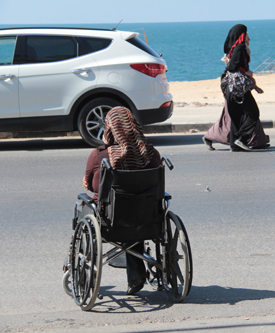 Disabled woman, the Gaza Strip, 2013 @ WHO3 December 2013, Jerusalem – As the world celebrates the special occasion of International Day of Persons with Disabilities, the World Health Organization in the occupied Palestinian territory is using this opportunity to promote the rights of persons with disabilities to equal treatment as a step towards a more equitable community.
According to the Palestinian disability survey carried out by the Palestinian Central Bureau of Statistics and Palestinian Ministry of Social Affairs in 2011, using a narrow definition of what is a disability, at least 110,000 Palestinians are living in the West Bank, East Jerusalem, and Gaza with a disability. “The main challenge that faces persons with disability is not their disability,” pointed out Dr. Mahmoud Daher, acting head of the WHO office in Jerusalem. “The problem is the way that people interact and respond to the person who has a disability.”
The Palestinian Authority issued the Palestinian Disability Law in 1999 with the goal of promoting and protecting the rights of persons with disabilities. Article II provides: “the disabled have the right to enjoy a free life, dignified living, and various services in a manner equal to that of other citizens and he/she have the same rights and obligations that are within his/her capabilities. It is not permissible to prevent any disabled from enjoying these rights because of his/her disability.” Yet persons with disabilities have not witnessed noticeable changes in their treatment. Many persons with disabilities find they are excluded from education, jobs and social life by society’s attitudes, and find physical accessibility to even public buildings and transportation a constant challenge. Integrating persons with disabilities into the community is the responsibility of not just government but also society as a whole and individuals. All Palestinians should respect the rights of persons with disabilities to the same treatment and opportunities as others in the Palestinian community. Civil society organizations, led by organizations of persons with disabilities, see the implementation of the Palestinian Disabilities law as an important milestone toward this end.
The World Health Organization stresses that institutions and people need to be pro-active in integrating persons with disabilities into educational facilities, the job market and in social activities, and to ensure that services can be accessed by those with a visual, hearing, mobility or mental disability. Persons with disabilities are a highly vulnerable group especially in the Palestinian community, and strengthening their role in the community will achieve a healthier equal environment for everyone.
This month the World Health Organization will launch a programme within government and UN agencies in the occupied Palestinian territory that aims to raise awareness and to mainstream respect for disability rights in the occupied Palestinian territory, as guaranteed by the UN Convention on the Rights of Persons with Disabilities (CRPD). The programme will involve WHO and five UN agencies; ILO, UNDP, UNESCO, UNICEF, and UNSCO and counterpart ministries in practical methods of ensuring protection of the rights of persons with disabilities in education, health, employment and social sectors.
Contacts
WHO, Dr. Tasneem Atatra
Email:
Telephone: 025400595
Urgent appeal: growing PA debt to East Jerusalem Hospitals, 24 September 2013
24 September 2013, Jerusalem – Despite recent European Union (EU) coverage of some of the Palestinian Authority (PA) debt to the East Jerusalem Hospitals (EJHs) by over US$ 17 million, the hospitals are still facing major cash flow problems as a result of accrued debt from the PA for specialized patient care, totalling US$ 24.15 million as of July 31, 2013. By the end of September 2013, this debt will exceed US$ 28 million. The PA’s debt to the EJHs has persisted over the last year as donor support to the PA has decreased.
The East Jerusalem Hospitals Network (EJHN) includes six facilities – Makassed Charitable Hospital, Augusta Victoria Hospital, St Joseph Hospital, St John Eye Hospital, Palestine Red Crescent Society Hospital and Princess Basma Rehabilitation Center – which serve as the main centres for specialized care within the Palestinian health system. Patients needing services and procedures that are not available in the West Bank and Gaza Strip are referred for treatment in the EJHN facilities by the Palestinian Ministry of Health.
In 2012, a total of 25 381 West Bank and Gaza Strip patients were referred by the Ministry of Health to East Jerusalem, representing over 45% of all Ministry referrals, and more than half of the EJHN caseload.
The recent EU support to the PA has enabled the PA to provide remuneration to the EJHs for the services provided in 2012. Some of the EJHs also received payment for part of 2013. However, the PA debt to the EJHs continues to accumulate given the PA’s current lack of financial capacity to cover costs for patients referred for treatment in the EJHs, which would reach US$ 28 million. This continuous debt has negatively impacted hospital operations causing hospitals to request credit lines, delay payment to vendors and postpone staff salaries.
The EJHN and its six health facilities have been supported by the EU and the World Health Organization (WHO) for the last four years for quality improvement and institutional development. The achievements of this programme will also be threatened if the financial crisis continues.
The EJHN is seeking urgent financial assistance to sustain the services of the six hospitals. It is calling on donors to support the PA to meet its obligation towards the EJHs - and requesting that funds be allocated directly to the PA (or donated directly to the hospitals) to be used specifically for paying off PA debts to the EJHs.
Contacts
WHO – Ms Aisha Mansour, 02-540-0595
EJHN Coordinator: Dr Tawfiq Nasser, 02-627-9902
Related links
Urgent appeal: financial distress of East Jerusalem Hospitals, 13 December 2012
Through EU Support to the East Jerusalem Hospitals Network: St. John Eye Hospital becomes first Palestinian hospital to achieve Joint Commission International Accreditation, 13 June 2013
13 June 2013 - Jerusalem: St. John Eye Hospital has been awarded the three-year Joint Commission International (JCI) accreditation for quality and patient safety. JCI notified St. John Eye Hospital on June 12, 2013 of successfully achieving the JCI accreditation. The Joint Commission is a US-based organization that has established patient safety and quality service standards and goals for health service facilities. The JCI accreditation survey at St. John Eye Hospital occurred between May 6-9, 2013. This accomplishment is a significant milestone for the Palestinian healthcare system which demonstrates the safety and quality of services.
Over the last three years, the East Jerusalem Hospitals (EJHs) have been preparing their facilities for JCI accreditation. The Joint Commission conducts site visits to facilities to evaluate their implementation of the standards. Successful facilities receive a three-year accreditation. The facilities within the East Jerusalem Hospital Network (EJHN) are the first in Palestine to endeavor to achieve this goal.