

Select your language
WHO mobilizes medical supplies funded by the Russian Federation for the Ministry of Health
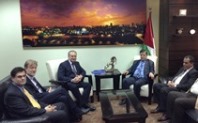
27 April 2015: Ramallah – During a handover ceremony in the Ministry of Health in Ramallah H.E. the Palestinian Minister of Health Dr Jawad Awwad welcomed the latest shipment of medicines and surgical equipment mobilized by WHO and funded by the Russian Federation to the Palestinian Authority. Russian Federation Ambassador Alexander Rudakov and WHO Head of Office for West Bank and Gaza, Dr Gerald Rockenschaub, participated in the ceremony.
The Russian Federation support to the Ministry of Health (MoH) in the occupied Palestinian territory (oPt) is an important contribution to cover urgent needs for medications and medical supplies in health facilities in Gaza. Russia is a key supporter of the World Health Organization’s (WHO) global emergency program; funding is used for procurement of supplies and a global contingency stock of emergency health kits. Following the Gaza crisis in summer 2014 and to help overcome chronic shortages of pharmaceuticals in Palestine WHO has deployed emergency health kits and surgical kits to Gaza.
During the ceremony the Minister highlighted the continued challenges for the Ministry of Health to overcome chronic drug shortages: “The support from donors, in particular from the Russian Federation, to help overcome acute gaps in medical supplies is highly appreciated.” Chronic shortages of essential medicines have been averaging 30% over the past 5 years, and up to 50% for medical disposables.
Ambassador Rudakov underlined the support Russia is providing to strengthen WHO’s global emergency program: “I am pleased that this support provided by Russia is also benefitting Palestine and that supplies could be mobilized by WHO to cover urgent health needs in Gaza.”
Apart from medications and basic medical supplies the shipment also contains much needed surgical equipment and supplies for surgical operations: “This is very important so that hospitals in Gaza can replenish their stocks and can ensure that often lifesaving surgical interventions can be provided to patients in Gaza,” WHO’s Gerald Rockenschaub said.
The shipment, which arrived through Tel Aviv airport WHO mobilizes medical supplies funded by the Russian Federation for the Ministry of Healthirport, consists of 20 Interagency Emergency Health Kit (IEHK) basic units, 1 IEHK supplementary module, sufficient to cover basic emergency needs for pharmaceuticals for 20 000 people in Gaza over a three-month period, and 2 trauma kits and 2 surgical supply kits for operations.
During the recent Gaza crisis, WHO has been working with the Palestinian Ministry of Health and health cluster partners to ensure delivery of essential medicines to health authorities and to strengthen and streamline health interventions of health partners. While the shipment is covering immediate gaps, efforts need to be further enhanced to mobilize resources to overcome the chronic shortages of pharmaceuticals in Palestine.
Media contact
Dr Mahmoud Daher
WHO Gaza office: 08-282-2033
Italy supports WHO project for improved hospital services data and transfers essential medicines to Gaza, April 2015
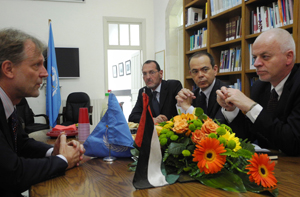 April 27, 2015 ̶ Jerusalem: Today Mr. Lapo Pistelli, Deputy Minister of Foreign Affairs from Italy, and the Italian Consul General Mr. Davide La Cecilia, visited the WHO Office for the West Bank and Gaza Strip and met with WHO Head of Office, Dr. Gerald Rockenschaub, concerning Italy’s interest in the health sector.
The Italian Cooperation is supporting a WHO quality of care program with the Palestinian Ministry of Health to systematically produce key health data on hospital performance to allow evidence-based analysis of appropriate care, service quality and efficiency in the ministry’s hospital system. The one-year Euro 280,000 initiative will also assist in improving decision-making about needed procurement of referral services from private Palestinian health providers and outside of the country.
WHO also facilitated a transfer from Italy of a humanitarian donation of three tons of pharmaceuticals for treatment of patients with chronic diseases in the Gaza Strip. The donation of 18 pallets containing 50,000 vials of concentrated insulin for diabetic patients, injection pens and medications for surgical patients (antivirals, anti-inflammatories, and anti-coagulants) entered Gaza on April 26 for distribution to Ministry of Health and non-government health facilities.
Gaza’s health system experiences chronic shortages of essential medications exceeding 25% to 30% and of half of all basic medical supplies that seriously affect patient care. The shortages are causing delays of elective surgeries by more than one year and greater out-of-pocket expenditures for patients who can afford to purchase medications from the private sector. Poorer patients are left without the medications that control their diseases and improve quality of life.
Contact: Advocacy, 054-717-9023
WHO report: Barriers to health for Palestinians under occupation, December 2014
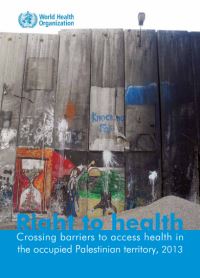 Read the Right to health report10 December 2014, Jerusalem – On the occasion of International Human Rights Day, the WHO West Bank and Gaza released a special report today highlighting reduced access in 2013 to referral health services for Palestinian patients and health providers, especially to the specialist Palestinian referral centres located in annexed East Jerusalem.
The study used data from 2013 from Palestinian Authority ministries, non-profit health providers and from interviews with patients to examine how the Israeli permit system and physical barriers affect patient health and well-being, as well as access for ambulances and hospital workers from the West Bank to the East Jerusalem hospitals.
The Palestinian Ministry of Health refers patients if their medical treatment is unavailable in Ministry hospitals. In 2013, 81.8% of referral patients from the West Bank and Gaza were referred to private health facilities within the West Bank including East Jerusalem and within Gaza, while 18.2% of referrals were to neighbouring countries, namely, Israel, Egypt and Jordan.
Of the 61 635 patients referred by the Ministry of Health in 2013, 57.41% of West Bank patients and 69.47% of Gaza patients required an Israeli-issued permit to access health care. Movement into annexed East Jerusalem for Palestinians with Gaza or West Bank IDs has become more tightly restricted in recent years following the completion of the separation wall around Jerusalem. While the overall number of approved permits (for patients referred by the Ministry and for private referrals) increased in 2013 compared to 2011, the approval rate for permits declined for both West Bank (81.4% to 79.5%) and Gaza (89.8% to 88.7%) patients. The closure of the Rafah border after July 2013 also significantly reduced access for Ministry and self-funded referral patients from Gaza to Egypt.
“This report is the third WHO annual report on monitoring access,” said Dr Gerald Rockenschaub, the head of office for WHO West Bank and Gaza. “The data continues to indicate serious restrictions for thousands of patients who are trying to travel to their places of referral.”
The report calls on all duty bearers to protect access to health care as an international legal obligation, and urges the international community to press Israel, as the Occupying Power and main duty bearer, to cancel the permit system and facilitate the access of Palestinian patients to their referral hospitals at all times.
Related publication
Right to health: Crossing barriers to access health in the occupied Palestinian territory, 2013