


Select your language
WHO: Urgent work is needed to rehabilitate the health system in Gaza to prevent loss of lives
 12 October 2014, Jerusalem – Urgent work is needed to rehabilitate the damaged health system in Gaza to prevent further loss of life after the recent conflict, according to a World Health Organization led joint assessment of health needs and services in Gaza, released today.
During the conflict more than half of existing hospitals and health centres were damaged or destroyed, and over 11,000 people were injured, putting immense strain on remaining facilities. The assessment found critical shortages of essential medicines and other supplies, medical equipment out-dated or in need of repair, health staff unpaid and in need of targeted trainings, and an urgent need to ensure sufficient fuel supply for generators at health facilities.
“The health system in Gaza was already on the brink of collapse after decades of occupation, and years of blockade and conflict,” WHO Regional Director for the Eastern Mediterranean Dr Ala Alwan said. “We need sustained interventions to repair and rehabilitate the damage done during the conflict, and to strengthen the health system for the future. Without this, more unnecessary loss of life will inevitably occur.”
Beyond those injured by violence, the assessment showed that during and after the conflict people with chronic health conditions such as cardiovascular disease, cancer and diabetes suffered from inaccessibility of services, shortage of drugs, and an increase in the demand for referrals outside of Gaza for patients who cannot receive adequate services in the Strip.
The assessment also warned of long-term increased demands on health services by more than 1,000 patients who acquired long-term or permanent injuries in the conflict, and the anticipated increase in mental health needs such as PTSD and depression. (WHO estimates 20 percent of the population in emergency-affected areas will require some form of mental health intervention.)
"WHO is working closely with the Palestinian Ministry of Health to provide patients in Gaza with access to high quality health care. This will require sustained support from donors, and unimpeded access for medicines, essential supplies and medical equipment and reconstruction materials to enter Gaza,” said Dr Alwan.
WHO is supporting the following activities: repair and rehabilitation of 67 damaged hospitals and primary health centres; provision of quality essential public health services, including mental health; provision of essential medicines, especially for chronic illnesses; rehabilitation of the disease early warning system; coordination of the health sector and management of health information; facilitation of 2,000 referral patients per month for specialized medical treatment outside of Gaza.
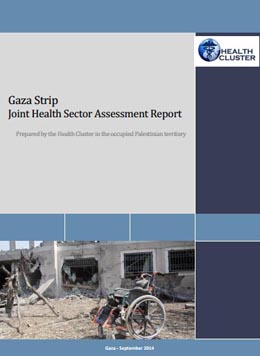
The Gaza Strip Joint Health Sector Assessment Report is the result of quantitative and qualitative data collection undertaken at the beginning of September 2014, with the support of 23 partner organizations working in response the conflict in Gaza. It can be accessed here.
WHO is the directing and coordinating authority for public health within the United Nations system.
:Media contact
Wendy Bruere, Media and Communications Officer (Gaza), ph. +972 598 944 627; email.
WHO appalled by attacks on health-care facilities in Gaza
WHO statement 28 July 2014 - WHO has been appalled by the continuing trend for health-care facilities, staff and vehicles to come under direct fire in Gaza since the escalation of violence on 8 July 2014.
Sustained calm is needed so thousands of injured people can receive urgently needed health care. It is vital for health facilities and staff to be able to perform their life-saving work without fear of attack.
WHO reminds all parties to the conflict of their ethical and legal obligations to protect medical services under international humanitarian law. The Organization calls on all parties and individuals to respect and protect the integrity of health systems, and assure the safety of patients, health workers and health-care facilities.
Media contact:
Paul Garwood
Communications officer
Mobile: +41 7 96 03 72 94
Telephone: +41 22 791 1578
email:
WHO releases short video: impact of drug shortages on hemophilia patients in the Gaza Strip
29 April 2014, Gaza Strip – A simple cut, a fall or a bruise means a trip to the hospital for a young boy with haemophilia, as shown in the short video, “Struggling with haemophilia in the Gaza Strip,” launched on 29 April 2014, in Gaza by the WHO office in the occupied Palestinian territory to mark World Hemophilia Day.
Hopefully an infusion with the correct clotting factor will prevent the child from suffering prolonged bleeding or a badly swollen joint. But in Gaza, up to one-third of essential drugs are missing and shortages are chronic due to the Palestinian Authority’s financial crisis and exacerbated by the blockade and Rafah closure. Palestinians with hemophilia often find that the ‘factor’ is not available in sufficient quantities, or must be kept in reserve to treat haemophilia patients in urgent cases. An alternative treatment, cryoprecipitate, is used by the Ministry of Health when the needed factor is unavailable, but it can mean difficult side effects for patients. Complications of inadequate treatment can be for the Ministry: expensive referrals, and for the patient: joint replacement surgery, amputation, paralysis, as well as being house-bound, impoverished, and suffering psychological impact.
There are 117 haemophilia patients in Gaza, one-half are children and all are males, and about 350–400 patients in the West Bank. Most cases are classified as moderate or severe based on the degree that clotting factors are missing in their blood; moderate cases are treated when there is bleeding, usually after trauma, while severe cases should receive regular prophylactic treatment of the missing factor to avoid life-threatening bleeds, such as from any head trauma.
Dr Mahmoud Daher, WHO head of the Gaza sub-office, stated, “The financially-strapped Palestinian Ministry of Health has 523 drug items on its essential medicine list, necessary for treatment at primary and secondary health care levels in the West Bank, and 480 medicines on the Gaza essential list, which it is pledged to provide but chronically falls short due to the financial crisis.” Medicines that are expensive, have limited suppliers, serve smaller patient groups, have cheaper – even if less effective – alternatives, or are not immediately ‘life-saving’ are most often missing. But particular medicines are life-lines for certain groups of patients, and shortages have profound impact on quality of life, meaning unnecessary suffering, prolonged illness, long-term disability or endangered lives.
Patients with haemophilia A, the most common form, require Factor VIII, and haemophilia B patients require Factor IX, but patients may be missing any of the 13 clotting factors and require accurate diagnosis and periodic testing, often unavailable. While one unit is only US$ 0.44, one bleeding episode may require 2000 units of the Factor, according to the Palestinian Society for Bleeding Disorders.
Contact: Walaa Ammar, WHO Gaza office: 08-282-2033
Related link