

Select your language
Islamic Advisory Group for polio eradication concludes its fifth annual meeting with renewed commitment to end polio and expand its mandate to other health priorities
 Members of the IAG and Dr Ahmed Al-Mandhari, WHO Regional Director for the Eastern Mediterranean, at the meeting26 November 2018 – The Islamic Advisory Group (IAG) concluded its fifth annual meeting on 14 November 2018, reaffirming its renewed commitment to continue supporting the Global Polio Eradication Initiative, protect children against vaccine-preventable diseases and expand its mandate to support maternal, childhood and other health priorities in line with the Strategic Health Programme of Action of the Organization of Islamic Cooperation (OIC) as endorsed by 57 Member States. IAG also reiterated its trust in the safety, effectiveness and Shari’ah compliance of routine childhood vaccinations. It commended and expressed its appreciation for the efforts made by governments, communities, parents, religious leaders and frontline health workers.
Workshop to review Kuwait's national polio outbreak and response plan
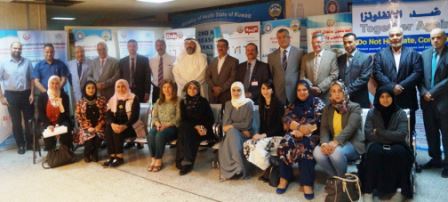
13 March 2017 – The management team of the Expanded Programme on Immunization and national and provincial surveillance focal points of the Ministry of Health of Kuwait attended a 4-day workshop in Kuwait City between 6 and 9 March 2017 to review Kuwait's polio outbreak preparedness and response plan, according to the requirements for polio-free countries by the Global Polio Eradication Initiative.
The Director of Communicable Disease Control Dr Mussab Al Saleh, during his opening remarks, expressed the importance of the polio eradication efforts in the Eastern Mediterranean Region. He highlighted the importance of implementation of a strategic plan which includes the testing of sewage to ensure that any poliovirus was detected in the case of importation and circulation, based on the WHO guidelines. Kuwait would start the screening of primary immune deficient patients to enhance another aspect of the acute flaccid paralysis surveillance system. Kuwait's surveillance system was sensitive enough to detect any emergence of vaccine derived poliovirus type 2 as per the plan of action of the communicable disease control department.
Kuwait has been polio free since 1984. A strong routine immunization system and functional sensitive surveillance system have sustained its status since then. Kuwait is not considered to be at high risk as per the detailed risk analysis conducted by the regional polio programme. However, population movements, including migrant workers from polio-endemic countries, requires vigilance against a potential importation of poliovirus, and wild and vaccine-derived poliovirus type 2.
During the workshop the outbreak preparedness and response plan was reviewed and updated. In addition, a strategic plan to start the screening of primary immune deficient children in Kuwait was developed, which brings to 10 the total number of countries in the Region undertaking such an important activity.
World Polio Day: WHO and UNICEF call for no complacency and increased access in last push to eradicate polio
24 October 2016, Amman | Today, on World Polio Day, polio eradication partners celebrate the successes of the programme to date and rally for the additional support needed to eradicate the disease. In the Middle Eastern Region, polio partners WHO and UNICEF acknowledge the hard work done to keep the Region polio free, but urge all countries to maintain vigilance and to guard against the virus being re-introduced. Despite the gains, serious challenges remain, for example, conflict limits consistent access to high-risk populations in Syria, Iraq and Yemen and this continues to hinder efforts to vaccinate every single child under five, and compromises surveillance and early warning systems.
“The continued efforts of governments, partners and communities to protect children in the Middle East from polio have been truly remarkable,” said Chris Maher, manager of WHO’s regional polio eradication group based in Amman. “But we are not out of the woods yet. Polio continues to circulate in Afghanistan and Pakistan, and recently made a comeback in Nigeria, and so long as there is transmission anywhere, children in the Middle East remain at risk,” he added. “We cannot afford to be complacent; we must ensure systems are strong enough to keep polio out of the region, until the job is finished in all parts of the world,” he said.
“Polio resurged in Syria in 2013 and Iraq in 2014, after 14 years of absence in the Middle East. An 18-month multi-country, multi-partner outbreak response, including more than 50 rounds of polio campaigns, successfully stopped the spread of the virus and again made the Middle East polio-free. It is now essential to strengthen routine immunization in all countries in the region and focus on high risk areas to ensure every child is vaccinated, to prevent future outbreaks,” said Anirban Chatterjee, the chief of Health and Nutrition in UNICEF Regional office for MENA.
Over the past 12 months, in addition to campaigns in polio-endemic countries – Pakistan and Afghanistan – WHO and UNICEF have supported polio campaigns in Djibouti, Egypt, Iraq, Jordan, Lebanon, Libya, Somalia, Sudan, Syria and Yemen. Campaigns will continue in countries with higher risk until polio is eradicated worldwide.
Related link
Note for journalists
The fight to end polio is led by the Global Polio Eradication Initiative, which includes Rotary International, UNICEF, the US Centers for Disease Control and Prevention, World Health Organization, the Bill & Melinda Gates Foundation and governments of the world, with the support of many others around the globe.
For media enquiries:
Joseph Swan
Communications Officer, Polio
World Health Organization
Amman, Jordan
+962 7 9048 4637