


Select your language
Statement by the Islamic Advisory Group for Polio Eradication on the occasion of World Polio Day
Praise be to Allah and prayers and peace be upon the Messenger of Allah, Prophet Mohammed, and upon his kin and companions.
24 October 2016 (23 Moharram 1438) – Every year the world is reminded on October 24 that a disease that has paralyzed and killed children for thousands of years still remains among us, threatening futures. On World Polio Day we are also reminded that Allah Almighty has bestowed upon us the blessing of a tool that not only can stop this disease from infecting our children but can finally eradicate it from Earth once and for all. This comes in fulfilment of Prophet Mohammed’s saying, prayers and peace be upon him, that “There is no disease that Allah has created, except that He has also created its treatment.” (Sahih Al-Bukhari)
The path towards polio eradication started a few decades ago with the discovery of the polio vaccine. This vaccine protects children from contracting the disease and infecting others with it. After having victimized hundreds of thousands of children in over a hundred countries across the globe, the virus has now been cornered into a few remaining pockets of three countries. While great progress has been made to bring down the number of polio cases in the past few years, anything less than the protection of every single child cannot be acceptable.
Allah Almighty has said in the Holy Qur’an: “They are losers who foolishly have slain their children without knowledge, and have forbidden that which Allah bestowed upon them, inventing a lie against Allah. They indeed have gone astray and are not guided” (Al-Anaam: 140). The Islamic Advisory Group for Polio Eradication (a partnership made up of AlAzhar AlSharif, the International Islamic Fiqh Academy, the Organisation of Islamic Cooperation, and the Islamic Development Bank, along with other religious scholars, technical experts, and academics) renews its call to all parents to step forward and vaccinate their children against this debilitating but preventable disease, especially those under-five who have not been vaccinated before. It is parents’ religious obligation to do so; ignoring this might leave these children paralyzed for life. As Prophet Mohammed has said, “It is sin enough for one to cause the loss of whom he feeds.” (Abu Dawoud)
The IAG also urges religious leaders and communities to protect and cooperate with vaccination teams who are exerting extraordinary efforts to reach every single child with this life-saving measure that Allah has blessed us with. On the occasion of World Polio Day, we would like to express our appreciation and full support of these workers, particularly as they put their lives at risk in order to fulfil their duties towards our children. Their dedication reminds us of the Prophet’s saying, “Allah loves the worker who when he is doing his work, he does it with perfection.” (Al-Tabarani)
May Allah protect our children from all harm, and bring them up to be the strong and productive members of the Ummah they deserve to be.
For further information please contact:
Related link
The leaders of the Group of Seven commit to polio eradication
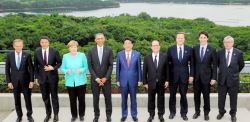 The leaders of the Group of Seven have reaffirmed their commitment to ending polio once and for all during the Ise-Shima Summit presided by the Government of Japan on 26–27 May 2016
The G7 communique and global health
At the 42nd G7 Summit on 26–27 May 2016 in Ise-Shima, Japan, global leaders discussed the most pressing issues in the world today. As part of an ambitious global health agenda promoted by the Government of Japan, the Leaders discussed pandemic and public health emergency response, anti-microbial resistance, and universal health coverage.
Polio Eradication
G7 Leaders in Tokyo reaffirmed their continued commitment to polio eradication in the Ise-Shima leaders’ statement, emphasizing immunization as one of the key cost effective measures to prevent the spread of infectious diseases and to stop emerging pandemics.
The leaders of the Group of Seven commit to polio eradication
Securing a polio-free world
A series of 6 videos explains the important steps that are being taken to make sure that, once the poliovirus has been eradicated, it will never have the opportunity to return. Although the world has never been closer to achieving the goal of polio eradication, much remains to be done.
Once wild polio has been eradicated, the only risks of the virus returning would come from rare strains of circulating vaccine derived polioviruses, and from potential leaks of the virus from laboratories or vaccine manufacturers. The 6 videos explaint he work being done to address these risks.
Securing a polio-free world (WHO YouTube page)
Videos