

Select your language
Devastating Middle East polio outbreak on verge of being stopped, say experts
Polio experts cautiously optimistic, but warn that disease could make renewed comeback
27 January 2015 | BEIRUT -A 12-month emergency immunization response across the Middle East appears to have halted an outbreak of polio that began in Syria and Iraq, according to health experts meeting in Beirut.
The outbreak, which paralysed at least 38 children in Syria and Iraq and prompted fears of a major epidemic, triggered an unprecedented response that immunized more than 27 million children across 8 countries. The outbreak in Syria – which spread to Iraq in early 2014 -- occurred due to the introduction of poliovirus from Pakistan.
National immunization campaigns target more than 3.9 million children in Jordan and Syria
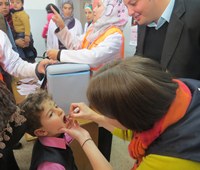 A child under five years old receives polio drops. WHO/R. Almosoukar 4 December 2014 | Efforts to vaccinate more than 1 million children under-five in Jordan and 2.9 million children under-five across the Syrian Arab Republic against polio wrap up today.
The synchronized vaccination campaigns in November were part of a crucial multicountry effort to eliminate polio in the Middle East, after the incurable disease made a return to the region in 2013.
During 2013, 35 cases of polio were confirmed in Syria, and in 2014, one case was confirmed in Syria and two cases in Iraq.
Multiple synchronized vaccination rounds across the region have prevented a major epidemic of polio, but there is more work to be done to ensure that all children at risk are reached with repeated doses of the polio vaccine.
Ongoing efforts are focused on the need to reach children who have been displaced by the violence in Iraq and Syria, and who may have missed out on previous vaccination campaigns because of heavy fighting.
The year-long response to the outbreak has been characterized by coordinated and sustained partnerships between governments of infected and at-risk countries, United Nations organizations, and local and international nongovernmental organizations, focused on protecting children from this crippling disease.
Parents defend their children’s right to life
In Pakistan, internally displaced persons leaving North Waziristan are able to protect their children against polio for the first time in two years.
The Convention on the Rights of the Child, which marks its 25th anniversary on 20 November, defines the right of each child to survive and develop to their full potential.
In North Waziristan, Pakistan, bans on immunization have meant that children have not had access to polio vaccine since July 2012. North Waziristan is one of the last reservoirs of the virus.
“The militants banned vaccination in their strongholds and would punish anyone in public if they were found vaccinating children,” said Salman Shah, a teenage boy, whose studies in political science were interrupted by the unrest.
This summer, military campaigns in North Waziristan caused over a million people to leave the area to protect their families. As unvaccinated people moved out of the area, the fear grew that this would offer the virus a chance to regain a hold in other areas of the country.
However, the Government of Pakistan and the partners of the Global Polio Eradication Initiative, including WHO, have taken steps to reach displaced families at permanent vaccination points as they leave North Waziristan and in the host communities in which they settle.