

Select your language
Two Vacancy Notices, WB and Gaza
WHO in the occupied Palestinian territory is seeking to recruit staff for two positions in its Jerusalem and Gaza offices. Details of each position are available from the following links:
Public Health officer WB – harmonized Reproductive Health Registry (hRHR)
Public Health officer Gaza – harmonized Reproductive Health Registry (hRHR)
WHO thanks donors for aiding the Palestinian health system in Gaza and urges continued support for recovery interventions
6 September 2014, Jerusalem – On 10 July 2014, just days after the escalation of violence in the Gaza Strip, the World Health Organization raised concern about the ability of the Ministry of Health of the occupied Palestinian territory to cope with the new emergency and its increased burden on the health system, given the high levels of shortages of medicines, medical disposables and hospital fuel supplies, and rising health care debt.
The World Health Organization (WHO) and the Palestinian Ministry of Health, and with UNRWA coordination, called on local and international donors to support the Ministry by providing US$ 40 million for medicines and medical supplies, and US$ 20 million for referral costs, to protect the health and welfare of Palestinians during the emergency.
The violence has been unprecedented in terms of the human toll. At the time of the appeal, there had been 80 deaths and 570 injuries, and one hospital and three clinics had been damaged. Today, following a negotiated ceasefire ending 51 days of violence, the casualty toll stands at 2130 deaths and more than 11 000 injuries, most of whom have been treated in Ministry of Health hospitals and clinics. At the same time, 17 of Gaza’s 32 hospitals and 45 of 97 primary health clinics have been damaged, and 4 hospitals and 5 clinics are still closed after severe damage.
The WHO Regional Director for the Eastern Mediterranean, Dr Ala Alwan, toured Gaza on August 11 and visited Gaza’s main hospital, Al Shifa, meeting with casualty patients, health workers and the hospital directors. Dr Alwan congratulated the hospital directors and leaders in the health sector for being able to maintain effective emergency services, even when 240 seriously injured patients arrived at the same time: “Their heroic efforts and highly professional work are greatly appreciated.”
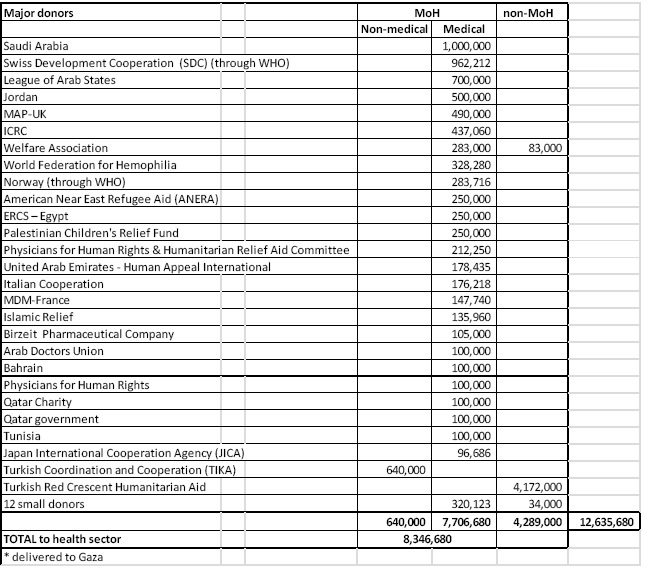
The response from the donor community through providing humanitarian aid and assistance to the Palestinian health sector has been crucial for maintaining services at a high level in Gaza. According to the Ministry of Health, which together with WHO, is coordinating with donors to ensure that aid is targeted to needs and that delivery is facilitated into Gaza, a total of US$ 12.6 million from 39 donor agencies, governments, humanitarian organizations and other donors has been delivered to the health sector in Gaza. Two thirds of these donations (US$ 8.35 million) were targeted to Ministry of Health facilities. Ninety-two per cent of the donations to the Ministry of Health were medicines and medical disposables, especially for trauma treatment. The remaining donations were for medical equipment, fuel supplies to hospitals, and meals for patients and staff in hospitals.
In addition, US$ 5.3 million in donations from 28 donors are in process or in the pipeline for delivery to Gaza. Almost all is for drugs and medical supplies and destined for the Ministry of Health facilities.
In total, the WHO appeal for US$ 40 million for medicines and medical supplies for the Ministry of Health in Gaza has achieved a response rate of 45%, considering both medical supplies delivered and those in the pipeline, as reported by the Ministry of Health up to 3 September. In addition, the UN Gaza appeal which was launched during the emergency and was updated following the ceasefire, requests US$ 23.5 million for health sector intervention to be implemented by UN agencies, including US$ 8.1 million for WHO, and by nongovernmental organizations to support health services in Gaza in the recovery period.
For further information please contact:
Dr Mahmoud Daher
Head of Gaza sub-office
Mobile: +970 598 944650/+972 54 7179010
Email:
Maria Y Al-Aqra'
Director of International Cooperation
Palestinian Ministry of Health
Tel/Fax: 00972 9 2387275 /Mobile: ++972 598 949104
E-mail:
Rana Sidani
Senior Communication Officer
Regional Office in Egypt
Mobile: +201099756506 Email:
Gaza after the conflict: assessing mental health needs, August 2014
28 August 2014, Jerusalem – Experience of previous conflicts in the Gaza Strip and elsewhere has shown that, as soon as the war is over, multiple organizations or institutions rush in to conduct a variety of assessments and surveys concerning mental health. The assessments may seek to inform programme planning, to support fundraising or advocacy, or to gain academic knowledge.
Most assessments take place during the first three months after the war, usually using various international tools which may not have been validated locally or within the emergency context. The majority focus on the prevalence of disorders, especially post-traumatic stress disorder (PTSD), anxiety and depression. However, these assessments rarely take into account that distress tends to be a normal manifestation in a community affected by an emergency, while in stable settings the same level of distress would more likely be a sign of pathology. This often leads to the reporting of extremely high prevalences of mental disorders in the immediate aftermath of emergencies.
Key messages
- Make use of existing mental health data
- Use standard mental health assessment tools
- Consult with WHO and Health Cluster before conducting a survey.
Considerable expertise is required to conduct a survey of mental disorders in a rapid and useful manner. WHO recommends the use of a combination of quantitative and qualitative methods in order to gain an adequate understanding of the meaning and the extent of people’s reactions.
WHO and the United Nations High Commissioner for Refugees (UNHCR) have developed standards for mental health assessments in emergencies: “Assessing mental health and psychosocial needs and resources – Toolkit for humanitarian settings” (2012)[i]. The toolkit, available also in Arabic, is consistent with the Interagency Standing Committee (IASC) Guidelines on Mental Health and Psychosocial Support in emergency settings (2007), the Sphere Project (2011) standards, and the work of the IASC Task Force on Needs Assessment (2012). The toolkit includes both validated instruments and appropriate indicators for measuring the severity of mental health problems as well as the level of daily functioning. WHO strongly urges all agencies involved in mental health and psychosocial assessments for the recent Gaza conflict to refer to the guidance available in the toolkit.
As substantial resources are required to conduct a reliable prevalence survey of mental disorders, the intended use of the findings should be explicitly defined. Furthermore, survey instruments for assessing the prevalence of mental disorders should not be used unless validated within the emergency context. Validation requires specific expertise and involves recalibrating the instrument using independent interviews by a psychiatrist or clinical psychologist trained in use of, for example, WHO's SCAN instrument.
Considering the high costs of time, human resources and finances needed for conducting assessments, efforts should be made to avoid asking questions for which the answers are already known or for which an answer can be found through review of existing data or needs assessments in similar situations. Assessments should be conducted only when the findings will be essential for addressing the key needs of the population and for informing mental health service development.
Although the precise extent of current mental disorders in Gaza is not known, meta-analysis of the most robust epidemiological surveys (those using random samples and diagnostic interviews) in conflict-affected populations around the world show an average prevalence of 15.4% (30 studies) for PTSD and of 17.3 % (26 studies) for depression[ii]. This corresponds with WHO estimates of up to 20% prevalence for mental disorders in emergency-affected populations. Normal mental distress will be common in the remaining 80%.
Instead of conducting further studies to report again that a very high percentage of the population needs mental health intervention, assessments could for example focus on the response capacity of existing mental health services and on potential ways to address gaps. Also, assessments may be used to investigate the characteristics of the treatment gap, such as the adequacy and distribution of services, awareness of the population about mental health and psychosocial support, stigma attached to mental illness, and the outcomes of mainstreaming mental health and psychosocial support into health, education and social care.
Agencies intending to conduct mental health surveys are advised to contact the WHO office for West Bank and Gaza (Dr Dyaa Saymah:
[i] http://www.who.int/mental_health/resources/toolkit_mh_emergencies/en
[ii] Steel, Z. et al (2009) Association of torture and other potentially traumatic events with mental health outcomes among populations exposed to mass conflict and displacement: a systematic review and meta-analysis. JAMA; 302: 537–549