

Select your language
Schoolchildren use art to highlight ‘No Smoking’
14 March 2014, Jerusalem - More than 12 000 schoolchildren in the West Bank and Gaza Strip participated in an art contest and online quiz competition to raise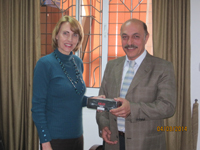 Dr Wendy Venter of WHO hands a prize to Dr Mohamed Rimawi, Head of School Health at the Ministry of Education awareness about the harm caused by tobacco. WHO collaborated with UNICEF, UNRWA and UNFPA to support the Ministry of Education and the Ministry of Health in organizing the competition, which was part of a ‘No Tobacco’ awareness‐raising campaign that includes the right of individuals to be protected from second-hand smoke.
The 40 winners, 2 schoolchildren from government, UNRWA and private schools from each of the 20 districts in Palestine, received a prize of an electronic tablet, provided by WHO to the Ministry of Education.
In Palestine, 9.8% of girls and 32.9% of boys aged 13 to 15 years use tobacco. Globally, tobacco causes 6 million deaths every year, of which 600 000 are the result of non-smokers being exposed to second-hand smoke. Only 16% of the world’s population is protected by comprehensive national smoke-free laws.
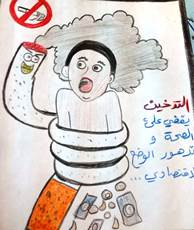 One of the winning drawings in the art contest
 Mr Zakareia Zoorob, General Director at Ministry of Environmental Affairs in Gaza, Dr Anwar El Barawi; Deputy Minister of Education for Administrative and Financial, Walaa Ammar; Advocacy Officer - WHO and Dr Tayseer El shurafa General; Director of School Health
Art Competition for World Health Day 2014, December 2013
Art Competition for World Health Day 2014
Theme: vector-borne diseases
Dear Students
The theme of World Health Day 2014 is vector-borne diseases. The goal of World Health Day 2014 is to raise awareness about the threat posed by vectors – such as mosquitoes, sandflies, bugs, ticks and snails – in transmitting certain diseases and to stimulate families and communities to take action to protect themselves. A core element of the campaign will be to provide communities with information.
The World Health Day 2014 campaign will spotlight some of the most commonly known vectors responsible for transmitting a wide range of diseases. Mosquitoes, for example, not only transmit malaria and dengue, but also lymphatic filariasis, Japanese encephalitis and yellow fever.
What are vectors and vector-borne diseases?
Vectors are organisms that transmit pathogens and parasites from one infected person (or animal) to another. Vector-borne diseases are illnesses caused by these pathogens and parasites in human populations. They are most commonly found in tropical areas and places where access to safe drinking-water and sanitation systems is problematic.
Why it is important to know about them?
Vectors cause many deadly diseases. Millions of people die as a result.
The most deadly vector-borne disease, malaria, caused an estimated 660 000 deaths in 2010. Most of these deaths were among African children. However, the world’s fastest growing vector-borne disease is dengue, with a 30-fold increase in disease incidence over the past 50 years. Globalization of trade and travel and environmental challenges such as climate change and urbanization are also affecting the transmission of vector-borne diseases, and causing their appearance in countries where they were previously unknown.
In recent years, renewed commitments from ministries of health, regional and global health initiatives – with the support of foundations, nongovernmental organizations, the private sector and the scientific community – have helped to lower the incidence and death rates from some vector-borne diseases.
What is the role of each of us?
We can all contribute to reducing the risk of vector-borne diseases:
- Families living in areas where diseases are transmitted by vectors should know how to protect themselves;
- Travelers should know how to protect themselves from vectors and vector-borne diseases when travelling to countries where these pose a health threat;
- In countries where vector-borne diseases are a public health problem, ministries of health should put in place measures to improve the protection of their populations; and
- In countries where vector-borne diseases are an emerging threat, health authorities should work with environmental and relevant authorities locally and in neighbouring countries to improve integrated surveillance of vectors and to take measures to prevent their proliferation.
Dear Students
You can contribute to the efforts to prevent vector-borne diseases by participating in World Health Day activities. For example you can raise awareness of the causes and ways of transmission of vector- borne diseases. You can also help make people around you aware of how to protect themselves from these diseases.
You may also express these concepts through a contest in drawing and in colour.
Contest participation conditions:
- Entries may be submitted in any form of drawing or painting by school children aged 8–18
- Entries can be made on appropriate drawing paper, using any type of colouring.
- Entries should be sent to the WHO Representative in your country, or to the Director of the Department of International Relations, Ministry of Health, so that they can be forwarded to the Eastern Mediterranean Regional Office.
- The last date for receiving entries is the end of February 2014.
- Entries shall be judged according to age groups as follows:
8-9, 10–11, 12–13, 14–15 and 16-18.
- Referees will sit at the Regional Office in Cairo to judge all entries and their verdict shall be final.
- WHO is not required to return any winning or non-winning entries to their owners.
- WHO reserves the right to use the submitted artwork in its publications.
- Every entry must include the form attached to this document, and must show the following information:
- The full name of the Entrant
- Country of residence
- Age
- Full home address
- Name and address of the school (with telephone contact)
- Name of the legal guardian (with telephone contact)
The above information must be legibly written, and preferably typed.
Drawings submitted without the above information will be disregarded.
10. Winners will receive prizes of US$ 200, US$ 175, US$ 150, US$ 125 and US$ 100 , as well as Certificates of Merit. An exhibit will be held for winning entries at the Regional Office premises in Cairo.
NOTE FOR SCHOOLS AND ART TEACHERS
Schools are kindly requested to be selective in the entries they submit. While all students are strongly encouraged to take part in the competition in order to raise their awareness about the theme of the World Health Day, the referees will consider promising entries only. Children should be assisted in completing the form legibly and in full.
The form is accessible in the following pdf(s), page 3.
Palestinian newborn dies at Rafah border, October 2013
20 October 2013, Jerusalem – On 26 September 2013, Iman Mashrawi, in her eighth month of pregnancy, travelled from Morocco, where she has lived for four years, to visit her family in the Gaza Strip. After flying into Cairo, she spent a night in the airport before embarking on the long taxi ride to El Arish, and then taking another taxi to the Rafah border crossing. Her family had in the past come to Cairo to assist her, but were now unable to leave the Gaza Strip due to restrictions imposed at the crossing by the Egyptian authorities. According to Iman, her trip to Rafah had been long due to repeated security checks, so that by the time she reached the crossing on 27 September, it was already closed for the day.
The trip had left Iman extremely tired and, in light of her condition, her family urged her to seek special humanitarian access at the crossing, but according to Iman, officials on the Egyptian-side of the crossing refused to allow her to pass. When she requested to be allowed to rest in the small prayer area inside the passenger terminal until the crossing opened, she was also refused. At this point, according to Iman, she was exhausted and asked to be transferred to a hospital, but officials at the crossing indicated that they were unable to assist her.