




Select your language
The checkpoint makes me sicker than I already am
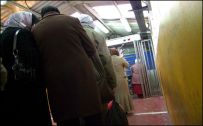 Queuing at an Israeli checkpoint entering Jerusalem – no exception made for chronically-ill people like Noor Three times a week, Noor H.* from the West Bank goes for dialysis at an East Jerusalem hospital. Chronically ill and barely able to walk, she has to cross an Israeli checkpoint on foot. Most of the time she is meticulously searched. No one from her family can accompany her.
“Each time I’m anxious: How will I reach the hospital? How long will I have to queue? Will the soldiers search me? Will the machine recognize my fingerprint? Three times a week I have to go for dialysis at Augusta Victoria Hospital. I’ve done this for the last 12 years. At the beginning I could get there by car, which took about 15 minutes. Today, with the Wall and the checkpoints around Jerusalem, it takes between half an hour and one hour, including two taxi rides that cost me 60 shekels one way.
At the Israeli checkpoint I have to go through the passenger terminal like everybody else. I can barely walk but there’s no separate line for sick people. Sometimes people in the queue are nice and let me pass, other times they don’t. I have to carry my portable oxygen pump, which weights five kilos and is connected with a tube to my nose. Therefore, I can’t pass the pump through the x-ray machine for luggage. And when I walk through the metal detector with it, the alarm goes off. So most of the time the soldiers take me to a separate room, make me undress and search me.
The Israeli soldiers see me all the time; they know me. All the same, only some of them treat me properly, others shout at me all the time. When I have problems at the checkpoint, for example when my fingerprints are again not recognized, I call the hospital and they try to help me. They also take care of my permit applications, which is a great relief.
In my family, only my father has a permit to enter Jerusalem, but he’s old and can’t accompany me. Several times I’ve had to be hospitalized for days or weeks. He was the only one who could visit me; sometimes my mother managed to get a permit, but my brothers and sisters were never allowed to come.
I’m sick and the checkpoint makes me even sicker. When I get up in the morning, I sometimes ask myself: Why don’t I just stay at home? I’m tired of all this.” (August 2010)
*Noor’s name has been changed and some of the details of her story have been omitted in order to protect her identity.
Restricted access for patients to hospitals in East Jerusalem
Almost two thirds of admissions to East Jerusalem hospitals are for patients from the West Bank. To enter the city they need an Israeli-issued permit. Sometimes these permits are granted for shorter periods than the treatment requires, particularly if multiple consultations or operations are necessary. Males aged 15–30 often have their requests for permits turned down on the grounds of security. In many cases, it is also difficult for family members to obtain permits to escort patients to Jerusalem.
Like all West Bank Palestinians, patients are only allowed to use the Qalandiya, Gilo and Zaytoun checkpoints, the three most crowded pedestrian terminals. They have to cross on foot like everybody else. Separate lines for people with special needs either do not exist or are out of service.
The right to the highest attainable standard of health is enshrined in the WHO Constitution and numerous human rights instruments. Four criteria make up the right to health: availability, accessibility, acceptability and quality.
Related link
There’s no care here for our daughter at all
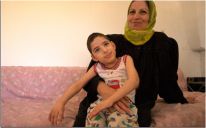 Ala Zahwahri in her mother's armsEight-and-a-half-year-old Ala’ Zahwahri has mental and physical disabilities. Living in a house trapped between Har Homa settlement and the Barrier, her parents are obliged to take her on an arduous journey to Bethlehem, or Beit Sahur, each time they need to access medical services.
“Just last week, we needed to take Ala’ to the doctor. She can’t speak, but when she cries, we know something’s wrong because usually she’s very quiet. When she was little, we could drive her to Bethlehem or Beit Sahur ourselves in less than 15 minutes. That was before the Barrier was built a few metres away from our house. Nowadays, we first have to find a taxi driver who actually agrees to come here and drive us to Gilo checkpoint. Then, when we get there, we have to cross the terminal on foot carrying Ala’ in our arms. On the other side, we need to take another taxi to the clinic or hospital. Altogether we pay about 45 shekels one way. Most of the time, the journey takes one to one and a half hours.
Ala’ can’t eat by herself, she can’t even sit up. Mostly she just lies quietly on her couch. She needs constant care and the doctor says that she’ll need that all her life. Here, where we live, there’s no care for Ala’ at all: no doctor, no mobile clinic. Nobody helps us to take care of her. About 100 metres from here, in the Israeli settlement, there’s everything, but we’re not allowed to go there. We have West Bank ID cards, although we live on the Jerusalem side of the Barrier.
We’ve repeatedly tried to register Ala’ for health insurance with the Palestinian Authority, but we’ve had no success even though the officials are aware of her case. Fifty three members of our family live here in Um Al Asafir – nobody has health insurance. A friendly doctor in Bethlehem used to treat Ala’ for free, but he died. Now, we not only have to pay for transport and medicine, but for doctors’ visits too. All in all, we’ve spent over 500 shekels since last year.
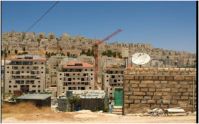 Har Homa settlement growing closer to Ala's houseWe have six other children. They’re older and live with relatives in Beit Sahur so that they can go to school and university easily. From the hill outside our house we can see where they’re staying, but to visit their sister Ala’ they need to make the long journey through the Gilo checkpoint.” (September 2010)
Dislocated communities: trapped by the Barrier
In addition to separating large parts of East Jerusalem and its population from the rest of the West Bank, the Barrier leaves approximately 1500 West Bank ID card holders on the “Jerusalem” side of the Barrier. They are cut off from centres that provide public sevices such as health and education in the West Bank.
To access hospitals, schools or even to go shopping the inhabitants of the dislocated communities have to take long detours and mostly have to cross checkpoints. They cannot drive to and from their homes because they are unable to receive yellow license plates, which would allow them to take their cars into Jerusalem.
The right to the highest attainable standard of health is enshrined in the WHO Constitution and numerous human rights instruments. Four criteria make up the right to health: availability, accessibility, acceptability and quality.
Related link
I was asked to spy if I wanted to study
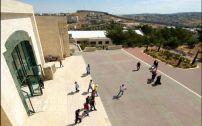 The entrance of Al Quds medical school in Abu Dis with the Barrier in the background cutting the school off from East JerusalemAhmed* is a medical student. He cannot continue his training at an East Jerusalem hospital because his permit was confiscated. He recounts how the Israeli secret service asked him to work for them if he wanted his permit back.
“As part of my studies at Al Quds medical school in Abu Dis, for the last two years I’ve been doing on-the-job training at an East Jerusalem hospital. Being a Palestinian from the West Bank, I need a permit from the Israeli authorities to enter Jerusalem. I’ve never had any problems getting one before. This spring, however, a soldier at the checkpoint confiscated my permit. I was told that I had to see the Israeli secret service, Shin Bet, if I wanted to get it back.
When I finally got an appointment a few weeks later, the Shin Bet officer told me: “If you help us, we will help you.” They asked me to inform them about my fellow students’ activities, in particular any travel abroad. In other words, I was asked to spy if I wanted to study. I refused and, as a result, I didn’t get my permit back.
Although I can do my training in Hebron, for example, there are huge repercussions on the quality of my studies. The East Jerusalem hospital where I’ve been training has half a dozen professors specialized in my field. In Hebron, there is only one. There is also much less interaction between students in the West Bank because there are far fewer students per hospital.
When I finish my undergraduate studies at Al Quds medical school in a bit over a year, I want to go to the United States (US) for my specialization. My diploma is recognized in the US, United Kingdom, the Arab world and many other countries. Israel, however, refuses to recognize it.” (September 2010)
*Ahmed’s name has been changed and some of the details of his story omitted in order to protect his identity.
Medical students face difficulties accessing East Jerusalem for training
150–160 students in the fourth, fifth and sixth year of studies at Al Quds medical school in Abu Dis are eligible for training at East Jerusalem hospitals.
90% come from the West Bank and need permits to attend specialized, medical training in pediatrics, neonatology, surgical interventions, internal medicine, cardiology, etc. On the whole, the same high-quality, specialized training is not available in the hospitals elsewhere in the occupied Palestinian territory.
Therefore, access to East Jerusalem for medical students is critically important, especially if the quality of medical care in the oPt is to be ensured in the long term.
In June 2010, Al Quds medical school reported that 11 students could not continue their training in East Jerusalem because the Israeli authorities had refused to renew their permits. Physicians for Human Rights Israel is helping these students to bring their case to court in order to create a precedent with regard to permits for medical students from the West Bank.
The right to the highest attainable standard of health is enshrined in the WHO Constitution and numerous human rights instruments. Four criteria make up the right to health: availability, accessibility, acceptability and quality.
Related link