


Select your language
I’m old and sick and my family can’t be with me
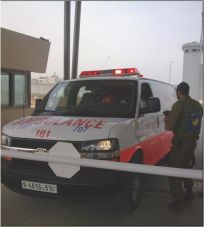 Even after prior coordination with Israeli authorities, soldiers can hold up ambulances at checkpoints for extended periods of time When doctors in Hebron could not find the cause of 74-year-old Abu Abed’s* acute pain they urgently referred him to a hospital in East Jerusalem. However, the ambulance he was travelling in was held up at the checkpoint entering the city. His frail wife is the only family member allowed to be with him.
“I went to the hospital in Hebron because I had terrible pains in my back and stomach. They did what they could but after nine days, when they weren’t able to find out what was wrong, they sent me home. However, the pain didn’t go away and I went back to the hospital. That’s when they decided to send me immediately to Al Maqassad Hospital in East Jerusalem.
Despite the fact that I was really sick, it took a whole day to get the papers from the Israeli authorities for my transfer. At nine o’clock the next morning, we arrived in a Palestine Red Crescent Society ambulance at one of the checkpoints outside Jerusalem. The soldiers stopped us. I heard the driver talking to them, but I didn’t understand what the problem was. I was lying in the ambulance, feeling totally helpless. I, an old man, was seeking medical treatment and it seemed no one was helping me. One and a half hours later, I was finally transferred to the ambulance that had come from Jerusalem to take me to the hospital.
Here at Al Maqassad Hospital I’m being looked after very well. They’ve run a number of tests, including two endoscopies, and they’ve sent some tissue to the laboratory. I should know the results shortly. I finally feel that someone can help me.
Only my wife, as sick and as old as I am, was allowed to accompany me. She stays at my bedside all the time. She even sleeps in a chair in my room. The Israeli authorities denied the requests from each one of my five sons to come to Jerusalem to visit me. Since we don’t have relatives here, nobody can take turns with my wife in looking after me. So, as soon as I can, I want to return to Hebron to be with my family.
I’m 74 years old, sick and weak. How could I harm Israel? I don’t understand why I’m being treated this way, why I’m not allowed to have my family with me when I need them the most.” (November 2010).
* Abu Abed’s name has been changed and some of the details of his story have been omitted in order to protect his identity.
Restricted emergency access to Jerusalem
Palestinians from the West Bank requiring emergency treatment available only in East Jerusalem are especially affected by the delay in accessing the city through Barrier checkpoints. Permission for emergency cases can be obtained the same day through the Palestine Red Crescent Society (PRCS). This involves coordination with the Israeli District Coordination Office, the authorizing of a specific checkpoint for the patient to cross, and back-to-back ambulance procedures since West Bank ambulances are prevented from entering Jerusalem.
Even if permission is granted, emergency cases are frequently delayed. In 2009, PRCS recorded 440 delays and denials of ambulances throughout oPt, two thirds of which occurred at checkpoints accessing East Jerusalem.
The right to the highest attainable standards of health as enshrined in the WHO constitution and numerous human rights instruments. Four criteria make up the right to health: availability, accessibility, acceptability and quality.
Related link
Permits, checkpoints and the Wall: Health care barriers due to movement restrictions
The portraits below give personal testimony to how the health care system in the occupied Palestinian territory has been seriously disrupted by Israeli movement restrictions on the population. Israel’s recent construction of the Separation Wall isolates parts of the West Bank from each other, and cuts off the West Bank from East Jerusalem, which Israel annexed illegally shortly after the 1967 war and occupation.
Since 2006, patients and hospital staff must apply for Israeli-issued permits in order to access the main specialized hospitals in East Jerusalem. These permits are difficult to obtain for many, and may carry “conditions,” such as providing information about colleagues to security authorities. Even with a permit, barriers to health access for Palestinian patients can include delays at checkpoints, limitations on family members seeking to accompany children and the elderly to hospital, longer distances to service centres and physical demands of access for people with physical disabilities and the chronically ill.
Related link
I couldn't even save my own mother
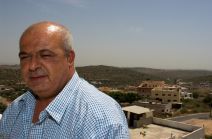 Abu Rami, village council member, coordinates medical cases with the Israeli authorities for sick people to leave the “Seam Zone” village of Barta’aThe Israeli Barrier cuts Barta’a off from the rest of the West Bank. The nearest hospital is in Jenin, which is only accessible by crossing a checkpoint. Abu Rami, a member of the village council, is responsible for the coordination of medical cases with the Israeli authorities.
“I remember the day my mother died as if it were yesterday. It was in the summer of 2007. She was old and had had health problems for some time, but during that day her condition deteriorated. I called the Israeli authorities to get permission for an ambulance from Jenin to come and pick her up.
The ambulance arrived at the checkpoint, three kilometres outside our village, in 15–20 minutes. However, the Israeli security guards searched it and ordered it to turn back. Why? I don’t know. They were probably just in a bad mood.
I telephoned my Israeli interlocutors over and over again to get permission for the ambulance to cross. When I realized that my efforts were in vain, I asked for permission to drive my mother to Jenin in my own car. This request was granted. Then, just after we crossed the checkpoint my mother passed away. When I turned around to go home, the guards insisted on searching the car with my dead mother in the back. It felt like they were making fun of me because I hadn’t even driven out of view of the checkpoint.
I deal on almost a daily basis with cases of sick people who need to cross the checkpoint. Anyone who can’t walk needs special coordination with the Israelis, as well as anyone who has to cross during the night when the checkpoint is closed. Pregnant women leave the village weeks before their expected delivery date, just to make sure that they can reach the hospital in time. With the Barrier and the checkpoint, what was a 15-minute drive to or from Jenin now takes about one hour.
My mother was old and I knew she would probably die, but the feeling of helplessness was terrible. I’m the person responsible for medical coordination in Barta’a so I know the procedure and I have all the telephone numbers. Nevertheless, I couldn’t even save my own mother.”
Villages separated from health services by the Wall
Israel constructed the Separation Wall well inside the West Bank in order to enclose Israeli settlements, rather than on the Green Line which demarcates the 1967 borders between Israel and the West Bank. The path of the Wall also separates a number of Palestinian villages and communities from the rest of the West Bank, restricting their access to health and other services. Non residents need to obtain a “visitor permit” to enter these villages, which generally prevents doctors from conducting house calls, ambulances from collecting patients and mobile teams from providing health services there.
''Barta'a is the largest Palestinian village in this zone, with 5600 inhabitants, who used to be visited twice weekly by a United Nations Relief and Works Agency (UNRWA) mobile health team. Since September 2007, UNRWA has been unable to access Barta'a and the mobile health programme has been suspended."
The right to the highest attainable standard of health is enshrined in the 1946 WHO Constitution and numerous human rights instruments. Four criteria make up the right to health: availability, accessibility, acceptability and quality.
Related link