


 WHO team assesses the laboratory detection capacity for dengue in a hospital
1 October 2017 – The World Health Organization Regional Office for Eastern Mediterranean and the WHO country office in Pakistan conducted a joint mission to Peshawar, the provincial capital of Khyber Pakhtunkhwa province from 19 to 21 September to investigate the ongoing outbreak of dengue fever which has affected Peshawar, and other adjoining districts of the province. Dengue, was declared as an “emergency” by the provincial authority on 31 August 2017 and since the second week of July to 23 September, a cumulative total of 41 770 suspected cases including 28 associated deaths were reported from this outbreak. At least 8660 of these suspected cases have been laboratory-confirmed. WHO conducted this mission upon a request received from the provincial health authority.
The mission met the concerned officials of the Dengue Response Unit, recently set up by the provincial health authority, conducted field visits to the Khyber Teaching Hospital and also to the affected union councils of Peshawar city to have a firsthand assessment of the situation, coordination of ongoing response measures and risk of spread.
The WHO mission appreciated the commitment of the government of Khyber Pakhtunkhwa and level of current response which continued to gain momentum. The WHO mission noted with interest the establishment of multisectoral Dengue Response Units at various levels for coordination and technical guidance, promulgation of the Khyber Pakhtunkhwa Public Health (Surveillance and Response) Ordinance 2017 for the implementation and enforcement of measures to prevent and control spread of diseases, strengthened disease surveillance and response, streamlined data collection from districts and hospitals, analysis and dissemination, free of cost standard dengue case management and laboratory services, vector surveillance, mapping and response, mass community mobilization and education through use of print and electronic media, social media, schools and colleges, religious institutions and local government representatives, as well as other financial and logistical support from the government.
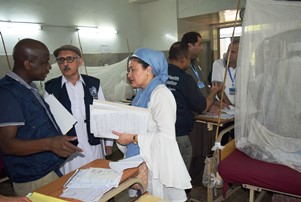 WHO mission team assessing the case management for dengue fever in Khyber Teaching Hospital which is receiving over 90% of dengue fever casesThe WHO mission noted that the geographic spread of the outbreak is currently limited as evidenced by the fact that most of the cases are dispersed in the city of Peshawar and few other districts, active transmission of the disease continues unabated in the absence of an integrated and sustained vector management and control measures. Presence of vector mosquitoes in other districts of Khyber Pakhtunkhwa province as well as frequent movement of people between the provincial capital and other districts is likely to be the main risk factor for further spread of the disease and subsequent transmission once the virus spreads.
WHO has scaled up its response to the current outbreak and called for the same from its other partners. WHO has recruited 4 entomologists and one disease surveillance officer to help the provincial health authority in vector control to interrupt current cycle of mosquito to human transmission, enhance current surveillance systems to collect quality data on disease progression and timely analyse the data to monitor the outbreak progression and guide appropriate interventions. WHO is also partnering with other agencies for organizing social mobilization campaigns at the community levels to destroy the active breeding sites of the mosquito larva.
The WHO mission recommended some immediate steps such as enhancing integrated surveillance and linking it to vector mapping and surveillance and using the surveillance data to monitor the progression of the outbreak, improving laboratory detection capacities in the districts, strengthening public health preparedness and readiness measures for epidemic control and setting up a body within the provincial health authority for coordinating response to public health threats As these remain the key mandate of its work, WHO would continue to provide its technical support to the provincial health authority to help improve the situation.