


Select your language
Polio
Syria has a robust surveillance system for acute flaccid paralysis (AFP). Stool specimens are collected and sent to the WHO-accredited National Polio Laboratory (NPL) in Damascus to determine whether poliovirus infection is the cause of paralysis. Surveillance indicators reached global targets for 2019 with a detection rate of >3/100 000 children under the age of 15. Sewer samples were collected from 16 sites in 13 governorates to exclude the possibility of poliovirus circulating unnoticed within the community. While the Syrian MoH is responsible for training, supervising and managing surveillance staff, WHO provides financial support for transport, incentives for timely collection and analysis, and capacity building.
Massive population displacements in northwest Syria served to emphasize the need to keep AFP surveillance indicators at the highest level. In 2019, 427 cases were detected with a high non-polio-AFP rate. No cases of Sabin type 2 or vaccine-derived wild polio virus were detected. However, the risk of polio remains. Despite limited access to some areas in the northwest, WHO and partners are continuing their monitoring efforts.
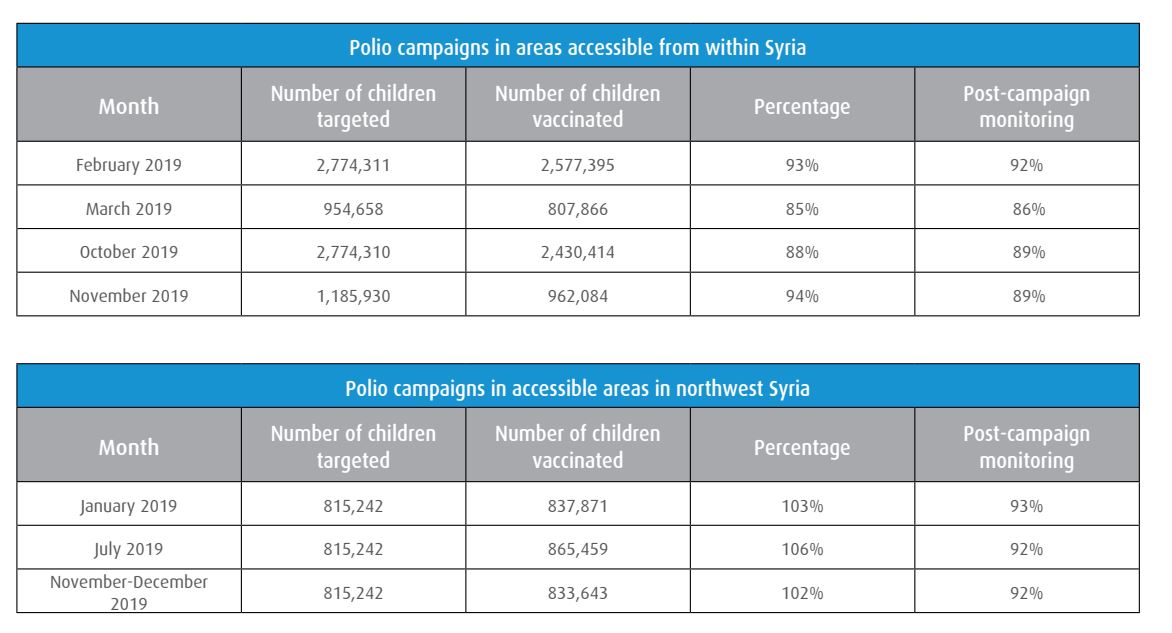
In 2019, WHO conducted two nationwide and two subnational polio immunization campaigns in all areas accessible from Damascus. Three polio immunization campaigns for children under the age of five were conducted in all accessible areas of northwest Syria.
National Polio Laboratory in Damascus
The NPL in Damascus carries out viral isolation and intra-typic differentiation of the poliovirus. Laboratory staff have been trained on genetic sequencing, which will enable the laboratory to perform this function once it receives the necessary equipment. In 2019, the NPL successfully passed the annual accreditation exercise carried out by WHO. Accreditation provides formal confirmation that the laboratory has the capability and the capacity to detect, identify and promptly report wild and vaccine-derived polioviruses that may be present in clinical and environmental specimens. WHO funded all supplies and equipment required by the NPL and supported capacity-building for senior NPL staff through internal and external workshops, in coordination with the WHO Regional Office in Cairo.
Tuberculosis
In 2018, the rate of TB was 18 per 100 000 people while in 2017, it was 15.8. In 2019, the National TB Programme (NTP) in Damascus reported that 2681 patients had registered for treatment, suggesting a notification rate of 15 for every 100 000 people. The governorates of Damascus, Aleppo and Rural Damascus reported the highest numbers of TB patients (708, 582 and 380, respectively). Based on MoH statistics, Aleppo represents a third of the entire caseload of TB patients in Syria. A survey in Al-Sheikh Maqsood in Aleppo governorate, conducted in July and August 2019, found 300 suspected cases out of 15 000 individuals tested, of which 19 patients were confirmed and treated.
In 2019, 165 NTP staff in Damascus, Homs and Rural Damascus were trained on managing TB patients based on WHO’s global guidelines, conducting laboratory diagnosis and following up on multi-drugresistant TB patients. Three fully equipped TB mobile clinics have recently been donated to Syria by theMiddle East Response project, which is mobilizing to provide TB services for people in IDP and refugee camps and other closed settings such as prisons. These clinics have been distributed to Aleppo, Deirez-Zor and Rural Damascus governorates. Lengthy international procurement procedures and insufficient funds continue to threaten the future of Syria’s TB centres. A 2018 WHO assessment found that the capacity of laboratories in northwest Syria was weak and human resources were inadequate. There were numerous shortages of TB drugs and the TB case detection rate was low (605 registered cases compared to the 1260 predicted new cases that WHO expects to be detected annually). At the end of 2019, there were three fully functioning TB centres in the northwest, in Afrin, Azaz and Idleb cities, with 59 physicians, laboratory technicians and health staff trained by WHO. In 2019, they diagnosed 314 patients with TB and managed to complete treatment for 114 of them. At the end of 2019, there was still no capacity for active case-finding of tuberculosis patients.
Lengthy international procurement procedures and insufficient funds continue to threaten the future of Syria’s TB centres. A 2018 WHO assessment found that the capacity of laboratories in northwest Syria was weak and human resources were inadequate. There were numerous shortages of TB drugs and the TB case detection rate was low (605 registered cases compared to the 1260 predicted new cases that WHO expects to be detected annually). At the end of 2019, there were three fully functioning TB centres in the northwest, in Afrin, Azaz and Idleb cities, with 59 physicians, laboratory technicians and health staff trained by WHO. In 2019, they diagnosed 314 patients with TB and managed to complete treatment for 114 of them. At the end of 2019, there was still no capacity for active case-finding of tuberculosis patients.
Tuberculosis
In 2018, the rate of TB was 18 per 100 000 people while in 2017, it was 15.8. In 2019, the National TB Programme (NTP) in Damascus reported that 2681 patients had registered for treatment, suggesting a notification rate of 15 for every 100 000 people. The governorates of Damascus, Aleppo and Rural Damascus reported the highest numbers of TB patients (708, 582 and 380, respectively). Based on MoH statistics, Aleppo represents a third of the entire caseload of TB patients in Syria. A survey in Al-Sheikh Maqsood in Aleppo governorate, conducted in July and August 2019, found 300 suspected cases out of 15 000 individuals tested, of which 19 patients were confirmed and treated.
In 2019, 165 NTP staff in Damascus, Homs and Rural Damascus were trained on managing TB patients based on WHO’s global guidelines, conducting laboratory diagnosis and following up on multi-drugresistant TB patients. Three fully equipped TB mobile clinics have recently been donated to Syria by theMiddle East Response project, which is mobilizing to provide TB services for people in IDP and refugee camps and other closed settings such as prisons. These clinics have been distributed to Aleppo, Deirez-Zor and Rural Damascus governorates. Lengthy international procurement procedures and insufficient funds continue to threaten the future of Syria’s TB centres. A 2018 WHO assessment found that the capacity of laboratories in northwest Syria was weak and human resources were inadequate. There were numerous shortages of TB drugs and the TB case detection rate was low (605 registered cases compared to the 1260 predicted new cases that WHO expects to be detected annually). At the end of 2019, there were three fully functioning TB centres in the northwest, in Afrin, Azaz and Idleb cities, with 59 physicians, laboratory technicians and health staff trained by WHO. In 2019, they diagnosed 314 patients with TB and managed to complete treatment for 114 of them. At the end of 2019, there was still no capacity for active case-finding of tuberculosis patients.
Lengthy international procurement procedures and insufficient funds continue to threaten the future of Syria’s TB centres. A 2018 WHO assessment found that the capacity of laboratories in northwest Syria was weak and human resources were inadequate. There were numerous shortages of TB drugs and the TB case detection rate was low (605 registered cases compared to the 1260 predicted new cases that WHO expects to be detected annually). At the end of 2019, there were three fully functioning TB centres in the northwest, in Afrin, Azaz and Idleb cities, with 59 physicians, laboratory technicians and health staff trained by WHO. In 2019, they diagnosed 314 patients with TB and managed to complete treatment for 114 of them. At the end of 2019, there was still no capacity for active case-finding of tuberculosis patients.