

Select your language
WHO Representative urges stronger tobacco control in Syria
1 June 2016 – Notwithstanding the current crisis in the country, Ms Elizabeth Hoff, WHO Representative to Syria, has stressed the urgency for controlling tobacco and shisha consumption among the population – especially among youths, women and teenage school children.
Speaking at the World No Tobacco Day 2016 event, Hoff said that tobacco and shisha consumption endangers the health and future life of smokers and people around them. “Many youths, women and school-age children in Syria have taken to shisha smoking believing that it is fashionable and less harmful than cigarettes,” said Hoff. “The truth is that shisha smoking is 20 times more dangerous than cigarette smoking, and shisha users are at risk for some of the same diseases as cigarette smokers such as oral cancer, lung and stomach cancer, cancer of the throat and impaired reproductive capacities.”
Hoff urged the Syrian health authorities at all levels to collaborate with WHO and implement the “plain packaging approach” being canvassed in order to reduce attractiveness and glamour, as is appropriate for a product that kills almost 6 million people annually.
The Deputy Minister of Health, Dr Ahmad Khlefawy, stated that Syria was one of the first countries to sign the WHO Framework Convention on Tobacco Control (WHO FCTC) and endorse a ban on public smoking in an effort to control consumption.
The Deputy Minister emphasized that, the current crisis notwithstanding, the Syrian health authorities will continue to discourage tobacco consumption – including shisha. He added that the current crisis cannot be an excuse for Syrians to endanger their lives. He appreciated WHO for its humanitarian support to the Syrian people across the country since the beginning of the crisis.
The event featured presentation of poems, essays, and cartoon drawing by youths and school children to reflect the harmful effect of tobacco consumption.
Related link
Syria achieves polio milestone; 2 years without a reported case
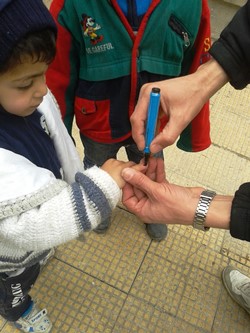 23 January 2016 - Syria is approaching 2 years without a reported case of polio today despite enormous challenges adversely affecting the delivery of health services, including childhood vaccinations.
Polio resurged in Syria in October 2013 after 14 years of absence, following a sharp drop in immunization coverage and importation of wild poliovirus. 35 cases were reported in 2013 (25 in Deir ez-Zor, 5 in Aleppo, 3 in Idleb, 2 in Al-Hassakeh) and 1 in Hama in January 2014. Transmission was halted after a series of mass vaccination campaigns held across the country reaching more than 2.9 million children under 5 years of age with repeat doses of oral polio vaccine (OPV).
“I am pleased and impressed that Syria has maintained a zero polio status for the past 2 years, given its current crisis context,” said Ms Elizabeth Hoff, WHO Representative to Syria. “This is a testament to the dedication and grit of Syrian health workers. Remember, the country is still at high risk of polio, and to keep Syria polio-free we must continue to carry out vaccination campaigns to increase immunity, focusing particularly on children in hard-to-reach areas,” she said. “We must also continue to strengthen disease surveillance systems to monitor for polio. We need to be prepared if the virus resurfaces,” she added.
“This is a major milestone for Syria,” said Hanaa Singer, UNICEF Representative in Syria. “We pay tribute to all health workers and volunteers who made this possible. We must grant them further protection and champion their efforts to reach every child, everywhere across Syria, particularly in hard-to-reach areas. Maintaining these gains remains of paramount importance.”
Stopping transmission of polio in Syria and the Region
Detection of wild poliovirus in Syria in 2013 prompted swift epidemiological response, not only nationally but across the region. In Syria, Egypt, Iran, Iraq, Jordan, Lebanon, occupied Palestinian territory and Turkey, WHO in collaboration with the central and local health authorities, UNICEF and other partners of the Global Polio Eradication Initiative, embarked on a multi-country, multi-phase outbreak response plan involving the implementation of national and sub-national immunization day campaigns to interrupt transmission and contain the outbreak. Thanks to continuous and coordinated efforts, in November 2015 the Middle East Outbreak Response was officially declared closed. In Syria, WHO and UNICEF supported 16 country-wide and localized campaigns.
“WHO has provided key technical and operational support to the 17 polio vaccination rounds held in Syria, including strategic micro-planning, mobilization and training of volunteers, supervision of vaccination teams, and monitoring and evaluation of programme effectiveness,” said Ms Hoff.
“In addition, WHO together with the central and local health authorities of Syria, has expanded the national Early Warning Response and Alert System to 995 sites across the country, which has enhanced national capacity to detect and respond to cases of priority communicable diseases, including polio,” she said.
“Since October 2013, UNICEF has provided a total of 45 million doses of polio vaccines, 1,500 cold boxes and 67 cold rooms to support the polio response efforts in Syria. A countrywide social mobilization campaign has been crucial to raise awareness on polio and the need to vaccinate all children under the age of five multiple times,” Ms Singer said. “UNICEF confirms its commitment to provide further vaccines and cold chain items.”
Challenges
A major challenge faced by the polio programme in Syria is access. Reaching children in besieged and hard-to-reach areas, particularly those in areas of active conflict such as Ar Raqqa, Idleb and Deir ez-Zor has proved an arduous task for WHO, UNICEF and their partners. Other major hindrances include population movement, shortages of health workers, and disruption to vaccine cold chain systems.
“In spite of these significant challenges, vaccination campaigns in Syria have achieved between 77% and up to 100% coverage of the estimated target, depending on the security situation during each round,” Ms Hoff said. “A great deal of thanks goes to partner agencies, donors and very importantly, to our health workers risking their personal safety to deliver and administer polio vaccine.”
Polio endemic and at-risk countries
Polio is endemic in only 2 countries – Pakistan and Afghanistan. The outbreak in Syria was due to virus of Pakistani origin. Until polio transmission is stopped globally, countries such as Syria, Iraq and Yemen, are at high risk of importation and transmission.
History of polio vaccination in Syria
Routine immunization against polio in Syria had been mandatory before the crisis with coverage over 95%. This sharply declined to less than 60% in 2014 due to severe disruption to health services.
Related link
For media enquiries, contact:
Chima Onuekwe
Communications Officer, WHO Syria
T: +963 9589 99800; +963 9593 90219
E:
Joseph Swan
Communications Officer
WHO Regional Center for Health Emergencies and Polio Eradication
T: +962 7 9048 4637
E:
Juliette Touma
UNICEF Middle East and North Africa Regional Office
T: +962 7 9867 4628 | E:
WHO delivers life-saving treatments across conflict lines
9 December 2015 – Despite increased security challenges, WHO continues to deliver health aid to populations in need inside Syria. In November 2015, WHO delivered over 625 000 life-saving treatments across 8 governorates, including more than 280 000 life-saving treatments to Quamshli in Al Hassakeh.
This was the first time since March 2015 that WHO accessed Quamshli with life-saving treatments for trauma, upper respiratory tract infections and psychotropic medicines, among others. In addition, more than 37 000 treatments were also delivered via cross-lines to Aleppo and Idleb.
The deliveries enabled hospitals and public health centres to treat patients in need, including those with chronic illnesses, such as diabetes and hypertension.
“With the intensification of the Syrian crisis, destruction of public health infrastructure has critically affected the quality and functionality of health facilities, availability of health staff, medicines and supplies,” says Elizabeth Hoff.
Hoff stated that WHO is committed to reaching all populations in Syria, including those in hard-to-reach areas.