

Select your language
Therapeutic feeding centres
The humanitarian crisis in Yemen affects the nutritional status of children under 5. The Nutrition Cluster estimates that of the 1.9 million children under 5 with acute malnutrition in 2020, 320 000 will have severe acute malnutrition, and 32 000 (10%) medical complications.
WHO is one of the leading agencies in the area of nutrition in Yemen. WHO has the responsibility to assure, based on its global recommendations, the management of severe acute malnutrition with medical complications. WHO Yemen is extending full support to 86 therapeutic feedingcentres across the country targeting at least 15 185 children in 2020.
From January to April 2020, WHO Yemen reached 3683 children with life-saving services in its supported centres across 222 districts in 22 governorates.
The support in centres is not exclusive to life-saving services but also extends to cover preventive measures through extensive infant and young child feeding counselling for caregivers to: protect and promote breastfeeding and appropriate complementary feeding; prevent relapses and similar episodes in children within the family; and promote caregivers' health-seeking behaviour.
WHO ensures the provision of medical and non-medical supplies to all centres, the running costs and referral payment for caregivers to reduce out-of-pocket payment.
Up until April, With the COVID-19 pandemic, and to assure the safety of caregivers and beneficiaries, WHO Yemen, provided personal protection equipment, trained therapeutic feeding centre workers (200) on infection prevention and control measures and on first aid psychosocial support which are cascaded to caregivers during counselling sessions.
From January to April 2020, performance indicators in WHO-supported therapeutic feeding centres were as below:
- Number of admitted children = 3683
- Percentage of children under-6 months = 22% (808)
- Percentage of stabilized and referred to OTP = 91% (3130)
- Percentage of defaulters = 7% (241)
- Percentage of deaths = 2% (76)
- Number of counselling sessions conducted = 18 415
- Percentage of relapse = 3% (101)
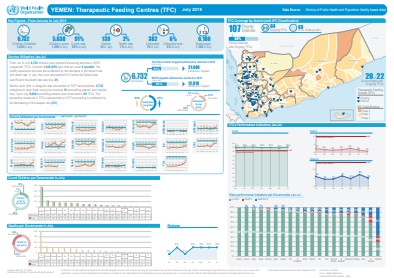 Therapeutic feeding centres dashboard, April 2020
Therapeutic feeding centres dashboard, March 2020
Therapeutic feeding centres dashboard, February 20220
Polio
Polio is caused by a virus and is highly contagious. It affects people differently — some don't feel sick at all, others complain of sore throat, fever, stomach pain or vomiting, stiff neck or headache. Oral polio vaccine has been recommended for use globally since 1963. The success of the OPV in curtailing polio epidemics and reducing or even eliminating the disease in endemic countries provides overwhelming evidence of the effectiveness of polio vaccines, in particular OPV. Vaccine efficacy was estimated at 82% after one dose, 96% after two doses and 98% after three or more doses.
Yemen has been polio free since 2006. In December 2019, WHO and UNICEF conducted a 3-day nationwide polio campaign to protect over 4 million children under the age of 5. The recent campaign covered 317 out of 333 districts and all 22 governorates across the country.
- During the campaign, around 4 538 861 (85%) children under-5 years of age received polio vaccine with the help of 18 133 house-to-house vaccination teams.
- 2572 fixed teams deployed in health facilities.
- vitamin A supplementation was also administered to children 6 months to 5 years of age.
- These teams were supervised by 4667 close supervisors (one close supervisors for 3–5 mobile teams, 630 district supervisors (2 per district).
- 132 governorate supervisors (6 per governorate).
- 680 supervisors from local authorities (2 per district and 2 per governorate).
- In addition to these 41 independent supervisors were deployed by WHO in various high-risk areas to support the district/governorate in training and implementation of campaign.
An independent post-campaign assessment was carried out and the preliminary results indicate an overall coverage of 91% with the lowest coverage in Say’oun (68%), Mokala (78%), Aden (79%) and Sana’a city (84%).
Preliminary results for national polio campaign, December 2019
Nutrition surveillance dashboard
The ongoing conflict and resulting economic crisis are the main drivers of food insecurity in Yemen leaving the country’s critical civil infrastructure in ruins. An estimated 20 million people are food insecure and almost a quarter of a million are on the brink of death from starvation if nothing is done soon. Children suffering from severe acute malnutrition with medical complications are the “sickest of the sick”. To save lives, WHO, in collaboration with local health authorities and its technical partner the World Bank, through the Emergency Health and Nutrition Project have established a surveillance system to find, refer and treat the “sickest of the sick”.
The surveillance system will prioritize and closely monitor communities at elevated risk of famine, because millions of people’s lives depend on it. The system is designed to find the lives we so desperately need to save.
Nutrition surveillance infographics
2020
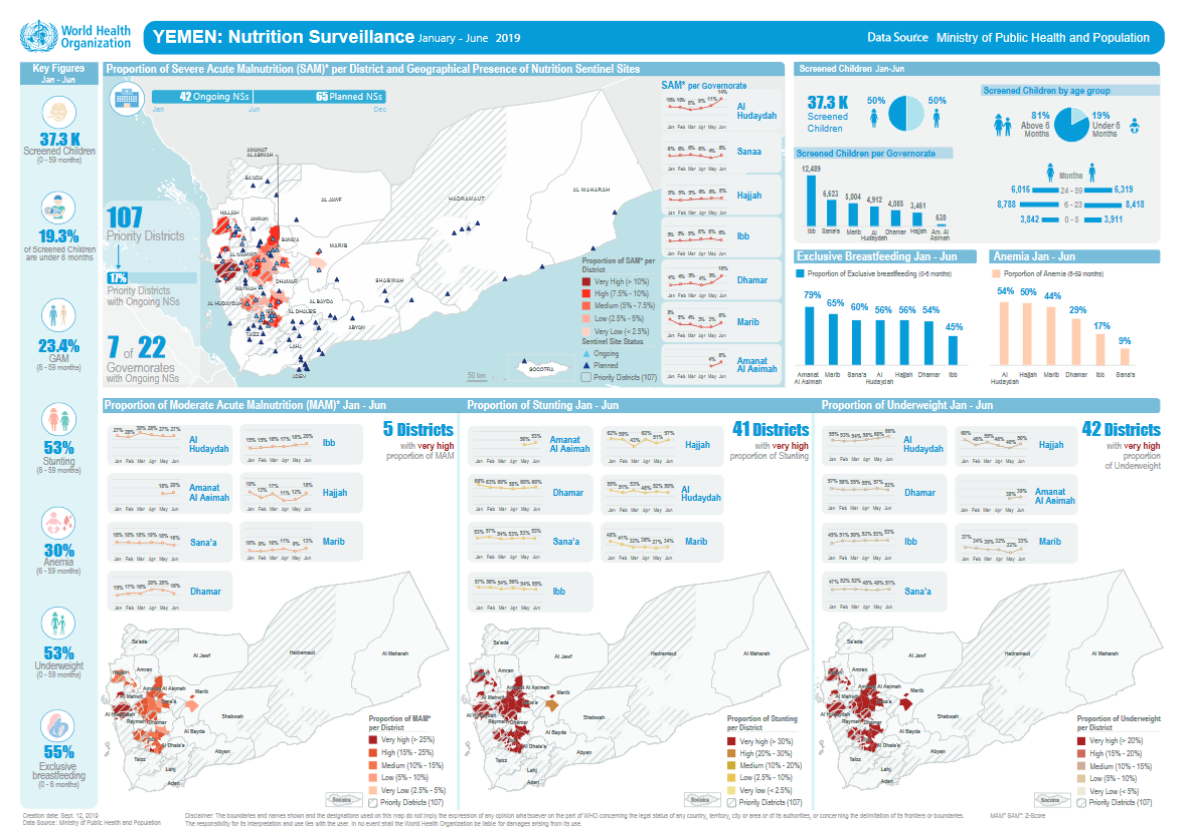 Nutrition surveillance dashboard, May 2020
Nutrition surveillance dashboard, March 2020
Nutrition surveillance dashboard, January–February 2020
2019
Nutrition surveillance dashboard, December 2019
Nutrition surveillance dashboard, November 2019
Nutrition surveillance dashboard, October 2019
Nutrition surveillance dashboard, September 2019
Nutrition surveillance dashboard, August 2019