

Select your language
WHO and partners working with national health authorities to contain disease outbreaks
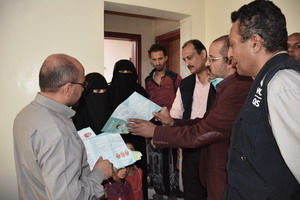 The initial response process includes case management and contact tracing and prevention activities, including water, sanitation and hygiene, and health and hygiene promotion. Photo: Sadeq Al-Wesabi13 June 2018 – Infectious disease outbreaks are a serious public health concern, posing a direct threat to families, especially children, in every home in Yemen. Emergency preparedness and response structures could mean the difference between life and death for many people. Through the quick mobilization of readily available teams, the number of people affected could be reduced and the spread of deadly diseases controlled.
In the midst of war and faced with a collapsing health system, WHO, national health authorities, along with local and international partners, have scaled-up their operations, through the establishment of rapid response teams (RRTs) in the fight against disease outbreaks. These teams are critical; investigating outbreaks and ensuring that prevention and control measures are rapidly executed to contain any infectious disease threat.
These multi-disciplinary teams comprise health care professionals each with a specific skillset, designed to rapidly detect and contain a potential outbreak before it has a chance to spiral out of control.
War and outbreaks
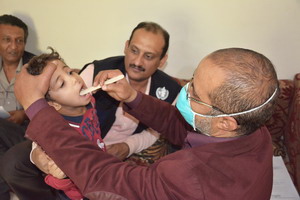 A rapid response team from Sana’a collects samples from symptomatic contacts after receiving an alert about a probable case of diphtheria. Photo: Sadeq Al-WesabiThe ongoing conflict has made the health situation worse, contributing to a rise in disease outbreaks across Yemen. In the hopes of arresting this, WHO supported the establishment of RRTs at the governorate level in all 22 governorates in 2016. By 2017, the number of RRTs increased to 331 available teams consisting of 1695 health workers in 331 out of the 333 districts in-country.
“These are difficult times and these dedicated health aid workers are making sure that vulnerable communities are provided with the assistance and protection they need against these highly pathogenic diseases,” says Dr Nevio Zagaria, Representative of WHO in Yemen.
The initial response process includes case management and contact tracing, prevention activities, including water, sanitation and hygiene, and health/hygiene promotion, collecting samples from symptomatic contacts and also testing samples collected from water sources to confirm the possibility of water contamination and identify the potential source of infection, and to confirm diagnosis, community engagement, social mobilization, and assessment.
In the event of an outbreak, the comprehensive approach ensures RRTs are able to mobilize resources and personnel to the affected area to prevent the further spread of disease.
The fight against cholera
As Yemen faces what is now known as the world’s largest cholera outbreak, these dedicated RRTs ensure that laser-focus on early detection, or the early identification of suspected cholera cases, and the investigation of the source are top priorities. The national epidemiological surveillance programme and WHO utilized the already established electronic integrated disease early warning system (eIDEWS) to support the early detection of suspected cholera. eIDEWS was initiated in 2013 as a pilot in 4 governorates (Aden, lahj, Abyan and Taiz) with a total 98 selected sites.
The eIDEWS is a surveillance and data collection program designed to rapidly detect potential outbreaks and public health threats at the earliest possible stages. The program then generates an alert in order to facilitate timely interventions and prompt response to help prevent or reduce the spread of the disease. These findings influence the response plan at district level, using essential findings from rapid assessments to formulate an informed and effective outbreak response.
The fight against cholera also resulted in the request of national health authorities for a way in which they could increase the mobility of RRTs to reach otherwise inaccessible areas in order to investigate and respond to reported outbreaks. This resulted in the procurement and planned distribution of 1000 motorbikes in Yemen.
“With disease outbreaks threatening the lives of millions of Yemeni people, an effective response relies heavily on the ability of RRTs to rapidly detect and investigate potential outbreaks. Early detection leads to timely interventions that save lives,” said Dr Zagaria.
WHO supports Yemeni health authorities to fight malaria
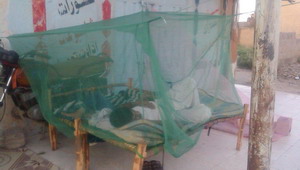 More than 21 million Yemenis lives in at-risk areas for malaria and nearly 7 million live in high-risk areas 26 April 2018 – With World Bank funding, the World Health Organization (WHO) continues to support Yemen’s health authorities to fight malaria and avoid potential setbacks.
More than 21 million Yemenis lives in at-risk areas for malaria, and nearly 7 million live in high-risk areas mostly in the coastal plains of western governorates and some areas in southern governorates. Yemen is suffering from a complex humanitarian crisis; the ongoing conflict has displaced some 1.6 million people to malaria endemic areas.
High rates of malnutrition have increased the risk of vulnerable groups contracting malaria, especially children under 5 and pregnant women, due to their low immune systems. This is a deadly combination.
“Despite conflict and population movement to malaria endemic areas, WHO and Yemeni health authorities have contributed substantially to ensure that those at risk of malaria have access to malaria control and prevention services,” said Dr Nevio Zagaria, WHO Representative in Yemen.
“Yemen has achieved a decline of malaria prevalence over the past 15 years. However, any setback in progress made so far is threatened, if malaria control and prevention efforts by WHO and its partners cannot continue.”
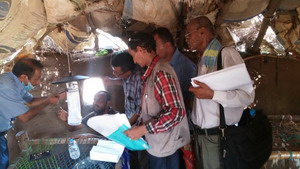 WHO supports health authorities and partners in the development of malaria epidemic detection preparedness and response at district levelIn 2017, the World Bank supported WHO with more than US$ 2 million to strengthen vector control interventions in Yemen. Sustaining improved malaria control is a direct result of support by WHO and health partners, like the World Bank. Efforts include distributing long-lasting insecticidal bed nets, introducing updated case management policies based on WHO standards and guidelines, and scaling up diagnostic testing through rapid diagnostic tests and microscopy.
In 2017, WHO facilitated the transportation of 1.5 million bednets to 76 districts in Yemen. This increased the bender coverage to an estimated 3 million people in 8 governorates. Also together with UNICEF, it supported the implementation of an indoor residual spraying campaign providing protection to 1.3 million people against malaria.
In terms of capacity building, 15 training courses targeting 297 medical doctors and health workers on the clinical management of malaria were also conducted.
Universal access to diagnosis and treatment
WHO is also supporting universal access to malaria diagnosis and treatment in all of Yemen’s governorates. Over the past two years, WHO distributed 1137 basic and supplementary malaria kits which enabled health facilities to test 941 600 patients for malaria by rapid diagnostic tests, which led to the identification and treatment of at least 402 110 malaria cases.
Financing for malaria control and prevention in Yemen is dependent on sufficient funding and strong health partnerships that have been hampered by the ongoing conflict. WHO is working with health partners to avoid any interruption of malaria life-saving activities.
“Without rapid response measures, proper case management and proper surveillance, many areas in the country may be prone to malaria outbreaks. WHO has scaled up its support to respond in curbing any possible surge in cases,” Dr Zagaria continued.
WHO plans to support health authorities and partners in the development of malaria epidemic detection, preparedness, and response at district level. Major activities in 2018 include vector control campaigns targeting 2 million people at risk of malaria in western and southern governorates and strengthening the entomological surveillance in 16 vector control sites.
Workshop on neglected tropical diseases concludes in Sana’a, Yemen
Sana’a 6 August 2017— The World Health Organization (WHO) has held a workshop on neglected tropical diseases bringing together 30 participants from the Yemeni health authorities and academia.
Participants in the 3-day workshop reviewed the current spread of neglected tropical diseases across the country, discussed challenges and identified the key public health interventions required to control and eliminate these diseases.
The workshop will inform the development of a master plan for neglected tropical diseases in Yemen, a key reference document highlighting national policies to address the burden of neglected tropical diseases. The master plan aims to guide action and coordination and to serve as a fundraising platform.
Yemen is affected by several neglected tropical diseases. The health staff and experts who participated in the workshop are working on a wide range of conditions such as leprosy, trachoma, schistosomiasis, onchocerciasis, lymphatic filariasis, leishmaniasis, rabies, dengue, chikungunya and scabies. The 30-month-long conflict in Yemen has resulted in an increase in the spread of some neglected tropical diseases such as rabies, leishmaniasis and dengue, and has created additional challenges in implementing control measures.
Over the past 10 years, the local health authorities, with support from WHO, have strengthened their commitment to addressing the major neglected tropical diseases affecting the people of Yemen and have implemented public health interventions to this effect. Notably, large-scale treatment for schistosomiasis has been carried out regularly since 2008 and has contributed to major reductions in the burden of the parasitic disease.