

Sélectionnez votre langue

Somalia’s polio teams help combat COVID-19
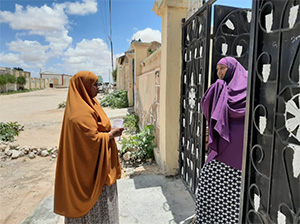 Polio programme staff are conducting disease surveillance for COVID-19 as well as educating communities on the symptoms of the virus, how to prevent transmission, and how to report suspected cases. ©WHO/Somalia4 May 2020 – “The road to the mountain village was rough. It’s only 50 kilometres, but it took more than 3 hours,” says Dr Fatima Ismail, a disease surveillance officer working in Somaliland. “We were bouncing in the car.”
In early 2020, Dr Fatima’s team headed to a remote village near Djibouti to check on a small boy. The boy’s right arm and leg showed a kind of paralysis that sometimes indicates polio. “The village polio volunteer in this mountainous area, geographically inaccessible, found an acute flaccid paralysis (AFP) case,” Dr Fatima remembers.
When children show signs of this paralysis, it’s critical to get stool samples to a laboratory to determine whether they have polio. Polio teams ride camels in the desert or donkeys in the mountains when they have to. They brave bombs to get samples out of conflict zones to laboratories. In brutally hot climates, they plug mini-freezers into car dashboards to keep samples cool.
All over the world, polio surveillance systems that have been built up over decades track infection sources, evaluate symptoms and transport samples to the laboratory — despite distance, natural disasters, and sometimes war. Now, this network of disease surveillance — reaching into the most far-flung corners of the globe — is being tapped to address the COVID-19 pandemic.
“In Somalia, the polio programme pivoted its workforce of thousands of frontline staff to support the effort as the cases of COVID-19 spread. Rapid response teams — made up of disease surveillance officers, community health care workers and volunteers — were trained to educate people about the virus and to test suspected cases. By April 2020, the teams were deployed in the field,” said Dr Mamunur Malik, WHO Representative in Somalia.
Polio eradication staff support COVID-19 response
April 2020 – Using the vast infrastructure developed to identify the poliovirus and deliver vaccination campaigns, the polio eradication programme is pitching in to protect the vulnerable from COVID-19, especially in polio-endemic countries. In Pakistan and Afghanistan, as well as worldwide, the programme is drawing on years of experience fighting outbreaks to support governments as they respond to the new virus.
Tracking the poliovirus in the Eastern Mediterranean Region
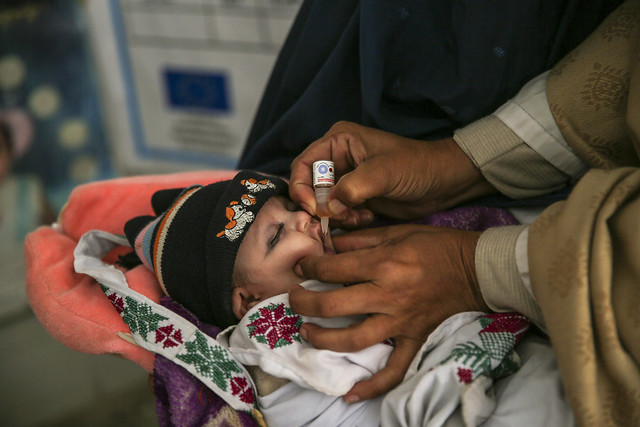 Majra Bibi gives polio drops to 10-day-old Bilal Khan at a health unit in Khyber Pakhtunkhwa province, Pakistan. The polio programme works to vaccinate every child and detect the poliovirus wherever it remains. ©WHO/Asad Zaidi
12 November 2019 -- In a rapidly expanding megacity, amongst conflict or in mountainous border areas, how does the polio programme deduce where the virus is hiding?
To eradicate the poliovirus, every child must be vaccinated. We must also detect where virus remains. The two key methods used to do this are acute flaccid paralysis (AFP) surveillance, which alerts the programme to children exhibiting the key sign and symptom of polio, and environmental surveillance, which is used to detect the poliovirus in the sewage water systems of communities. But the most skilled disease surveillance officers can go one step further.
By cross referencing AFP and environmental surveillance data with data on immunization activities, population movements and high-risk populations, surveillance officers can learn to interpret the poliovirus risk in the countries where they work. Through painstakingly piecing these clues together, they can determine where there may be a high chance of polio re-appearing.
Disease surveillance officers and data managers from across the Eastern Mediterranean Region came together across a series of workshops held in September and October 2019, to learn how to use QGIS mapping software to record the clues that help the polio programme determine where the virus could circulate. Representatives attended from many member states in the region, three levels of the World Health Organization (WHO), and from CDC STOP, the Eastern Mediterranean Public Health Network, the VPI WHO EMR team, and the UNICEF MENA Regional Office.
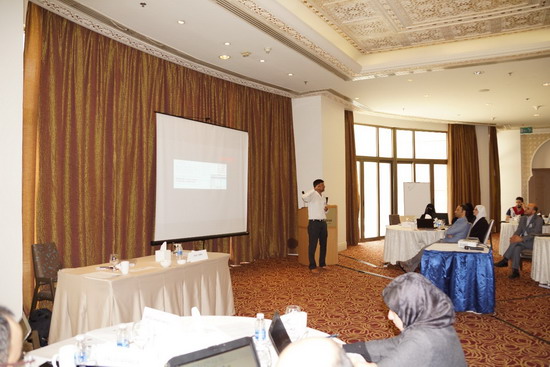 GIS and Mapping expert Ravi Santhana Gopala Krishnan presents aspects of QGIS to meeting participants. ©WHO/EMRO
QGIS is a powerful open-source Geographic Information System that supports editing, storing, analysing and displaying diverse geospatial data. The workshop taught the officers to use QGIS and mapping services in addition to other risk assessment tools to provide decision makers with a clear picture of country surveillance indicators, AFP cases, the geographical reach of routine and supplementary immunization activities, and data on accessibility and the movement of high-risk populations.
Information can be layered in QGIS to create a highly detailed virtual map with key indicators and risks for disease spread. For instance, it would allow programme officers to spot a high-risk area where there is a low level of AFP reporting, where there is high population movement, and where few vaccination campaigns have been carried out and children have low immunity to the virus.
In other words, the maps allow real time analysis of outbreak risk. This information can then be used to strategize upcoming supplementary immunization campaigns and technical surge support or make recommendations to improve programme performance.
QGIS is free, works on mobile phones, and does not require a license, making it ideal for use in resource-poor contexts where the expensive licenses required for other GIS applications are not a viable option for some users.
The workshop ultimately aimed to empower surveillance officers and data managers to create maps that will help them to spot areas of concern and develop mitigation strategies. They learnt how to overcome common challenges, for instance, how to reconcile data sets created in different programmes, and how to treat data that arrives without a dedicated GPS coordinate.
This training is just one strategy to improve our ability to prevent outbreaks and stay ahead of the virus, in some of the most challenging epidemiological contexts in the world.
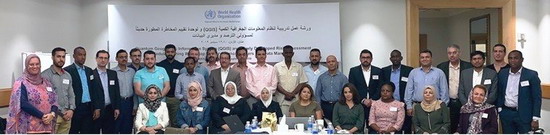 Participants at the first QGIS training, held in September 2019. ©WHO/EMRO
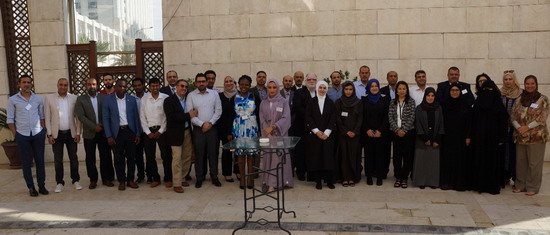 Participants at the second QGIS training, held in October 2019. ©WHO/EMRO
Related link
Out-running polio: an ultra-marathon runner’s dedication
Ala Baydoun dedicates her ultra-marathon run in Jordan to raise awareness in the final fight against polio
 Ala Baydoun runs through the Jordanian desert in the Rum International Marathon. Ala dedicated her run to raise awareness for polio eradication. Photo: Ali Barqawi22 January 2018 – It’s just after 6am on a Friday morning in Petra, one of Jordan’s ancient southern cities. Ala Baydoun ties her shoe laces with an extra secure knot as she prepares for what is no normal run. It’s the first day of her weekend and Ala will run for 100km to Wadi Rum in an Ultra Marathon, an effort that she’s dedicated to polio eradication.
Taking her position at the starting line, she looks calm and collected, despite the high altitude and the 8 km of hilly terrain immediately ahead of her.
After a grueling 14-hour run, through the desert, Ala crosses the finish line in second place and cuts more than 2 hours off her personal best time.
“I was injured and wasn’t sure I would finish the race, but I beat my time from last race! As runners we are so cautious of seconds, so to say that I cut 2 hours off is a big deal.”
Ala works for the World Health Organization and says that dedicating the run to ‘end polio’ was important to her.
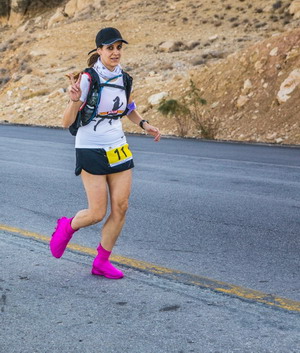 Ala hits the pavement every day running anywhere between 10 and 15 kilometres in Amman, Jordan. On a Friday she’ll run between 30 and 35 km. She dedicated her run in the Rum International Marathon to ending polio. Photo: Ali Barqawi“We haven’t seen polio in Jordan now for many years, but it remains a risk because it continues to circulate in countries in the Region. I work with a team of people who are very dedicated to finally ending polio around the world, and I know we are so close. This was a way that I could continue to raise awareness around this cause,” she says.
A born runner, Ala hits the pavement every day running anywhere between 10 and 15 kilometres in Amman. On a Friday she’ll run between 30 and 35 km outside the city, which she says is partly out of love and partly to train.
“I’m a road runner by obligation because it’s too far to travel to run regularly in the desert, and completing trail runs in Jordan can be dangerous for a woman running solo. Basically I’d need a group of men running with me and that’s not always possible, nor is it practical.”
This isn’t Ala’s first ultra-marathon and certainly not her first time running through the desert. She’s competed in a number of races and running events in Jordan and overseas, inspired often by her marathon-running father. “Running is in my blood,” she says.
“I remember the first time I started running, when I was about 12 years old and I couldn’t complete 3 kilometres with him. But then we started going out every day, and quickly I got faster and realized how much I loved it.”
Now, she says, that love of running is what keeps her motivated on the big runs.
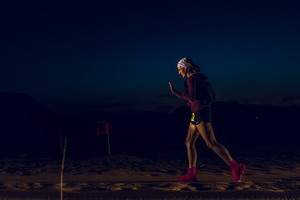 Ala says the runners high, when the endorphins kick in’ is what keeps her motivated to keep running during big running events. She placed second in the Rum International Marathon. Photo. Ali Barqawi“You have to motivate yourself, because you’re in the middle of nowhere, often alone. One negative thought in that environment can really derail you. And you’re not only thinking about keeping motivated and positive, you’ve also got other things to be thinking about…like there are stray dogs in the desert and running in the sand requires so much more effort,” she says.
But she says adrenaline can do wonders. “It’s called the runners high, when the endorphins kick in. I can get into a zone where I totally forget that the lower part of my body is moving. It’s a dream state or something, I don’t know how to explain it”
Besides, Ala says, when you have a strong will and you’re running with a purpose and for a purpose, that’s what will get you over the finish line.
“I don’t want to see more kids paralysed by this disease in my lifetime, so I ran for polio, hoping with every step that we see an end to it very soon.”
