

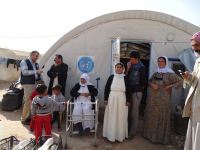
 Basy Murad, siting in front of her tent, standing next to her are her daughter, daughter-in-law, gran son, and to the left her grandchildren and son, Ahmed Hussein, and WHO staff. Photo credit: WHO/P AjelloIraq, 11 November, 2014 – Madam Basy Murad, a 70-year-old mother of five, received a wheelchair from WHO. This is important for her because for over one and half months Basy has spent her time inside a makeshift tent in Bajet Kandela camp.
Basy is a beneficiary of one of the 58 wheelchairs donated by WHO, and funded by Saudi Arabia, to Duhok Directorate of Health. This wheelchair has enabled ease her mobility in and outside of her house and has lessened the burden of her caretakers. “Before getting this whee chair I spent 40 days inside my tent with no opportunity of seeing the sun and other people other than my close family members, I was also unable to move within the space of my tent, but the day I received this wheelchair, members of my family immediately wheeled me out of bed and I managed to see the sun again after a long time; I cannot express the gratitude that I have,” said Basy.
Her son, Ahmed Hussein Khalaf, with whom Basy lives with, says life is much easier now with the donation of the wheelchair. “I used to find it extremely hard to move my mother to the health facility, I always looked out for the support of my neighbours to assist me lift her to the health facility using a blanket; it was a nightmare, I developed backache and I was reluctant to seek help from my neighbours sometimes, this is a big relief,” Ahmed says.
He says that the wheelchair has psychologically helped to enhance the health of his mother, making them a happy family. “Thank you so much for this support WHO,” he adds.
Basy Murad suffers from cerebral vascular accident; a medical term for a stroke, this among other symptoms made her unable to walk. She is a displaced Yazidi from Sinjar who managed to flee the area into Bajet Kandela with the support of her son Ahmed.
Accessibility to basic services in internally displaced people’s camps is challenging for people with mobility issues. Measures to make sure that these people have equal access to health and social facilities is essential to WHO. In less resourced settings, the Organization supports the Ministry of Health to fill some missing gaps. WHO provided wheelchairs to ease this mobility as a step towards the implementation of the Convention of the Rights of Persons with Disabilities related to personal mobility.
Related link
Convention on the Rights of Persons with Disabilities