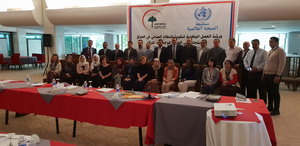
 27 November 2018 – The Iraqi Ministry of Health, in collaboration with WHO and the United Nations Population Fund (UNFPA), have trained more than 50 health professionals from national and governorate levels on the response to gender-based violence against women and girls.
The two events took place in Baghdad and Erbil from 11 to 15 November 2018. The training focused on violence against women and girls that is aggravated by humanitarian emergencies where vulnerability and risks are higher, as well as the different forms of gender-based violence and identifying concrete action. Others topics addressed included the use of guidelines and tools to strengthen the capacity of the health system to respond to gender-based violence against women and girls, the results of mapping tools, and statistics on violence in Iraq by an intimate partner.
“Almost all violence is predictable and preventable. Early identification and interventions are key to preventing violence; this requires a holistic, multi-systems approach, starting with the health sector. WHO is committed to supporting with the Government of Iraq, health partners and all concerned stakeholders to address this problem while ensuring that all victims of violence get access to medical care,” said Dr Adham Ismail, the acting WHO Representative in Iraq.
“In emergencies, gender-based violence for women and girls is a public health threat. In Iraq, the conflict has significantly increased this threat. Hence, WHO, UNFPA and other partners have increased their focus towards eliminating this inhuman act,” added Dr Adham.
Violence has a significant negative impact on women and girls’ lives and on society overall. It puts a strain on the minimal available resources, which could be supporting other critical life-saving interventions. Gender-based violence against women and girls has many consequences, including physical injuries, noncommunicable diseases, mental distress and long-term mental illness, and its impact on reproductive health, all of which are seen in health care facilities as the first point of contact and a key entry point to the referral pathway to other sectors.
For more information please contact:
World Health Organization, Iraq Country Office
Ms Pauline Ajello
Email: This email address is being protected from spambots. You need JavaScript enabled to view it.
Tel: +9510101460
Ms G. AlMayahi
Email: This email address is being protected from spambots. You need JavaScript enabled to view it.
Tel: +964 782 788 6765
27 November 2018 – The Iraqi Ministry of Health, in collaboration with WHO and the United Nations Population Fund (UNFPA), have trained more than 50 health professionals from national and governorate levels on the response to gender-based violence against women and girls.
The two events took place in Baghdad and Erbil from 11 to 15 November 2018. The training focused on violence against women and girls that is aggravated by humanitarian emergencies where vulnerability and risks are higher, as well as the different forms of gender-based violence and identifying concrete action. Others topics addressed included the use of guidelines and tools to strengthen the capacity of the health system to respond to gender-based violence against women and girls, the results of mapping tools, and statistics on violence in Iraq by an intimate partner.
“Almost all violence is predictable and preventable. Early identification and interventions are key to preventing violence; this requires a holistic, multi-systems approach, starting with the health sector. WHO is committed to supporting with the Government of Iraq, health partners and all concerned stakeholders to address this problem while ensuring that all victims of violence get access to medical care,” said Dr Adham Ismail, the acting WHO Representative in Iraq.
“In emergencies, gender-based violence for women and girls is a public health threat. In Iraq, the conflict has significantly increased this threat. Hence, WHO, UNFPA and other partners have increased their focus towards eliminating this inhuman act,” added Dr Adham.
Violence has a significant negative impact on women and girls’ lives and on society overall. It puts a strain on the minimal available resources, which could be supporting other critical life-saving interventions. Gender-based violence against women and girls has many consequences, including physical injuries, noncommunicable diseases, mental distress and long-term mental illness, and its impact on reproductive health, all of which are seen in health care facilities as the first point of contact and a key entry point to the referral pathway to other sectors.
For more information please contact:
World Health Organization, Iraq Country Office
Ms Pauline Ajello
Email: This email address is being protected from spambots. You need JavaScript enabled to view it.
Tel: +9510101460
Ms G. AlMayahi
Email: This email address is being protected from spambots. You need JavaScript enabled to view it.
Tel: +964 782 788 6765