




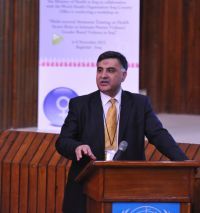
 Iraq's Parliament is the first legislative institution to further study the situation of violence against women in IraqThe Ministry of Health of Iraq, in collaboration with WHO, conducted two major events between 6 and 8 November 2012 in Baghdad. The first was the launch of the WHO mapping results of the multisectoral response to intimate partner violence/gender-based violence tool, and the second on multisectoral awareness training on health sector roles in intimate partner violence/gender-based violence in Iraq.
The objective of the events was to share the results of the mapping tool which has been developed for the purpose of promoting intersectoral coordination on intimate partner violence/gender-based violence in Iraq and raise awareness of the crucial role of the health sector in primary and secondary response to these types of violence.
H.E Dr Liqa Al Yassin, Head of the Health and Environment Committee in the Iraqi Parliament, highlighted during the opening session that “ Violence against women is present in all societies and has no religion, race or identity”. Dr Al Yassin reaffirmed the commitment of the Iraqi Parliament as the first legislative institution to further study the situation of violence against women in Iraq, as well as the importance of opening the way for research and field surveys to arrive at durable solutions for both the preventive and protective aspects of violence against women.
Mr Jim Parsaingram, Acting Resident Coordinator of the United Nations Assistance Mission in Iraq (UNAMI), confirmed, “It is crucial to raise awareness to combat all types of violence and highlighting the necessity of uniting all efforts to bring actions in this area to success”.
“Gender and violence are cross-cutting issues” said the WHO Iraq Representative Dr Syed Jaffar Hussain and emphasized further that, “As the UN, we will exert all efforts to support national governmental and nongovernmental institutions involved in this area to move forward with their action towards future strategic visions and planning”, Dr Syed Jaffar added.
Ms Juan Akram Amin, Representative for the State Minister for Women’s Affairs on behalf of the Minister, shared that, “Women are exposed to violence of different kinds all over the world, as well as in Iraq” and confirmed that the Ministry, in collaboration with all related ministries and UN agencies, are working together to implement the national women’s strategy as part of its efforts towards protecting women from violence and advancing the situation of Iraqi women.
All participants agreed on the importance of strengthening efforts towards ending gender-based violence, and particularly violence targeting Iraqi women, and that can only be achieved through coordinating efforts via the utilization of a multisectoral approach involving all related stakeholders in this sensitive issue. A list of recommendations was formulated outlining the next steps of each sector in its plans to work collectively on strengthening Iraqi women against being violated (on the domestic/familial, educational, work and societal levels).
The meetings were conducted in the presence of 30 health professionals representing Parliamentarian Committees of Health and Environment, Women and Child and Education and Higher Education along with line ministries and educational institutions, in addition to representatives from local nongovernmental organizations and sister UN agencies.