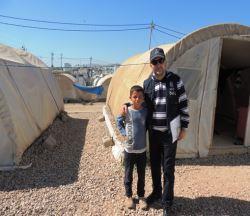
 Member of TB review team at Essyan camp for internally displaced YezidisBaghdad, 13 March – An international review of the national tuberculosis control programme of Iraq was commissioned to take an in-depth look at the performance of the programme within the context of the rising incidence of large-scale internal displacement and declining socioeconomic conditions now existing in the country.
The international review team has just concluded field missions to examine the performance of the national TB control programme in 6 of the 19 governorates in the country. Governorates covered by the review included areas with a high case load of internally displaced persons and Syrian refugees. An estimated 3.3 million people in Iraq are estimated by the United Nations to be internally displaced and over 7 million are considered to be in dire need to health and socioconomic services.
The review of the national TB progamme was commissioned by the WHO's Iraq country office TB programme, in collaboration with the WHO Regional Office in Cairo and the national TB programme.
The Secretariat was led by Dr Paul Nunn, a renowned international infectious diseases expert, and comprised a 5-member interdisciplinary team of well-known TB practitioners, microbiologists, field workers and communication, advocacy and public outreach experts.
Over 50 top TB practitioners from all 19 governorates and the federal TB programme, as well as partners from the international community, including International Organization for Migration and the United Nations Development Programme participated in the review.
Findings focused on progress made in TB case detection and estimation, the state of laboratory services, progress in building strong public–private partnerships in addressing issues of stigma associated with the disease and achieving internationally and nationally agreed TB control and prevention goals. The review examined the impact of declining national budgets for human resources for health and TB control and technical capacities needed to fight TB in Iraq.
Related link
WHO calls on countries and partners to "Unite to End Tuberculosis"
Member of TB review team at Essyan camp for internally displaced YezidisBaghdad, 13 March – An international review of the national tuberculosis control programme of Iraq was commissioned to take an in-depth look at the performance of the programme within the context of the rising incidence of large-scale internal displacement and declining socioeconomic conditions now existing in the country.
The international review team has just concluded field missions to examine the performance of the national TB control programme in 6 of the 19 governorates in the country. Governorates covered by the review included areas with a high case load of internally displaced persons and Syrian refugees. An estimated 3.3 million people in Iraq are estimated by the United Nations to be internally displaced and over 7 million are considered to be in dire need to health and socioconomic services.
The review of the national TB progamme was commissioned by the WHO's Iraq country office TB programme, in collaboration with the WHO Regional Office in Cairo and the national TB programme.
The Secretariat was led by Dr Paul Nunn, a renowned international infectious diseases expert, and comprised a 5-member interdisciplinary team of well-known TB practitioners, microbiologists, field workers and communication, advocacy and public outreach experts.
Over 50 top TB practitioners from all 19 governorates and the federal TB programme, as well as partners from the international community, including International Organization for Migration and the United Nations Development Programme participated in the review.
Findings focused on progress made in TB case detection and estimation, the state of laboratory services, progress in building strong public–private partnerships in addressing issues of stigma associated with the disease and achieving internationally and nationally agreed TB control and prevention goals. The review examined the impact of declining national budgets for human resources for health and TB control and technical capacities needed to fight TB in Iraq.
Related link
WHO calls on countries and partners to "Unite to End Tuberculosis"