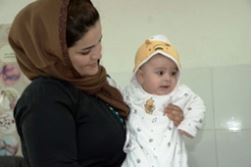
 A mother brings her 6-month-old daughter to be vaccinated against polio understanding that immunization provides the greatest protection against the most dangerous childhood diseases 2 March, 2016, Baghdad – The first round of the 2016 nationwide polio vaccination campaign started this week in Iraq on 28 February. The campaign will last until 3 March. About 26 000 workers and 406 vaccinators will immunize nearly 6 million children across the entire country.
In May 2015, Iraq was removed from the list of polio-infected countries, a landmark achieved by the Ministry of Health with the continued support of WHO, UNICEF and multiple partners in the Global Polio Eradication Initiative. This achievement has been attributed to the efforts of frontline polio workers under the leadership of the Ministry of Health. They have conducted a house-to-house campaign to deliver oral polio vaccine to children despite the dire security situation. The Ministry of Health plans to implement 4 national polio immunization days in 2016 in order that Iraq retains its polio-free status.
The present campaign takes place 8 weeks before the globally synchronized withdrawal of the type 2 component of the oral polio vaccine, as outlined in the Polio Eradication and Endgame Strategic Plan 2013–2018. Iraq will switch from trivalent oral polio vaccine to bivalent oral polio vaccine on 30 April 2016. In October 2015, the Global Certification Commission declared eradication of poliovirus type 2. The bivalent vaccine is more effective, and since no type 2 wild poliovirus exits—the last case was detected in 1999—there is no need to immunize against that strain.
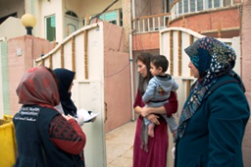 A WHO team visits Serhaladan quarter in Duhok providing information to parents on the vaccination campaign and distributing health promotion and informational materialsThe Ministry of Health, WHO and UNICEF are closely collaborating in the current polio vaccination campaign to cover 5.8 million children under 5 years of age. A total of 26 000 workers are engaged by the Ministry of Health and Departments of Health at national and subnational levels. The aim is to reach at least 95% vaccination coverage, verified by finger-marking in the post-campaign independent assessment by volunteers of the Iraqi Red Crescent Society.
Community influencers, elders and members of civic society are urged to support polio vaccination teams in reaching every single child and to report to the nearest primary health care centre in case vaccination teams do not reach their home by 3 March 2016.
“Iraq is a polio-free country and WHO actively contributes to transition planning discussions, globally and at the country level, to help Iraq to be synchronized with the polio endgame strategy,” said acting WHO Representative Altaf Musani.
“Childhood vaccinations are one of the most effective health interventions available. The polio endgame strategy will not only ensure that children are free forever from this terrible disease, but also help strengthen systems to deliver routine immunization, especially to the most deprived and vulnerable children,” added UNICEF Iraq Representative Peter Hawkins.
For more information, please contact:
Ms Rosane Lopes
Communications Officer
World Health Organization
Iraq country office
This email address is being protected from spambots. You need JavaScript enabled to view it.
+964 7809 288 614
Ms Ajyal Sultany
Communications Officer
World Health Organization
Iraq country office
This email address is being protected from spambots. You need JavaScript enabled to view it.
+964 7510 101 469
Mr Jeffrey Bates
Chief of Communications
UNICEF Iraq
This email address is being protected from spambots. You need JavaScript enabled to view it.
+964 780 196 4524
Mr Karim Elkorany
Communications Specialist
UNICEF Iraq
This email address is being protected from spambots. You need JavaScript enabled to view it.
+964 780 925 8542
Related links
Polio Eradication Initiative
UNICEF – Eradicating polio
Polio Eradication and Endgame Strategic Plan 2013–2018
More on polio
A mother brings her 6-month-old daughter to be vaccinated against polio understanding that immunization provides the greatest protection against the most dangerous childhood diseases 2 March, 2016, Baghdad – The first round of the 2016 nationwide polio vaccination campaign started this week in Iraq on 28 February. The campaign will last until 3 March. About 26 000 workers and 406 vaccinators will immunize nearly 6 million children across the entire country.
In May 2015, Iraq was removed from the list of polio-infected countries, a landmark achieved by the Ministry of Health with the continued support of WHO, UNICEF and multiple partners in the Global Polio Eradication Initiative. This achievement has been attributed to the efforts of frontline polio workers under the leadership of the Ministry of Health. They have conducted a house-to-house campaign to deliver oral polio vaccine to children despite the dire security situation. The Ministry of Health plans to implement 4 national polio immunization days in 2016 in order that Iraq retains its polio-free status.
The present campaign takes place 8 weeks before the globally synchronized withdrawal of the type 2 component of the oral polio vaccine, as outlined in the Polio Eradication and Endgame Strategic Plan 2013–2018. Iraq will switch from trivalent oral polio vaccine to bivalent oral polio vaccine on 30 April 2016. In October 2015, the Global Certification Commission declared eradication of poliovirus type 2. The bivalent vaccine is more effective, and since no type 2 wild poliovirus exits—the last case was detected in 1999—there is no need to immunize against that strain.
A WHO team visits Serhaladan quarter in Duhok providing information to parents on the vaccination campaign and distributing health promotion and informational materialsThe Ministry of Health, WHO and UNICEF are closely collaborating in the current polio vaccination campaign to cover 5.8 million children under 5 years of age. A total of 26 000 workers are engaged by the Ministry of Health and Departments of Health at national and subnational levels. The aim is to reach at least 95% vaccination coverage, verified by finger-marking in the post-campaign independent assessment by volunteers of the Iraqi Red Crescent Society.
Community influencers, elders and members of civic society are urged to support polio vaccination teams in reaching every single child and to report to the nearest primary health care centre in case vaccination teams do not reach their home by 3 March 2016.
“Iraq is a polio-free country and WHO actively contributes to transition planning discussions, globally and at the country level, to help Iraq to be synchronized with the polio endgame strategy,” said acting WHO Representative Altaf Musani.
“Childhood vaccinations are one of the most effective health interventions available. The polio endgame strategy will not only ensure that children are free forever from this terrible disease, but also help strengthen systems to deliver routine immunization, especially to the most deprived and vulnerable children,” added UNICEF Iraq Representative Peter Hawkins.
For more information, please contact:
Ms Rosane Lopes
Communications Officer
World Health Organization
Iraq country office
This email address is being protected from spambots. You need JavaScript enabled to view it.
+964 7809 288 614
Ms Ajyal Sultany
Communications Officer
World Health Organization
Iraq country office
This email address is being protected from spambots. You need JavaScript enabled to view it.
+964 7510 101 469
Mr Jeffrey Bates
Chief of Communications
UNICEF Iraq
This email address is being protected from spambots. You need JavaScript enabled to view it.
+964 780 196 4524
Mr Karim Elkorany
Communications Specialist
UNICEF Iraq
This email address is being protected from spambots. You need JavaScript enabled to view it.
+964 780 925 8542
Related links
Polio Eradication Initiative
UNICEF – Eradicating polio
Polio Eradication and Endgame Strategic Plan 2013–2018
More on polio