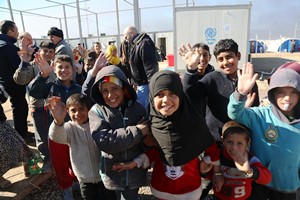
 Smiling faces of children in Qayyara internally displaced persons camp29 January 2017 – WHO,UNICEF and partners are working with Ministry of Health in Iraq to ensure that more than 6 million children, including those in newly liberated areas in Mosul are protected against polio.
“Insecurity denied my children the opportunity to be vaccinated, and to receive health services,” says Safia Ali, an internally displaced person in Qayyarah camp, south of Mosul. For several months, Safia’s 3 children were unable to receive vaccination services in the conflict-affected district of Mosul.
To escape the violence, Safia and her children walked for 8 days, sometimes through mined areas until they reached safety in Qayyarah internally displaced persons camp. Although her children were not vaccinated on arrival, an initiative that WHO, UNICEF and the Directorate of Health are working to address, Safia’s children were vaccinated against polio during the emergency campaign that took place in December 2016, reaching more than 700 000 and 540 000 children with polio and measles vaccines, respectively, in the newly accessible areas of Mosul and surrounding districts.
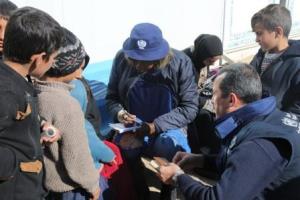 WHO staff interviews Safia a lady displaced from Mosul. Standing next to her are her children“I know the value of vaccinating my children because this protects them from many diseases like polio. It’s only until about a month ago that I managed to get them vaccinated,” says Safia Ali.
Like Safia, many parents are faced with fears of having their children exposed to disease outbreaks due to lack of vaccination in areas like Mosul and others where health services are limited.
WHO, UNICEF and partners will continue working with the government of Iraq to ensure that all children are reached. Health authorities aim to conduct several vaccination campaigns in 2017 reaching over 6 million in Iraq and 600 000 in Mosul in order to sustain Iraq’s polio-free status. And to sustain its gains, Iraq with the support of WHO are expanding disease surveillance in newly accessible areas for acute flaccid paralysis cases in order to rapidly detect and respond to any suspected polio cases.
Related link
Polio Eradication Initaitive
Smiling faces of children in Qayyara internally displaced persons camp29 January 2017 – WHO,UNICEF and partners are working with Ministry of Health in Iraq to ensure that more than 6 million children, including those in newly liberated areas in Mosul are protected against polio.
“Insecurity denied my children the opportunity to be vaccinated, and to receive health services,” says Safia Ali, an internally displaced person in Qayyarah camp, south of Mosul. For several months, Safia’s 3 children were unable to receive vaccination services in the conflict-affected district of Mosul.
To escape the violence, Safia and her children walked for 8 days, sometimes through mined areas until they reached safety in Qayyarah internally displaced persons camp. Although her children were not vaccinated on arrival, an initiative that WHO, UNICEF and the Directorate of Health are working to address, Safia’s children were vaccinated against polio during the emergency campaign that took place in December 2016, reaching more than 700 000 and 540 000 children with polio and measles vaccines, respectively, in the newly accessible areas of Mosul and surrounding districts.
WHO staff interviews Safia a lady displaced from Mosul. Standing next to her are her children“I know the value of vaccinating my children because this protects them from many diseases like polio. It’s only until about a month ago that I managed to get them vaccinated,” says Safia Ali.
Like Safia, many parents are faced with fears of having their children exposed to disease outbreaks due to lack of vaccination in areas like Mosul and others where health services are limited.
WHO, UNICEF and partners will continue working with the government of Iraq to ensure that all children are reached. Health authorities aim to conduct several vaccination campaigns in 2017 reaching over 6 million in Iraq and 600 000 in Mosul in order to sustain Iraq’s polio-free status. And to sustain its gains, Iraq with the support of WHO are expanding disease surveillance in newly accessible areas for acute flaccid paralysis cases in order to rapidly detect and respond to any suspected polio cases.
Related link
Polio Eradication Initaitive