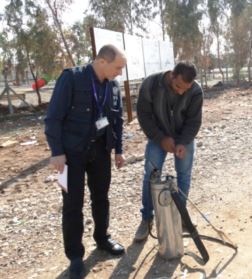
 The team make final adjustments before leaving to conduct fieldworkBaghdad, 19 November, 2015 – On a sunny day after weeks of rain in Iraq, Saher, Aqeel, Faris and Ahmed resume their spraying of all the houses in Baraka IDP camp. The team has been working together for 4 years, 3 years in Mosul and last year in 6 camps near Erbil. Their work consists of spraying houses, distributing prevention products to households, fumigating, and assessing mosquito, and other insect, kinds and densities found in homes. “I notice the difference our work makes in homes. We used to live with mosquitoes, mice and rats in our houses, but not anymore”, says Saher.
The team is aware of the importance of its work: leishmaniasis is, after malaria, the most common parasitic killer. In its most severe form, it is 100% fatal if left untreated for 2 years. Spread by the bite of infected female sandflies, leishmaniasis is highly endemic in Iraq. Globally, some 12 million people are estimated to be currently infected with leishmaniasis.
When an infected sandfly bites a human, it injects the parasite under the skin. The parasite stays alive by hiding inside the human body’s immunity system, in the white blood cells. They multiply, infect other white blood cells and a progressive infection is triggered.
Leishmaniasis control includes early diagnosis and effective case management, effective disease surveillance, and mobilization and education of the community through effective behavioural change interventions and locally-tailored communication strategies. “We need promotional material to educate families about the importance of seeking care at the onset of symptoms. These could be distributed by the team while spraying houses”, says Aqeel.
Containing the disease faces several challenges, including the remoteness of endemic areas, making them difficult to access, the lack of security in some areas and difficulties in transporting diagnostic testing kits and medicines for case management.
Elimination of the disease, defined as an annual incidence of less than 1 per 10 000 population at the district or subdistrict level, will not only be a public health success story, it will also help in the mitigation of poverty in affected areas.
Altaf Musani, acting WHO Representative in Iraq, reaffirms WHO’s continued technical support to Iraq. “WHO’s work on leishmaniasis control involves supporting national leishmaniasis control programmes,” he says. Partnership and collaboration with various stakeholders and other vector-borne disease control programmes is critical, as is the need to improve data on the vector and the effectiveness of vector control measures.
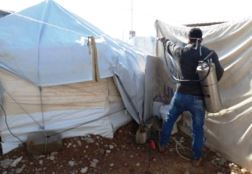 Saher is tireless. He sprays everywhere in the camps.
 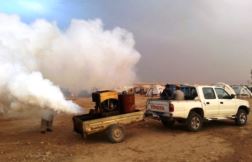 Fumigation is conducted at sunset
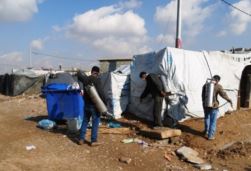 The team sprays the location thoroughly, including refuse bins, all standing water and around the sewage manholes beside the tents
Related links
Leishmaniasis fact sheet
WHO's work on leishmaniasis
The team make final adjustments before leaving to conduct fieldworkBaghdad, 19 November, 2015 – On a sunny day after weeks of rain in Iraq, Saher, Aqeel, Faris and Ahmed resume their spraying of all the houses in Baraka IDP camp. The team has been working together for 4 years, 3 years in Mosul and last year in 6 camps near Erbil. Their work consists of spraying houses, distributing prevention products to households, fumigating, and assessing mosquito, and other insect, kinds and densities found in homes. “I notice the difference our work makes in homes. We used to live with mosquitoes, mice and rats in our houses, but not anymore”, says Saher.
The team is aware of the importance of its work: leishmaniasis is, after malaria, the most common parasitic killer. In its most severe form, it is 100% fatal if left untreated for 2 years. Spread by the bite of infected female sandflies, leishmaniasis is highly endemic in Iraq. Globally, some 12 million people are estimated to be currently infected with leishmaniasis.
When an infected sandfly bites a human, it injects the parasite under the skin. The parasite stays alive by hiding inside the human body’s immunity system, in the white blood cells. They multiply, infect other white blood cells and a progressive infection is triggered.
Leishmaniasis control includes early diagnosis and effective case management, effective disease surveillance, and mobilization and education of the community through effective behavioural change interventions and locally-tailored communication strategies. “We need promotional material to educate families about the importance of seeking care at the onset of symptoms. These could be distributed by the team while spraying houses”, says Aqeel.
Containing the disease faces several challenges, including the remoteness of endemic areas, making them difficult to access, the lack of security in some areas and difficulties in transporting diagnostic testing kits and medicines for case management.
Elimination of the disease, defined as an annual incidence of less than 1 per 10 000 population at the district or subdistrict level, will not only be a public health success story, it will also help in the mitigation of poverty in affected areas.
Altaf Musani, acting WHO Representative in Iraq, reaffirms WHO’s continued technical support to Iraq. “WHO’s work on leishmaniasis control involves supporting national leishmaniasis control programmes,” he says. Partnership and collaboration with various stakeholders and other vector-borne disease control programmes is critical, as is the need to improve data on the vector and the effectiveness of vector control measures.
Saher is tireless. He sprays everywhere in the camps. Fumigation is conducted at sunsetThe team sprays the location thoroughly, including refuse bins, all standing water and around the sewage manholes beside the tents
Related links
Leishmaniasis fact sheet
WHO's work on leishmaniasis