


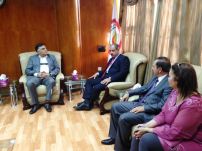
 Kurdistan region of Iraq’s Minister of Health Dr Rekawt Rashed Karim (centre) meets with WHO’s Representative in Iraq Dr Syed Jaffar Hussain (left) and WHO public health experts21 June 2014 – The Ministry of Health of the Kurdistan region of Iraq and WHO plan to launch a vaccination campaign for measles and polio across the Kurdistan region of Iraq. The emergency campaign, due to be launched on 29 June across the Kurdistan region of Iraq, is in response to the arrival of more than 300 000 internally-displaced persons (IDPs) to the region following the fighting in the Ninewa governorate in northern Iraq.
The campaign aims to reach more than 800 000 Syrian and Iraqi children age 0-5 years old both in camps and host communities, as well as children crossing the checkpoint from Mosul into Erbil.
While sufficient polio vaccines are available, the Ministry of Health has asked WHO to procure additional measles vaccines to cover shortages.
WHO is also providing technical support to the Ministry of Health and the epidemiological team in planning and monitoring activities; ensuring efficient micro-planning and vaccine logistics; ensuring adequate resources; supporting implementation and ensure quality field supervision of national immunization days; and providing independent monitoring to ensure maximum impact.
Polio and measles vaccinations activities have started in transit camps hosting IDPs in Dohuk, Erbil and Solimaniya. To date, more than 20 000 children in camps hosting Syrians and IDPs have been vaccinated in the Kurdistan Region of Iraq.
“The crisis in Iraq presents major challenges for the control of communicable diseases such as measles and polio,” said Dr Hussain. “Measles is endemic in Mosul and the arrival of internally-displaced persons could potentially lead to outbreaks, especially in overcrowded areas where they are located. The spread of polio is also a high risk as new cases were reported in the country earlier this year as a result of the Syria crisis. WHO is working with the ministry to reduce the risk of outbreaks as we enter the summer months, and ensure that preparedness and control measure are in place to detect and respond to new cases.”