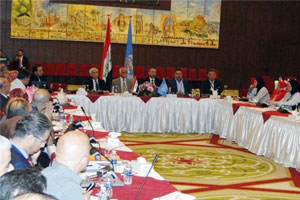
 19 September 2017, Baghdad, Iraq – The Federal Ministry of Health Iraq and World Health Organization (WHO) concluded, in Baghdad, a 5-day workshop to develop a national action plan on antimicrobial resistance for Iraq.
Antimicrobial resistance has become one of the biggest threats to global health and endangers other major priorities, such as human development. All around the world, many common infections are becoming resistant to the antimicrobial medicines used to treat them, resulting in longer illnesses and more deaths. At the same time, not enough new antimicrobial drugs, especially antibiotics, are being developed to replace older and increasingly ineffective ones. That is why AMR is also included in the Sustainable Development Goals (SDGs).
In September 2016, global leaders met at the United Nations General Assembly in New York to commit to fighting antimicrobial resistance together. Due to its seriousness and scope of the situation, this was only the fourth time in the history of the United Nations that a health topic is discussed at the General Assembly alongside HIV, noncommunicable diseases, and Ebola. G20 health ministers, who met in 2017, reaffirmed their resolve to keep AMR on their agenda as a high priority.
This joint activity marked the participation of national and international partners and stakeholder in the fields of human health, animal health, agriculture and environment.
“The Ministry of Health welcomes WHO’s initiative to support Iraq's efforts to respond to AMR as a serious public health problem with immense threats on human health and global economy,” said Dr Ihsan Jaffar Khayat, Director General of Public Health Directorate in the ministry. “Our target is to provide comprehensive health care services to our people, apply preventive methods, and ensure availability of effective treatment through rational use of medicines and antibiotics” He added.
“We are already witnessing increasing health challenges that transcend national borders,” said Altaf Musani, WHO Representative in Iraq. “It is our hope that the plan of action drafted in this workshop will be endorsed by the Government of Iraq. That will reaffirm the commitment of WHO, the Iraqi Ministry of Health and all partners towards the Global Action Plan on Antimicrobial Resistance and recognize that the key to tackling AMR lies with the prevention and control of infections in humans and animals” he added.
The importance of rational use of antibiotics is key in Iraq and a recently conducted study showed that 70% of all prescriptions contained antibiotics in the Country.
The Government of Iraq has developed a draft national plan of action to prevent and control Antimicrobial Resistance. This is to follow up on the commitment by Heads of State during the 71st session of the UN GA where all countries endorsed taking a comprehensive, coordinated approach to address the root causes of AMR across multiple sectors, especially human health, animal health and agriculture.
The Iraqi multi-sector road map will be led by the Ministry of Health of Iraq and technically supported by the World Health Organization. Key aspects of the road map include: awareness raising of the public health problem, strengthening surveillance to obtain data that better represents the country , improving infection prevention control in health facilities, Cautious use of antibiotics, promoting more research and development and finally and very importantly political commitment to ensure fulfillment/attainment of the SDGs. Resources both technical and financial are needed to sustain this critical global health imperative.
For more information, please contact:
Ajyal Sultany
Communications Officer
This email address is being protected from spambots. You need JavaScript enabled to view it.
+964 7510101469
Pauline Ajello
Communications Officer
This email address is being protected from spambots. You need JavaScript enabled to view it.
+964 7510101460
19 September 2017, Baghdad, Iraq – The Federal Ministry of Health Iraq and World Health Organization (WHO) concluded, in Baghdad, a 5-day workshop to develop a national action plan on antimicrobial resistance for Iraq.
Antimicrobial resistance has become one of the biggest threats to global health and endangers other major priorities, such as human development. All around the world, many common infections are becoming resistant to the antimicrobial medicines used to treat them, resulting in longer illnesses and more deaths. At the same time, not enough new antimicrobial drugs, especially antibiotics, are being developed to replace older and increasingly ineffective ones. That is why AMR is also included in the Sustainable Development Goals (SDGs).
In September 2016, global leaders met at the United Nations General Assembly in New York to commit to fighting antimicrobial resistance together. Due to its seriousness and scope of the situation, this was only the fourth time in the history of the United Nations that a health topic is discussed at the General Assembly alongside HIV, noncommunicable diseases, and Ebola. G20 health ministers, who met in 2017, reaffirmed their resolve to keep AMR on their agenda as a high priority.
This joint activity marked the participation of national and international partners and stakeholder in the fields of human health, animal health, agriculture and environment.
“The Ministry of Health welcomes WHO’s initiative to support Iraq's efforts to respond to AMR as a serious public health problem with immense threats on human health and global economy,” said Dr Ihsan Jaffar Khayat, Director General of Public Health Directorate in the ministry. “Our target is to provide comprehensive health care services to our people, apply preventive methods, and ensure availability of effective treatment through rational use of medicines and antibiotics” He added.
“We are already witnessing increasing health challenges that transcend national borders,” said Altaf Musani, WHO Representative in Iraq. “It is our hope that the plan of action drafted in this workshop will be endorsed by the Government of Iraq. That will reaffirm the commitment of WHO, the Iraqi Ministry of Health and all partners towards the Global Action Plan on Antimicrobial Resistance and recognize that the key to tackling AMR lies with the prevention and control of infections in humans and animals” he added.
The importance of rational use of antibiotics is key in Iraq and a recently conducted study showed that 70% of all prescriptions contained antibiotics in the Country.
The Government of Iraq has developed a draft national plan of action to prevent and control Antimicrobial Resistance. This is to follow up on the commitment by Heads of State during the 71st session of the UN GA where all countries endorsed taking a comprehensive, coordinated approach to address the root causes of AMR across multiple sectors, especially human health, animal health and agriculture.
The Iraqi multi-sector road map will be led by the Ministry of Health of Iraq and technically supported by the World Health Organization. Key aspects of the road map include: awareness raising of the public health problem, strengthening surveillance to obtain data that better represents the country , improving infection prevention control in health facilities, Cautious use of antibiotics, promoting more research and development and finally and very importantly political commitment to ensure fulfillment/attainment of the SDGs. Resources both technical and financial are needed to sustain this critical global health imperative.
For more information, please contact:
Ajyal Sultany
Communications Officer
This email address is being protected from spambots. You need JavaScript enabled to view it.
+964 7510101469
Pauline Ajello
Communications Officer
This email address is being protected from spambots. You need JavaScript enabled to view it.
+964 7510101460