

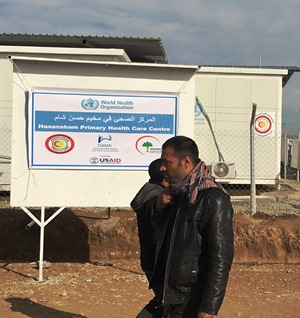
 3 January 2017 – The World Health Organization (WHO), in cooperation with the federal and regional Ministries of Health, has expanded the provision of health services in Hasansham internally displaced persons (IDPs) camp through a 24/7 static primary health care centre. The centre was officially inaugurated on Thursday 28 December 2016 by the Federal Minister of Health Dr Adela Hammoud and the Kurdistan Regional Minister of Health Dr Rekwat Hama Rasheed.
The centre consists of 12 consultation rooms providing primary health care services, including consultations for communicable and noncommunicable diseases, laboratory services, disease surveillance, and referral of emergency cases. Two additional caravans supported by the United Nations Population Fund provide reproductive health care services through the nongovernmental organization Women and Health Alliance International.
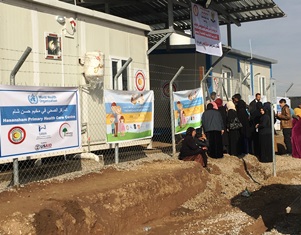 Tens of patients gathered at the gate of the centre waiting to receive medical care. Um Salam, an old lady came in experiencing breathing difficulties with her 3-year-old granddaughter who was showing symptoms of a cold. Samira (34-years old) and Shatha (32-years old) came to receive their monthly share of contraceptives. “The best things this centre has is the reproductive health clinic with female doctors and nurses,” said Shatha happily. “I had postnatal problems after the delivery of my third child in 2015 but couldn’t get the required treatment due to the conflict inside Mosul and the non-availability of a female doctor in the few clinics that remained open there. Now I feel comfortable to talk about my problem openly and get examined by the female staff operating this clinic”.
The centre is equipped with a laboratory operated by 4 staff, a male doctor and assistant, in addition to 2 female assistants, one displaced from Al Samah town in Mosul and living in Hasansham camp at the present. The laboratory staff confirmed availability of laboratory material and capacity to serve the camp's patients. An average of 40 to 45 tests is performed per shift/day, as stated by the laboratory manager Dr Ahmed Dhia Aldin.
Hozan Ahmed, the pharmacist who runs the pharmacy with the assistance of one pharmacy assistant in the morning shift, said that WHO provides the required medicines and medical supplies to ensure the centre’s functionality. He further explained that requests for medicines are promptly met by WHO though with few missed items which he hoped to get very soon. He said that the pharmacy provided an average of 150 treatments per shift daily. Chronic diseases patients have been provided with a monthly card to receive their monthly treatment dose.
The primary health care centre is staffed by 6 doctors, 4 males and 2 females who see a range of 150 to 200 cases per shift a day. The main conditions treated include upper respiratory tract infections and acute diarrhoea. The centre also provides ambulatory and referral services through 2 WHO ambulances. The general doctor responsible for emergency referrals indicated that 480 referrals had been carried out since 9 November 2016 according to the referrals registration book he was keeping on his desk.
WHO began providing health services in the mentioned camp on 5 November through its implementing partner, Doctors Aid Medical Activities nongovernmental organization. Services were initially offered through a mobile medical clinic and 2 caravans operating in 2 working shifts: morning and afternoon. The centre is now a static facility operated by 34 health workers providing an average of 250 consultations a day.
WHO’s support to the primary health care centre at Hasansham camp has been made possible through the generous financial contribution from the Office of US Foreign Disaster Assistance USAID/OFDA.
Related links
United Nations Population Fund
Women and Health Alliance International
Doctors Aid Medical Activities
Office of US Foreign Disaster Assistance