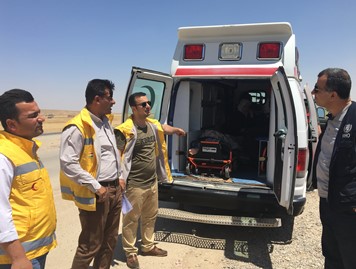
 Patients from west Mosul are transferred by ambulance to Erbil for treatment. Photo: P AjelloBaghdad, 31 May 2017 – The World Health Organization (WHO) and the United Nations Population Fund (UNFPA) are extremely concerned about the health conditions of about 180 000 men, women and children who are reportedly still trapped inside west Mosul’s old city where access to health care services has been limited.
Tens of thousands of vulnerable women, children and older people in the old city are at high risk of sustaining war-related injuries and are vulnerable to vaccine-preventable diseases, waterborne diseases and acute diarrhoea, severe dehydration and malnutrition. Reproductive health needs are critical, including maternal and newborn care and management of complicated pregnancies.
The already high number of 6906 trauma casualties recorded from west Mosul from February to May (as of 28 May 2017) is expected to further increase as the conflict deepens in the old city. It is anticipated that those fleeing combat zones will be arriving at assembly points and camps with deteriorating health conditions and will require urgent medical attention.
In order to be ready to respond to these health needs, WHO and UNFPA in support of the Ministry of Health, have scaled up their emergency response capacity around Mosul’s city to ensure that civilians have access to trauma care, primary health care and reproductive health services. Specifically, WHO and partners are increasing the number of trauma stabilization points, prepositioning trauma supplies, life-saving medicines and supplies at and around assembly points and camps.
WHO has also expanded medical referral capacity through provision of 6 additional ambulances critically needed to support the entire medical referral pathway from point of stabilization to rehabilitation. Additionally, deployment of 5 new mobile medical clinics to west Mosul aims to immunize unvaccinated children and provide essential health services at all major assembly and reception sites and camps for the internally displaced.
“Urgent access to front-line trauma care complemented with lifesaving health services, emergency immunization campaigns and vigilance against the risk of communicable outbreaks are our top priorities at this point considering the precarious conditions fleeing populations have to survive in under soaring temperatures,” said Altaf Musani, WHO Representative in Iraq.
Of the 180 000 persons expected to be in the old city, approximately 50 000 are women of reproductive age, who have had no access to any reproductive health services and are vulnerable to different risks, including complicated deliveries. UNFPA is providing emergency reproductive health services to these women through 5 maternity hospitals, 14 mobile and static delivery rooms and 35 mobile and static reproductive health clinics. UNFPA-supported services have been established in IDP camps, as well as in host communities in east and west Mosul, and are well positioned to serve women and girls in the old city of Mosul.
"UNFPA is well positioned to continue providing life-saving reproductive health services on the frontlines and strengthening referral pathways. We are grateful to the donors who help make this happen, namely Australia, Canada, Humanitarian Aid and Civil Protection (ECHO), Japan, the Office of U.S. Foreign Disaster Assistance (OFDA), Central Emergency Response Fund (CERF) and the Humanitarian Pooled Funding," said Ramanathan Balakrishnan, UNFPA Representative in Iraq.
WHO and other health cluster partners are appealing for urgent support to bridge the current funding gap of 85% to address these emergency health challenges in the context of the Mosul operation and to assist over 6 million people in need of health services, nationwide.
For more information, please contact:
Ajyal Sultany
Communications Officer
+964 7510101469
This email address is being protected from spambots. You need JavaScript enabled to view it.
Pauline Ajello
Communications Officer
+964 7510101460
This email address is being protected from spambots. You need JavaScript enabled to view it.
Patients from west Mosul are transferred by ambulance to Erbil for treatment. Photo: P AjelloBaghdad, 31 May 2017 – The World Health Organization (WHO) and the United Nations Population Fund (UNFPA) are extremely concerned about the health conditions of about 180 000 men, women and children who are reportedly still trapped inside west Mosul’s old city where access to health care services has been limited.
Tens of thousands of vulnerable women, children and older people in the old city are at high risk of sustaining war-related injuries and are vulnerable to vaccine-preventable diseases, waterborne diseases and acute diarrhoea, severe dehydration and malnutrition. Reproductive health needs are critical, including maternal and newborn care and management of complicated pregnancies.
The already high number of 6906 trauma casualties recorded from west Mosul from February to May (as of 28 May 2017) is expected to further increase as the conflict deepens in the old city. It is anticipated that those fleeing combat zones will be arriving at assembly points and camps with deteriorating health conditions and will require urgent medical attention.
In order to be ready to respond to these health needs, WHO and UNFPA in support of the Ministry of Health, have scaled up their emergency response capacity around Mosul’s city to ensure that civilians have access to trauma care, primary health care and reproductive health services. Specifically, WHO and partners are increasing the number of trauma stabilization points, prepositioning trauma supplies, life-saving medicines and supplies at and around assembly points and camps.
WHO has also expanded medical referral capacity through provision of 6 additional ambulances critically needed to support the entire medical referral pathway from point of stabilization to rehabilitation. Additionally, deployment of 5 new mobile medical clinics to west Mosul aims to immunize unvaccinated children and provide essential health services at all major assembly and reception sites and camps for the internally displaced.
“Urgent access to front-line trauma care complemented with lifesaving health services, emergency immunization campaigns and vigilance against the risk of communicable outbreaks are our top priorities at this point considering the precarious conditions fleeing populations have to survive in under soaring temperatures,” said Altaf Musani, WHO Representative in Iraq.
Of the 180 000 persons expected to be in the old city, approximately 50 000 are women of reproductive age, who have had no access to any reproductive health services and are vulnerable to different risks, including complicated deliveries. UNFPA is providing emergency reproductive health services to these women through 5 maternity hospitals, 14 mobile and static delivery rooms and 35 mobile and static reproductive health clinics. UNFPA-supported services have been established in IDP camps, as well as in host communities in east and west Mosul, and are well positioned to serve women and girls in the old city of Mosul.
"UNFPA is well positioned to continue providing life-saving reproductive health services on the frontlines and strengthening referral pathways. We are grateful to the donors who help make this happen, namely Australia, Canada, Humanitarian Aid and Civil Protection (ECHO), Japan, the Office of U.S. Foreign Disaster Assistance (OFDA), Central Emergency Response Fund (CERF) and the Humanitarian Pooled Funding," said Ramanathan Balakrishnan, UNFPA Representative in Iraq.
WHO and other health cluster partners are appealing for urgent support to bridge the current funding gap of 85% to address these emergency health challenges in the context of the Mosul operation and to assist over 6 million people in need of health services, nationwide.
For more information, please contact:
Ajyal Sultany
Communications Officer
+964 7510101469
This email address is being protected from spambots. You need JavaScript enabled to view it.
Pauline Ajello
Communications Officer
+964 7510101460
This email address is being protected from spambots. You need JavaScript enabled to view it.