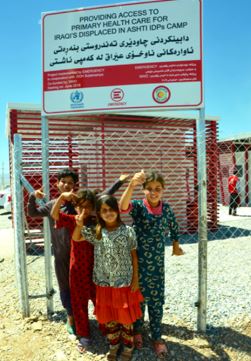
 Baghdad, 02 August 2016 – WHO officially opened a new primary health care (PHC) centre in Ashti internally displaced person (IDP) camp in Sulayaniyah, Iraq. The facility will be run by Emergency International, a WHO-implementing partner using the generous financial contribution provided by the Office of U.S. Foreign Disaster Assistance and European Union Humanitarian Aid.
As many as 14 000 displaced people live in the camp, and the new PHC centre is the second to be established in this camp. In addition to traditional services, the centre will also offer services for chronic diseases while the first will provide maternal and child health care services. “The new centre will ensure that the camp is well equipped to provide support in revitalizing primary care,” said Giacomo Menaldo Humanitarian Response Programme Manager at Emergency International.
Sulaymaniyah Department of Health Director General Dr Miran Abbas attended the opening ceremony and stressed the importance of primary health care. Dr Miran said, “The Government has taken special care to provide better health care services in camps for IDPs and build resilient health systems in order to develop people-centred health service delivery.” “I thank WHO for this unique opportunity to strengthen health care systems, encourage development and protect global health security,” he added.
Many people feel that the centre is helping to promote a sense of community in the camp.
"I feel like I’m a big part of the community," said 28-year-old Hammed, who for the first time was visiting the centre. He expressed his hope that the centre would make the life of his family easier. “It is vitally important for the IDP community to have a facility that can provide primary health care and health-related advice and guidance for people. Hammed has diabetes and will visit the centre regularly to pick up his medication.
The new centre has a pharmacy, laboratory and an area for decontamination in the case of any contagious diseases. For referral of cases requiring more specialized care, the centre has 4 ambulances and is linked to Sulaymaniyah tertiary hospitals.
“A primary health care approach is the most efficient and cost-effective way to organize a health system. It can prevent much of the disease burden. Decades of experience tell us that primary health care produces better outcomes, at lower costs, and with higher user satisfaction,” said WHO staff member engineer Mohammad Hamasha.
WHO has identified five 5 key elements which are fundamental to the primary health care approach:
• reducing exclusion and social disparities in health (universal coverage reforms);
• organizing health services around people's needs and expectations (service delivery reforms);
• integrating health into all sectors (public policy reforms);
• pursuing collaborative models of policy dialogue (leadership reforms); and
• increasing stakeholder participation.
WHO thanks the Government of Iraq and partners for its global commitment to the primary health care approach, which will contribute to protecting and promoting health for all. Outcomes of prevention and treatment measures remind us that safe behaviour and life-saving supportive care cannot be promoted without the understanding and cooperation of individuals, their families and communities.
Related links
Office of U.S. Foreign Disaster Assistance
European Union Humanitarian Aid
For more information please contact:
Ms Rosane Lopes
Communications Officer
World Health Organization
Iraq Country Office
Email: This email address is being protected from spambots. You need JavaScript enabled to view it.
Mobile +964 7809 288 614
Ms Ajyal Sultany
Communications Officer
World Health Organization
Iraq Country Office
email: This email address is being protected from spambots. You need JavaScript enabled to view it.
Mobile: +964 7510 101 469
Baghdad, 02 August 2016 – WHO officially opened a new primary health care (PHC) centre in Ashti internally displaced person (IDP) camp in Sulayaniyah, Iraq. The facility will be run by Emergency International, a WHO-implementing partner using the generous financial contribution provided by the Office of U.S. Foreign Disaster Assistance and European Union Humanitarian Aid.
As many as 14 000 displaced people live in the camp, and the new PHC centre is the second to be established in this camp. In addition to traditional services, the centre will also offer services for chronic diseases while the first will provide maternal and child health care services. “The new centre will ensure that the camp is well equipped to provide support in revitalizing primary care,” said Giacomo Menaldo Humanitarian Response Programme Manager at Emergency International.
Sulaymaniyah Department of Health Director General Dr Miran Abbas attended the opening ceremony and stressed the importance of primary health care. Dr Miran said, “The Government has taken special care to provide better health care services in camps for IDPs and build resilient health systems in order to develop people-centred health service delivery.” “I thank WHO for this unique opportunity to strengthen health care systems, encourage development and protect global health security,” he added.
Many people feel that the centre is helping to promote a sense of community in the camp.
"I feel like I’m a big part of the community," said 28-year-old Hammed, who for the first time was visiting the centre. He expressed his hope that the centre would make the life of his family easier. “It is vitally important for the IDP community to have a facility that can provide primary health care and health-related advice and guidance for people. Hammed has diabetes and will visit the centre regularly to pick up his medication.
The new centre has a pharmacy, laboratory and an area for decontamination in the case of any contagious diseases. For referral of cases requiring more specialized care, the centre has 4 ambulances and is linked to Sulaymaniyah tertiary hospitals.
“A primary health care approach is the most efficient and cost-effective way to organize a health system. It can prevent much of the disease burden. Decades of experience tell us that primary health care produces better outcomes, at lower costs, and with higher user satisfaction,” said WHO staff member engineer Mohammad Hamasha.
WHO has identified five 5 key elements which are fundamental to the primary health care approach:
• reducing exclusion and social disparities in health (universal coverage reforms);
• organizing health services around people's needs and expectations (service delivery reforms);
• integrating health into all sectors (public policy reforms);
• pursuing collaborative models of policy dialogue (leadership reforms); and
• increasing stakeholder participation.
WHO thanks the Government of Iraq and partners for its global commitment to the primary health care approach, which will contribute to protecting and promoting health for all. Outcomes of prevention and treatment measures remind us that safe behaviour and life-saving supportive care cannot be promoted without the understanding and cooperation of individuals, their families and communities.
Related links
Office of U.S. Foreign Disaster Assistance
European Union Humanitarian Aid
For more information please contact:
Ms Rosane Lopes
Communications Officer
World Health Organization
Iraq Country Office
Email: This email address is being protected from spambots. You need JavaScript enabled to view it.
Mobile +964 7809 288 614
Ms Ajyal Sultany
Communications Officer
World Health Organization
Iraq Country Office
email: This email address is being protected from spambots. You need JavaScript enabled to view it.
Mobile: +964 7510 101 469