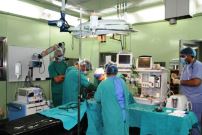
 WHO consultant surgeon trains a team of health workers to conduct cochlear implant in a hospital in Duhok 22 January 2015 – WHO and the Ministry of Health of the Kurdistan Regional Government have provided cochlear implants to 20 internally displaced and refugee children in Iraq between the ages of 1 and 6.
The support is part of a larger WHO disability prevention and reduction project targeting internally displaced persons (IDPs), refugees and affected host communities in Dohuk. This ongoing project focuses on three main components: 1) the correction of the hearing impairment; 2) vision correction; and 3) restoration of mobility among emergency-affected populations.
Strengthening health services
WHO is also working with the Ministry to strengthen the ear, nose and throat (ENT) departments in Duhok governorate to provide surgeries for IDPs and refugees.
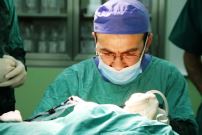 A trained ear, nose and throat doctor conducts a cochlear implant in a hospital in Duhok following the completion of the training The Ministry of Health and WHO conducted an assessment to determine the number of children living with hearing impairment within host communities and IDP and refugee camps. A total of 70 IDP and refugee children were identified as suitable for the cochlear implant and 20 have already undergone the surgery. More operations will be carried out in the coming months.
An international surgeon has trained 20 ENT doctors, nurses, paramedics and medical equipment engineers. The Ministry of Health provided the cochlear devices and operation and admission rooms.
WHO's humanitarian response
According to WHO Representative in Iraq Dr Hussain Syed Jaffer the support being provided is in line with the strategic objectives of WHO providing a timely package of primary and secondary health care services, which includes care for people with physical disabilities and patients with chronic diseases.
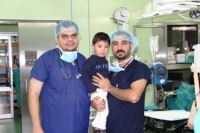 ENT specialists hold a young child who benefited from a cochlear implant “Strengthening primary health care services and establishing referral of secondary health care system is part of WHO’s strategy for responding to the humanitarian health needs in Iraq; and supporting cochlear implants is one way through which we are responding as an agency”, said Dr Hussain. He added that the second part of the project would include ophthalmic consultations and provision of glasses for those in need among IDPs, refugees and host populations displaced in Dohuk.
WHO will continue supporting the government of Iraq and the Ministry of Health by providing appropriate techincal and opperational support to the humanitarian health response in Iraq.
What is a cochlear implant?
A cochlear implant is an electronic medical device that replaces the function of the damaged inner ear. Unlike hearing aids, which make sounds louder, cochlear implants do the work of damaged parts of the inner ear (cochlea) by providing sound signals to the brain. Children as young as 14 months of age can be candidates for cochlear implants.The potential exists for successful implantation at younger ages. It is generally agreed that the best child candidates are those who:
- have profound hearing loss in both ears, and have had limited benefit from hearing aids
- are healthy and have no medical conditions that would make the surgery risky
- are involved (when able), along with their parents, in all steps of the process
- understand, along with their parents, their role in the successful use of cochlear implants
- have, along with their parents, realistic expectations for cochlear implant use
- are willing to be actively involved in their habilitation/rehabilitation
- have support from their educational programme to emphasize the development of auditory skills.
WHO funding needs
To continue responding to the ongoing emergency, WHO requires more financial resources. Of the US$ 187 million that WHO requires to respond to the health needs of more than 5 million people (2.1 million IDPs and 3.5 million host communities), the Organization has so far raised only US$ 55 million (29%).
For more information, please contact:
Ms Pauline Ajello, Communications and Donor Relations | 07809288618 | This email address is being protected from spambots. You need JavaScript enabled to view it.
Ms Ajyal Sultany, Communications Officer| 07809269506 | This email address is being protected from spambots. You need JavaScript enabled to view it.
WHO consultant surgeon trains a team of health workers to conduct cochlear implant in a hospital in Duhok 22 January 2015 – WHO and the Ministry of Health of the Kurdistan Regional Government have provided cochlear implants to 20 internally displaced and refugee children in Iraq between the ages of 1 and 6.
The support is part of a larger WHO disability prevention and reduction project targeting internally displaced persons (IDPs), refugees and affected host communities in Dohuk. This ongoing project focuses on three main components: 1) the correction of the hearing impairment; 2) vision correction; and 3) restoration of mobility among emergency-affected populations.
Strengthening health services
WHO is also working with the Ministry to strengthen the ear, nose and throat (ENT) departments in Duhok governorate to provide surgeries for IDPs and refugees.
A trained ear, nose and throat doctor conducts a cochlear implant in a hospital in Duhok following the completion of the training The Ministry of Health and WHO conducted an assessment to determine the number of children living with hearing impairment within host communities and IDP and refugee camps. A total of 70 IDP and refugee children were identified as suitable for the cochlear implant and 20 have already undergone the surgery. More operations will be carried out in the coming months.
An international surgeon has trained 20 ENT doctors, nurses, paramedics and medical equipment engineers. The Ministry of Health provided the cochlear devices and operation and admission rooms.
WHO's humanitarian response
According to WHO Representative in Iraq Dr Hussain Syed Jaffer the support being provided is in line with the strategic objectives of WHO providing a timely package of primary and secondary health care services, which includes care for people with physical disabilities and patients with chronic diseases.
ENT specialists hold a young child who benefited from a cochlear implant “Strengthening primary health care services and establishing referral of secondary health care system is part of WHO’s strategy for responding to the humanitarian health needs in Iraq; and supporting cochlear implants is one way through which we are responding as an agency”, said Dr Hussain. He added that the second part of the project would include ophthalmic consultations and provision of glasses for those in need among IDPs, refugees and host populations displaced in Dohuk.
WHO will continue supporting the government of Iraq and the Ministry of Health by providing appropriate techincal and opperational support to the humanitarian health response in Iraq.
What is a cochlear implant?
A cochlear implant is an electronic medical device that replaces the function of the damaged inner ear. Unlike hearing aids, which make sounds louder, cochlear implants do the work of damaged parts of the inner ear (cochlea) by providing sound signals to the brain. Children as young as 14 months of age can be candidates for cochlear implants.The potential exists for successful implantation at younger ages. It is generally agreed that the best child candidates are those who:
- have profound hearing loss in both ears, and have had limited benefit from hearing aids
- are healthy and have no medical conditions that would make the surgery risky
- are involved (when able), along with their parents, in all steps of the process
- understand, along with their parents, their role in the successful use of cochlear implants
- have, along with their parents, realistic expectations for cochlear implant use
- are willing to be actively involved in their habilitation/rehabilitation
- have support from their educational programme to emphasize the development of auditory skills.
WHO funding needs
To continue responding to the ongoing emergency, WHO requires more financial resources. Of the US$ 187 million that WHO requires to respond to the health needs of more than 5 million people (2.1 million IDPs and 3.5 million host communities), the Organization has so far raised only US$ 55 million (29%).
For more information, please contact:
Ms Pauline Ajello, Communications and Donor Relations | 07809288618 | This email address is being protected from spambots. You need JavaScript enabled to view it.
Ms Ajyal Sultany, Communications Officer| 07809269506 | This email address is being protected from spambots. You need JavaScript enabled to view it.