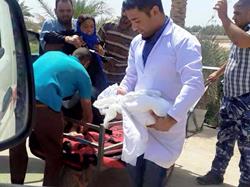
 A baby delivered at Bzebiz Bridge is held by a member of a mobile medical team. Photo: WHO24 May 2015 – As the exodus of thousands of families from Anbar to Baghdad and different parts of the country continues, a new life began when on the morning of 19 May, a 25-year-old internally displaced woman from Ramadi City gave birth to a healthy baby at Bzebiz Bridge, the crossing point between Anbar and Baghdad. While both mother and baby were fine, the incident highlighted the plight of the approximately 25 000 people displaced from their homes in Ramadi, who in the search for an area offering safe refuge, are unable to access essential health services.
Displacement compounds the extreme difficulties already being experienced by civilians in areas of conflict, and affects most profoundly the vulnerable in society – children, older people, patients and pregnant women in need of not only essential health, but humanitarian, services.
The increasing number of displaced people, many exhausted and walking long distances under the hot summer sun, has consequently scaled up the need for services. Patients seeking medical care continue to overload already depleted health facilities in the governorate. Shortages of medicines and supplies are increasing and are exacerbating the impact of the emergency on the health of over 5 million people already in need.
On 18 April, WHO supported the establishment of 2 clinics in Amiriyat Al Falluja and Nukhaib in Anbar, west of Iraq. The clinics are being managed by the United Iraqi Medical Society (UIMS), a medical nongovernmental organization and WHO implementing partner. WHO has supported UIMS with the delivery of essential medicines and other health technologies, and services in the clinics continue. In their first 2 weeks of opening, almost 600 consultations took place at the Amiriyat Al Falluja clinic and close to a thousand at the clinic in Nukhaib.
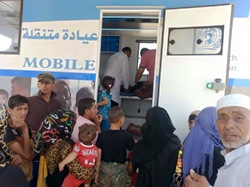 Mobile medical clinic delivers health service to internally displaced people from Ramadi at the Bzebiz Bridge. Photo: WHOSince the crisis in Ramadi began, WHO has been working closely with the Federal Ministry of Health and Baghdad and Anbar directorates of health; 6 ambulances, essential medicines and health workers have been deployed to treat internally displaced people in transit on both sides of Bzebiz Bridge.
WHO has also provided the Federal Ministry of Health in Anbar with 3 mobile medical clinics and has facilitated the safe delivery of medicines and medical health kits of basic and supplementary units to health facilities in Ramadi, Khalidiya, Al Baghdadi, Haditha, Amiriyat Al Falluja, Al Habaniya Tourist City, and many other areas inside Anbar.
Related link
United Iraqi Medical Society
Media contacts
Ms Ajyal Sultany
Communications Officer
WHO Iraq country office
This email address is being protected from spambots. You need JavaScript enabled to view it.,
+964 7510 101 469
Ms Pauline Ajello
Communications and Donor Relations
WHO Iraq country office
This email address is being protected from spambots. You need JavaScript enabled to view it.
+964 7809 288 618
A baby delivered at Bzebiz Bridge is held by a member of a mobile medical team. Photo: WHO24 May 2015 – As the exodus of thousands of families from Anbar to Baghdad and different parts of the country continues, a new life began when on the morning of 19 May, a 25-year-old internally displaced woman from Ramadi City gave birth to a healthy baby at Bzebiz Bridge, the crossing point between Anbar and Baghdad. While both mother and baby were fine, the incident highlighted the plight of the approximately 25 000 people displaced from their homes in Ramadi, who in the search for an area offering safe refuge, are unable to access essential health services.
Displacement compounds the extreme difficulties already being experienced by civilians in areas of conflict, and affects most profoundly the vulnerable in society – children, older people, patients and pregnant women in need of not only essential health, but humanitarian, services.
The increasing number of displaced people, many exhausted and walking long distances under the hot summer sun, has consequently scaled up the need for services. Patients seeking medical care continue to overload already depleted health facilities in the governorate. Shortages of medicines and supplies are increasing and are exacerbating the impact of the emergency on the health of over 5 million people already in need.
On 18 April, WHO supported the establishment of 2 clinics in Amiriyat Al Falluja and Nukhaib in Anbar, west of Iraq. The clinics are being managed by the United Iraqi Medical Society (UIMS), a medical nongovernmental organization and WHO implementing partner. WHO has supported UIMS with the delivery of essential medicines and other health technologies, and services in the clinics continue. In their first 2 weeks of opening, almost 600 consultations took place at the Amiriyat Al Falluja clinic and close to a thousand at the clinic in Nukhaib.
Mobile medical clinic delivers health service to internally displaced people from Ramadi at the Bzebiz Bridge. Photo: WHOSince the crisis in Ramadi began, WHO has been working closely with the Federal Ministry of Health and Baghdad and Anbar directorates of health; 6 ambulances, essential medicines and health workers have been deployed to treat internally displaced people in transit on both sides of Bzebiz Bridge.
WHO has also provided the Federal Ministry of Health in Anbar with 3 mobile medical clinics and has facilitated the safe delivery of medicines and medical health kits of basic and supplementary units to health facilities in Ramadi, Khalidiya, Al Baghdadi, Haditha, Amiriyat Al Falluja, Al Habaniya Tourist City, and many other areas inside Anbar.
Related link
United Iraqi Medical Society
Media contacts
Ms Ajyal Sultany
Communications Officer
WHO Iraq country office
This email address is being protected from spambots. You need JavaScript enabled to view it.,
+964 7510 101 469
Ms Pauline Ajello
Communications and Donor Relations
WHO Iraq country office
This email address is being protected from spambots. You need JavaScript enabled to view it.
+964 7809 288 618