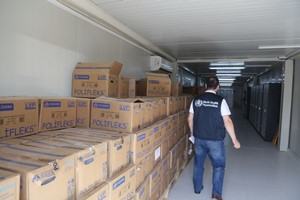
 Medical supplies that WHO delivered to Haji Ali Field Hospital to support treatment of trauma and medical patients29 October 2017 – In October 2016, the Government of Iraq launched military operations in Mosul. More than 1 million people became internally displaced from different parts of Ninewa governorate, and more than 25 000 hospital casualties were recorded. As the number of war-related trauma patients increased and major hospitals in Mosul became damaged and inaccessible, treatment for the wounded became increasing challenging. At the time, the majority of patients were being transported to the neighbouring governorates of Erbil and Dahuk (more than 80 kilometres) to access treatment for their life-threatening injuries. This was challenging as patients spent long hours at checkpoints before they were transferred to ambulances for transportation to major hospitals.
To reduce the time that patients spend on the road by more than half and to provide trauma patients with life-saving emergency trauma wit in the “golden hour”, WHO and other health partners supported the Government of Iraq to establish 6 field hospitals that were used to deliver the necessary critical care. Many lives were saved as the government and its partners treated more than 25 000 trauma patients in hospitals and more than 17 000 were treated in trauma stabilization points.
Finally, the crisis in Ninewa province has subsided but injuries resulting from improvised explosive devices and landmines are likely to increase. This requires enhanced response to improve survivability of trauma patients.
Eight-year-old Ahmed Mohamood and his family had just arrived at their house in rural Imam Garbee, on the morning of 20 October 2017 when an improvised explosive device suddenly went off, killing one of his brothers instantly and injuring Ahmed and his younger brother.
His father recalls the incident: “Hearing that the fighting in our town had ended, my wife and I decided to leave the camp where we had been living for 2 months and go back home with our 3 children. On the morning that we arrived home, my wife and I were arranging our house, when we heard a loud sound outside our house, so we went to see what was going on and saw the place where our children were playing took a direct hit. I’ll never forget what I saw when we ran outside. My children were lying in a pool of blood. One child had died instantly, while the others lay on the ground with serious injuries.”
Ahmed’s brother, who had been metres away from the 2 boys, had only sustained multiple small wounds. Ahmed’s injuries were the most severe and life-threatening. The explosion had shattered his abdomen, damaging his organs, including his liver. At the newly established WHO field hospital in Haj Ali, run by implementing partner ASPEN, surgeons and physicians did all they could to resuscitate and transfuse him, given that he was severely anaemic. The team repaired the damage in his colon and his abdomen was left open with a clear plastic bag as covering. Suffering from hypothermia, he was kept in the intensive care unit until his condition stabilized for the doctors repair his intestines and part of the liver on the second day.
After 3 days in intensive care and multiple operations, Ahmed survived. Doctors at the field hospital say that this is remarkable as the wounds he sustained are often fatal and expensive to manage. Through support from the UN Central Emergency Relief Fund (CERF), European Commission’s Humanitarian Aid Office (ECHO) and the Office of U.S. Foreign Disaster Assistance (USAID/OFDA), WHO is able to provide trauma care services on the front lines to ensure that Ahmed and thousands more lives are saved.
Medical supplies that WHO delivered to Haji Ali Field Hospital to support treatment of trauma and medical patients29 October 2017 – In October 2016, the Government of Iraq launched military operations in Mosul. More than 1 million people became internally displaced from different parts of Ninewa governorate, and more than 25 000 hospital casualties were recorded. As the number of war-related trauma patients increased and major hospitals in Mosul became damaged and inaccessible, treatment for the wounded became increasing challenging. At the time, the majority of patients were being transported to the neighbouring governorates of Erbil and Dahuk (more than 80 kilometres) to access treatment for their life-threatening injuries. This was challenging as patients spent long hours at checkpoints before they were transferred to ambulances for transportation to major hospitals.
To reduce the time that patients spend on the road by more than half and to provide trauma patients with life-saving emergency trauma wit in the “golden hour”, WHO and other health partners supported the Government of Iraq to establish 6 field hospitals that were used to deliver the necessary critical care. Many lives were saved as the government and its partners treated more than 25 000 trauma patients in hospitals and more than 17 000 were treated in trauma stabilization points.
Finally, the crisis in Ninewa province has subsided but injuries resulting from improvised explosive devices and landmines are likely to increase. This requires enhanced response to improve survivability of trauma patients.
Eight-year-old Ahmed Mohamood and his family had just arrived at their house in rural Imam Garbee, on the morning of 20 October 2017 when an improvised explosive device suddenly went off, killing one of his brothers instantly and injuring Ahmed and his younger brother.
His father recalls the incident: “Hearing that the fighting in our town had ended, my wife and I decided to leave the camp where we had been living for 2 months and go back home with our 3 children. On the morning that we arrived home, my wife and I were arranging our house, when we heard a loud sound outside our house, so we went to see what was going on and saw the place where our children were playing took a direct hit. I’ll never forget what I saw when we ran outside. My children were lying in a pool of blood. One child had died instantly, while the others lay on the ground with serious injuries.”
Ahmed’s brother, who had been metres away from the 2 boys, had only sustained multiple small wounds. Ahmed’s injuries were the most severe and life-threatening. The explosion had shattered his abdomen, damaging his organs, including his liver. At the newly established WHO field hospital in Haj Ali, run by implementing partner ASPEN, surgeons and physicians did all they could to resuscitate and transfuse him, given that he was severely anaemic. The team repaired the damage in his colon and his abdomen was left open with a clear plastic bag as covering. Suffering from hypothermia, he was kept in the intensive care unit until his condition stabilized for the doctors repair his intestines and part of the liver on the second day.
After 3 days in intensive care and multiple operations, Ahmed survived. Doctors at the field hospital say that this is remarkable as the wounds he sustained are often fatal and expensive to manage. Through support from the UN Central Emergency Relief Fund (CERF), European Commission’s Humanitarian Aid Office (ECHO) and the Office of U.S. Foreign Disaster Assistance (USAID/OFDA), WHO is able to provide trauma care services on the front lines to ensure that Ahmed and thousands more lives are saved.