The World Health Organization (WHO) was actively engaged in providing lifesaving health care on the front lines during the Mosul operation in 2016-2017. The setting up of mobile trauma stabilization points (TSPs) and 4 field hospitals close to the battle lines has significantly contributed to saving hundreds of lives.
However, the conflict in Ninewa governorate, which is about to enter its fourth year, has left many victims with lifelong disabilities. It is estimated that severe trauma injuries have resulted in over 300 patients needing amputations, bringing the number of people in the governorate with physical disabilities as a result of the conflict in the governorate to approximately 5000.
Improving access to assistive technologies like wheelchairs, walkers and walking canes, hearing aids and others has been the focus of WHO, donors and local health authorities, marking a new phase of recovery in conflict-affected governorates.
In April 2018, WHO welcomed a contribution from the Government of Italy to support rehabilitation services for people suffering from disabilities as a result of the conflict in Mosul.
The contribution focused on supporting the prosthetics and rehabilitation centre in east Mosul. The project aimed to provide over 450 people, including 50 under the age of 5 and 300 older than 5, with specialized medical care and rehabilitation services.
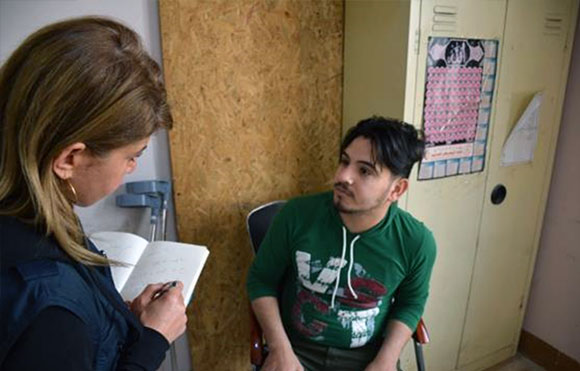 21-year-old Ahmed Jamil was injured by an improvised explosive device on 11 December 2016 in Mosul
21-year-old Ahmed Jamil came with his father to the Mosul rehabilitation centre to receive a WHO-donated wheelchair.
Trying to hide the bitterness and pain behind a shy smile, Ahmed described how he sustained his injuries. “It was the morning of the Mosul liberation, 11 December 2016. I was out buying some groceries when a device fixed to a tank exploded, causing me severe injuries. My right leg and a finger on my right hand were amputated, and I was left with a sharp fragment in my left eye as a result of the explosion,” he said.
“I was transferred by a WHO ambulance to Erbil Emergency Hospital where they did the amputation and referred me to the Rehabilitation and Prosthesis Centre for a prosthetic limb, which I haven’t yet received,” he added.
Mosul had one prosthesis facility and two rehabilitation centres prior to the crisis in 2014. As a result of the conflict, the prosthesis facility and one rehabilitation centre have been forced to close and the other rehabilitation centre is now only partially operational.
“Without a wheelchair, individuals must rely on their families or friends for transportation or resort to crawling,” said Dr Imad Hassan from the Mosul Rehabilitation Centre. “Our humanitarian duty is to provide this vulnerable population with assistive technology until a new factory to manufacture these aids is established in Mosul,” he added.
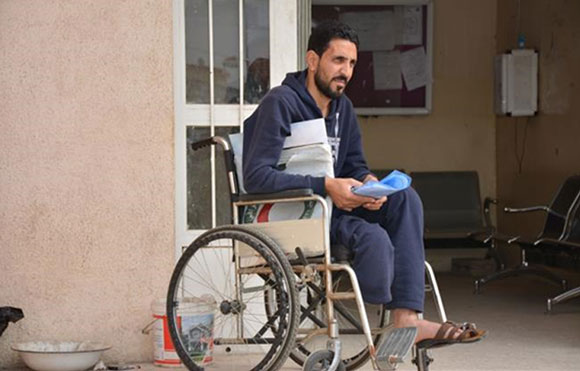 A man in need of a prosthetic leg visits the Mosul Rehabilitation Centre for a routine check and registration update
Majid Latif, a physiotherapist at the Mosul Rehabilitation Centre, explained that prosthetics are lifesaving for people with a limb amputation. As many as 10 requests are sent to the Suleimaniya rehabilitation and prosthetics production facility weekly. “We need a new rehabilitation centre in Ninewa to respond to the 19 000 requests for prosthetics that have so far been registered. Our staff also needs training in medical rehabilitation and physiotherapy,” he added.
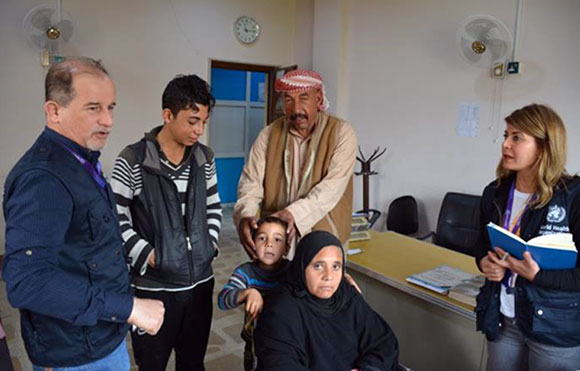 Jamila Ahmed, a mother of 10, was shot by a sniper in Mosul, her injuries resulting in the amputation of a leg
Jamila Ahmed, a mother of 10, came to the centre assisted by her husband, to receive a wheelchair. “I was injured by a sniper’s bullet on 17 March 2017,” she said. “I waited 4 months for an operation to remove the bullet. I had the operation and am now in need of a wheelchair for mobility and independence.”
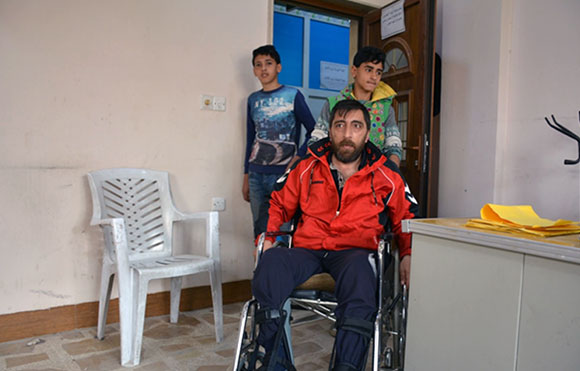 36-year-old Saif Muhaned Nima_Mosul is a victim of the conflict in Mosul
People in Mosul recount their stories and the grief among Mosul’s affected populations is immense, but assistive technologies like wheelchairs bring them hope. Saif Muhaned Nima, a resident of the east Mosul area who was evacuated with his family to the Hassan Sham camp for internally displaced persons during the liberation operation, says, “I am a father of 4 young children. I was at work when an armed group attacked me and shot me in the back. I have been using a walking stick for nearly a year now and was desperate for a wheelchair. Now I have one and I am so happy as it’s going to improve my life.”
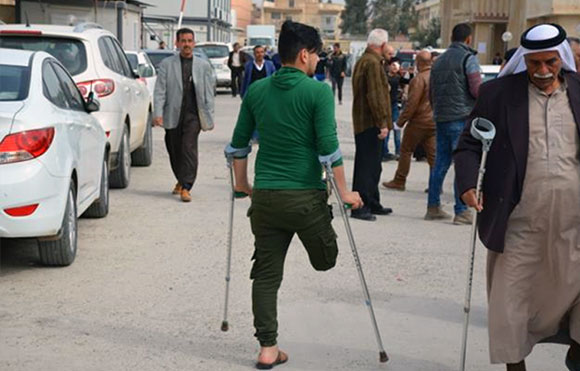 Ahmed Jamil makes his way down the street with the aid of crutches
People in conflict-affected governorates recently received wheelchairs as a result of several initiatives led by various local and international donors and individuals. Nearly 40 000 wheelchairs have been distributed in Ninewa, Anbar, Salah Aldin and Kirkuk. But needs are still huge and require the production of prosthetics locally and the establishment of national centres.
WHO’s emergency response operations and support to people with physical disabilities have been made possible through generous contributions from donors such as the Office of US Foreign Disaster Assistance (OFDA), the European Civil Protection and Humanitarian Aid Operations (ECHO), and the governments of Italy and Germany.
The World Health Organization (WHO) was actively engaged in providing lifesaving health care on the front lines during the Mosul operation in 2016-2017. The setting up of mobile trauma stabilization points (TSPs) and 4 field hospitals close to the battle lines has significantly contributed to saving hundreds of lives.
However, the conflict in Ninewa governorate, which is about to enter its fourth year, has left many victims with lifelong disabilities. It is estimated that severe trauma injuries have resulted in over 300 patients needing amputations, bringing the number of people in the governorate with physical disabilities as a result of the conflict in the governorate to approximately 5000.
Improving access to assistive technologies like wheelchairs, walkers and walking canes, hearing aids and others has been the focus of WHO, donors and local health authorities, marking a new phase of recovery in conflict-affected governorates.
In April 2018, WHO welcomed a contribution from the Government of Italy to support rehabilitation services for people suffering from disabilities as a result of the conflict in Mosul.
The contribution focused on supporting the prosthetics and rehabilitation centre in east Mosul. The project aimed to provide over 450 people, including 50 under the age of 5 and 300 older than 5, with specialized medical care and rehabilitation services.
21-year-old Ahmed Jamil was injured by an improvised explosive device on 11 December 2016 in Mosul
21-year-old Ahmed Jamil came with his father to the Mosul rehabilitation centre to receive a WHO-donated wheelchair.
Trying to hide the bitterness and pain behind a shy smile, Ahmed described how he sustained his injuries. “It was the morning of the Mosul liberation, 11 December 2016. I was out buying some groceries when a device fixed to a tank exploded, causing me severe injuries. My right leg and a finger on my right hand were amputated, and I was left with a sharp fragment in my left eye as a result of the explosion,” he said.
“I was transferred by a WHO ambulance to Erbil Emergency Hospital where they did the amputation and referred me to the Rehabilitation and Prosthesis Centre for a prosthetic limb, which I haven’t yet received,” he added.
Mosul had one prosthesis facility and two rehabilitation centres prior to the crisis in 2014. As a result of the conflict, the prosthesis facility and one rehabilitation centre have been forced to close and the other rehabilitation centre is now only partially operational.
“Without a wheelchair, individuals must rely on their families or friends for transportation or resort to crawling,” said Dr Imad Hassan from the Mosul Rehabilitation Centre. “Our humanitarian duty is to provide this vulnerable population with assistive technology until a new factory to manufacture these aids is established in Mosul,” he added.
A man in need of a prosthetic leg visits the Mosul Rehabilitation Centre for a routine check and registration update
Majid Latif, a physiotherapist at the Mosul Rehabilitation Centre, explained that prosthetics are lifesaving for people with a limb amputation. As many as 10 requests are sent to the Suleimaniya rehabilitation and prosthetics production facility weekly. “We need a new rehabilitation centre in Ninewa to respond to the 19 000 requests for prosthetics that have so far been registered. Our staff also needs training in medical rehabilitation and physiotherapy,” he added.
Jamila Ahmed, a mother of 10, was shot by a sniper in Mosul, her injuries resulting in the amputation of a leg
Jamila Ahmed, a mother of 10, came to the centre assisted by her husband, to receive a wheelchair. “I was injured by a sniper’s bullet on 17 March 2017,” she said. “I waited 4 months for an operation to remove the bullet. I had the operation and am now in need of a wheelchair for mobility and independence.”
36-year-old Saif Muhaned Nima_Mosul is a victim of the conflict in Mosul
People in Mosul recount their stories and the grief among Mosul’s affected populations is immense, but assistive technologies like wheelchairs bring them hope. Saif Muhaned Nima, a resident of the east Mosul area who was evacuated with his family to the Hassan Sham camp for internally displaced persons during the liberation operation, says, “I am a father of 4 young children. I was at work when an armed group attacked me and shot me in the back. I have been using a walking stick for nearly a year now and was desperate for a wheelchair. Now I have one and I am so happy as it’s going to improve my life.”
Ahmed Jamil makes his way down the street with the aid of crutches
People in conflict-affected governorates recently received wheelchairs as a result of several initiatives led by various local and international donors and individuals. Nearly 40 000 wheelchairs have been distributed in Ninewa, Anbar, Salah Aldin and Kirkuk. But needs are still huge and require the production of prosthetics locally and the establishment of national centres.
WHO’s emergency response operations and support to people with physical disabilities have been made possible through generous contributions from donors such as the Office of US Foreign Disaster Assistance (OFDA), the European Civil Protection and Humanitarian Aid Operations (ECHO), and the governments of Italy and Germany.