


Select your language
Regional early warning and response bulletins
WHO, in collaboration with governments affected by the Syrian crisis, has established an early warning alert and response network through their respective ministries of health. It is a network to strengthen the national surveillance system to detect outbreak threats in the Syria emergency situation. The EWARN is now well implemented in Iraq, Jordan, Lebanon and Syria.
Bulletins
 |
Regional early warning and response bulletin, March 2015, [pdf 561kb] |
|
Regional early warning and response bulletin, February 2015, [pdf 538kb] |
Iraqi refugees manage their diabetes in Jordan
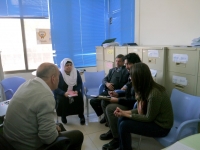 Iraqi patients discuss their conditions and the difficulties of being a refugee with diabetesOn the second floor of a building in downtown Amman, my colleague and I are ushered past a room of waiting people and into the reception area of Jordan Health Aid Society’s (JHAS) medical clinic. We are greeted with hot tea infused with mint leaves which we gratefully accept. It’s cold outside and the city is bracing itself for winter.
We’re met by Ms Fayroz Al Shamali, head of JHAS referral unit, and Dr Mohammad Al Nsour, the internist doctor and medical consultant for the JHAS referral hub. Fayroz organizes some chairs and introduces us to some patients who have travelled to the urban clinic for medical treatment and advice.
Shefeya (68), Afifah (61) and Riyad (59), are Iraqi refugees living in Amman. All three patients are diabetic.
Smiling, Shefeya slowly takes a seat next to us and shuffles towards a small fan heater. She begins to explain how she left Baghdad a year ago because of insecurity. The creases in the corners of her eyes change as she recalls home; Shefeya lost a son and grandson in Iraq. Shortly afterwards she was diagnosed with type 2 diabetes. She now lives in a suburb nearby to the clinic with three of her sons and her only daughter. Two of her boys remain in Iraq.
This is Afifah’s first visit to JHAS. She escaped Baghdad with her daughter five months ago after militants threatened to marry the girl by force. Afifah suffers from type 1 diabetes, hypertension and ischaemic heart disease. The new patient has gone without her diabetes medication for 40 days as the insulin stocks she brought with her from Iraq have run out.
Riyad arrived in Jordan in 2009, from Damascus, Syria, where he spent six years after fleeing his homeland. He has been a type 2 diabetic since 1999. With a stiff face he explains that he hasn’t seen his family since 2003 and does not know if they are still in Iraq, let alone alive.
Ongoing conflicts in the Middle East, particularly those in Iraq and Syria, have resulted in the forced displacement of millions of people. Many have crossed Jordan’s borders to find safety in camps and amongst host communities. According to UNHCR, the kingdom now hosts more than 640 000 registered refugees, mostly from Syria.
With such a large number of new residents has come a heavy strain on the country’s public services and infrastructure. Jordan’s health care system is buckling as it tries to meet the needs of a growing refugee population on top of already significant domestic needs.
The Government of Jordan provides free health care at all levels to UNHCR-registered Syrian refugees through its Ministry of Health primary care centres and hospitals. Iraqi refugees however, need to pay for health services. Cost of care, shortages in medicines and services and lengthy waiting times can make accessing necessary treatment a challenge.
JHAS is one of a handful of local nongovernmental organizations in Jordan working to address the health needs of the disadvantaged and vulnerable by filling gaps in health service provision and offering free health services to refugees and hard-hit locals alike. The organization operates eight primary health care clinics in Amman, Zarqa, Mafraq, Erbid and Ramtha governorates, and in Za’atari and Cyber City refugee camps, and runs a mobile health clinic in the country’s southern governorates.
Some of the primary health care services JHAS provides include GP consultations, medicines, laboratory tests, reproductive health services, mental health services, nutrition and health education, and dental care. Importantly, the organization also financially assists patients in need of secondary and tertiary health care, and aids in the patient referral process.
“Through our affiliation with UN agencies, health NGOs and Ministry of Health, academic and private hospitals, we strive to minimize the burden on our patients by helping to facilitate a smooth referral process,” says Fayroz.
“We try to ensure that our patients receive the care they need,” she says.
On average a JHAS clinic receives 50 patients per day. The majority of patients attending JHAS clinics present with chronic noncommunicable diseases (NCDs).
“Chronic illnesses are a huge problem in Jordan and across the Middle East,” says Dr Mohammad.
“The top three chronic conditions we treat in our clinics are cardiovascular diseases, respiratory diseases and diabetes mellitus. And diabetes is a big one; we see a lot of type 2 diabetics,” he adds.
According to the International Diabetes Federation, 382 million people worldwide live with diabetes. Of this figure, almost 10 percent, 35 million, live in the Middle East and North Africa Region (MENA)[1]. Regional prevalence for the disease is at 9.2%, meaning that nearly one in 11 people living in the MENA region suffers from the disease.
WHO figures show that last year in Jordan, NCDs accounted for 76% of total deaths in Jordan. Diabetes made up 7% of the total number of deaths, after cardiovascular diseases (35%), cancers (15%) and injuries (11%)[2].
Chronic illnesses such as diabetes place a significant financial burden on refugee families struggling to make ends meet, as they require ongoing medication and medical consultations. These illnesses can also have a substantial negative impact on human development as they reduce productivity, which in turn contributes to poverty.
According to Dr Mohammad, management of chronic illnesses in refugees is particularly challenging, as psychosocial stress caused by physical displacement, loss and separation from family, and exposure to war, can drastically affect whether or not patients follow prescribed medical advice and keep up with their treatment.
In terms of diabetic patients, stress and depression can lead to unhealthy lifestyle choices such as poor diet, physical inactivity and smoking, which complicate management of the disease.
Diabetes is a disease that occurs either when the pancreas does not produce enough insulin or when the body cannot effectively use the insulin it produces. Insulin is a hormone that regulates blood sugar. In type 1 diabetes, the body’s immune system attacks insulin-producing beta cells in the pancreas. As a result, the body can no longer produce insulin. The disease mostly occurs in children or young adults. In type 2 diabetes, the more common of the two types which typically occurs in adults, the body produces insulin but amounts are either insufficient or the body is unable to respond to its effects. This leads to a build-up of glucose in the blood.
Hyperglycaemia, or raised blood sugar, is a common effect of uncontrolled diabetes and over time leads to serious damage to many of the body's systems, especially the nerves and blood vessels. The disease can provoke damage to the eyes, heart, kidneys and feet, and, left untreated, can result in early death.
Unlike people with type 1 diabetes, most patients with type 2 diabetes do not require daily doses of insulin to survive. Many can manage their condition through a healthy diet, increased physical activity or oral medication such as Metformin – the medicine prescribed to Shefeya and Riyad, which decreases the amount of sugar in the blood and increases the body’s response to insulin. Metformin is relatively inexpensive in Jordan costing approximately 4 Jordanian dinars (USD 5.6) for 30 tablets. The medicine is taken once or twice daily.
Afifah requires insulin injections for her type 1 diabetes and her condition demands closer monitoring. Her treatment is more expensive costing approximately 16 dinars (USD 22.5) per ampoule, which allows for 30 doses of the drug. Afifah takes two injections of insulin daily to manage her diabetes.
When asked about which medicines they prefer, Iraqi or Jordanian branded, the patients laugh.
“Iraqi of course!”
“Why? Because they’re Iraqi,” the say, grinning.
“We rely on the medicines and treatment that JHAS provides, to help us carry on with our lives,” says Shefeyah. “It’s [living with diabetes] difficult sometimes, but the staff here really help us,” she adds.
“I’m very satisfied with the service here,” Riyad comments. “It is very good.”
Thanking the patients and staff for their time, we exchange “Maasalaama” (farewell), and part ways, heading back out into the cold. On the way back to work, I think about these patients’ stories and wonder how I would fare, if I were a 68-year-old forced to flee my home, needing to manage my diabetes on top of all my other problems.
WHO supports JHAS financially, enabling it to fill gaps in services for refugees and provide secondary and tertiary health care services to people in need of life-saving medical interventions. WHO support is particularly focused on the provision of tertiary health care for patients with chronic health conditions.
WHO continues to work closely with the Jordan Ministry of Health to strengthen the national health system.
By Joseph Swan
Jordan's weekly epidemological bulletins
In collaboration with the Ministry of Health, WHO/Jordan has created weekly epidemological bulletins. To access them please click on the links below.
Weekly Epidemiological Bulletin (Week 14)
Weekly Epidemiological Bulletin (Week 13)
Weekly Epidemiological Bulletin (Week 12)
Weekly Epidemiological Bulletin (Week 11)
Weekly Epidemiological Bulletin (Week 10)
Weekly Epidemiological Bulletin (Week 9)
Weekly Epidemiological Bulletin (Week 8)
Weekly Epidemiological Bulletin (Week 7)
Weekly Epidemiological Bulletin (Week 6)
Weekly Epidemiological Bulletin (Week 5)
Weekly Epidemiological Bulletin (Week 4)
Weekly Epidemiological Bulletin (Week 3)