

Select your language
WHO/Jordan vacancies announcement
In support of the national response to the Syrian refugee crisis in Jordan, the World Health Organization (WHO) office in Jordan is seeking highly-motivated Jordanian nationals under Special Service Agreements (SSA). All contracts for the following vacancies:
. Please click on the individual links below for the job descriptions.
(a) WHO Irbid Sub-office:
* 1 Field Office Coordinator - Health Systems Services (HSS)/Primary Health Care (PHC)
* 1 Technical Officer (Epidemiologist)
(b) WHO Mafraq Sub-office:
* 1 Field Office Coordinator - Health Systems Services (HSS)/Primary Health Care (PHC)
(c) WHO Amman Main Office
* 1 National Professional Officer- Health Systems Services (HSS)/Primary Health Care (PHC)
All contracts are to the end of 2013 and may be renewable subject to performance and funding availability.
Interested candidates should send their CVs to
WHO Regional Office calls for proposals for demonstration projects
In response to the World Health Assembly resolution (WHA66.22), the Regional Office invites submissions on possible demonstration projects on health research and development. The call for proposals is open to all sectors; including (but not limited to) civil society, academic and research centres, the private sector, nongovernmental organizations and researchers. Health research and development demonstration projects aim to address identified gaps that disproportionately affect developing countries, particularly the poor, and for which immediate action can be taken.
In November, the WHO Regional Office will organize a meeting of experts to review and select a maximum of four projects from the ones received. These short-listed projects will be further assessed during a global technical consultative meeting of experts and Member States planned for 3–5 December 2013 at WHO headquarters in Geneva, with the objective of proposing a priority list of a few projects for consideration by Member States. A report of the 3–5 December meeting, as well as description of the priority projects will be submitted by the WHO secretariat for consideration by the 134th WHO Executive Board; 20–25 January 2014) and the 67th World Health Assembly in May 2014.
The selection of demonstration projects will be based primarily on the following considerations:
1. addressing research and development gaps related to discovery, development and/or delivery of health technologies for diseases that disproportionally affect developing countries, particularly the poor, and for which immediate action can be taken;
2. utilization of collaborative approaches, including open-knowledge approaches, for research and development coordination;
3. promotion of the de-linkage of the cost of research and development from product price; and
4. proposing and fostering innovative financing mechanisms, including innovative, sustainable and pooled funding;
For example, the projects may include diagnostic tools for infectious diseases, and antibiotics and other anti-infective agents, among others.
The deadline for submission of demonstration projects is 31 October 2013 : Interested parties may send their proposals (using the below template) to
Standard_Template_for_Candidate_Demonstration_Project
Any proposals received after this date will not be considered.
Al Zaatari: an overview of health services in the camp
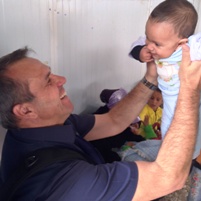 Dr Pier Paolo Balladelli, new WHO Regional Emergency Coordinator for the Syrian crisis, with a Syrian baby at a health facility in AlZaatari camp8 October 2013 – With over 115 000 refugees in Al Zaatari camp, the provision of quality health services remains a priority not only for Syrians living in the camp but for those outside living among the host community.
15 months after Al Zaatari refugee camp in northern Jordan opened, Syrian refugees continue to seek shelter there. The protracted crisis has meant many services in the camp have been expanded and improved to respond to the growing needs of the vulnerable populations, none more so than the health sector. Although the number of refugees entering Jordan has decreased since the early spring (which saw 2000–3000 Syrians per day cross the border), the heavy burden on health services remains.
Primary health care
There are now over 115 000 Syrians currently residing in Al Zaatari (source: UNHCR). They are in need of regular health services. Even though the Ministry of Health together with the United Nations Office of the High Commissioner for Refugees (UNHCR), UNICEF, United Nations Population Fund (UNFPA), Médecins du Monde (MDM), Médecins San Frontières (MSF), WHO and other partners have worked tirelessly to improve the quality of health outreach, some gaps still remain.
Dr Mohammed Abu Khadair, the Health Coordinator for Al Zaatari believes that “the health sector in the refugee camp has seen dramatic improvements since the opening over a year ago. Now there are surveillance mechanisms in place and all actors are involved in securing regular analysis and acting rapidly on collecting health information. Secondary care is in place in the camp; however, primary health care remains the focus.”
In tight coordination with the Jordanian Ministry of Health, numerous facilities provide primary health care, including clinics administered by MDM, the Jordan Health Aid Society, Saudi Government, and MSF. In the camp, secondary care is being supplied through the Moroccan and Jordan–Italian military field hospitals. Tertiary care needs are referred outside the camp to the hospital in Mafraq.
Hygiene – a pressing issue
“Hygiene is a key issue for the overall health of the individuals in Al Zaatari,” stated Dr Abu Khadair. “Solid waste management needs improvement, and hygiene practices as well. “Vulnerability related to foodborne diseases, such as hepatitis A and rotavirus, remain as a top priority in the camp in order to prevent outbreaks,” said Dr Pier Paolo Balladelli, WHO Regional Emergency Coordinator for the Syria crisis. “Sanitation, specifically exploring how to improve waste management and hygiene of food stalls within the camp”.
An improved health system management
Emphasis is being placed on diseases, such as tuberculosis and measles. Active surveillance measures have been put in place to monitor and respond to any potential outbreaks in the camp. Health surveillance and preparedness of outbreak in Al Zaatari has greatly improved since the opening of the camp 15 months ago, with the early warning systems being strategically enforced.
Similarly, the improvement of overall health service management has been a key success story for Al Zaatari. Qualitative and timely in-camp laboratory-testing has meant that many diseases are being timely identified. Similarly, the systematic measles vaccination of all individuals under the age of 30 who enter the camp has been a major success, and the outbreak with 16 cases is now just a situation of the past as 0 cases of measles have been reported since the decision took place. With the imminent introduction of patient cards and the tracking of patients, it is expected that the provision of health care will be increasingly effective and efficient.
However, the camp needs medicines, particularly for chronic diseases, and ambulances for the referral to secondary and tertiary non-camp hospitals and health facilities.
Refugees outside Al Zaatari
With over 400 000 Syrians living in host communities around Jordan (source UNHCR), the Ministry of Health and WHO have shifted attention towards refugees in these local areas. Through the excellent work of UNHCR and UNICEF, WHO has been able to move away from much of the day-to-day health activities in Al Zaatari, and target the Syrians living in Jordan. “While technical actions are still needed for camp refugees, we believe that it is now time for WHO to focus and work for strengthening access of people in need outside camps to health services in host communities,” said Dr Pier Paolo Balladelli WHO Regional Emergency Coordinator for the Syrian crisis.
Lessons for the future
The work carried out by the health sector actors both in and outside Al Zaatari cannot be underestimated: the systematic improvements of services is apparent and should be commended as such. However, some issues still need to be addressed. As mentioned previously, hygiene, sanitation and waste management are crucial. Similarly, the improvement of both referral systems and health system management with the direct technical support from the Ministry of Health and WHO should be a priority. The need for involvement of community and religious leaders in health aspects in the camp is key. These influential figures have the ability to advocate for behavioural change (such as hygiene) that will not only prevent diseases, but ultimately promote health.