

Select your language
Securing a polio-free world
 A series of 6 videos explains the important steps that are being taken to make sure that, once the poliovirus has been eradicated, it will never have the opportunity to return. Although the world has never been closer to achieving the goal of polio eradication, much remains to be done.
Once wild polio has been eradicated, the only risks of the virus returning would come from rare strains of circulating vaccine derived polioviruses, and from potential leaks of the virus from laboratories or vaccine manufacturers. The 6 videos explaint he work being done to address these risks.
Videos
4. Phasing out oral polio vaccines
Pakistan second endemic country to introduce IPV into routine immunization schedule
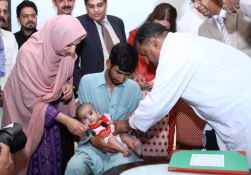 A child is vaccinated using inactivated polio vaccine (IPV) at the national launch of IPV into the routine immunization programme in Islamabad, Pakistan, presided over by the Honorable Minister of State Mrs Saira Afzal TararIslamabad, 24 August 2015 -- Pakistan has taken another step towards a polio-free future on Thursday, introducing IPV into its routine immunization schedule at a ceremony presided over by the Minister of State, Ministry of National Health Services Regulation and Coordination, Mrs Saira Afzal Tarar, and attended by representatives of WHO, UNICEF, GAVI and other development partners, such as USAID and the UK Department for International Development, in the capital, Islamabad.
The introduction of the inactivated polio vaccine (IPV) across Pakistan will benefit more than 6 million children per year, and will be administered to children alongside other life-saving vaccines.
Epidemiological analysis of HIV epidemic and AIDS response in Pakistan
Pakistan is preparing to submit a concept note under new funding model to the GFATM in April 2015. In this context, national authorities and UN partner agencies will compile and review available information on the epidemiology of HIV in Pakistan and develop an up-to-date epidemiological profile, of the country. The WHO country office will provide support to the national AIDS control programme in the epidemiological analysis of the HIV epidemic and AIDS response in Pakistan. The consultant will also work closely with the technical working group constituted for providing oversight to the concept note development, under the new funding model for Pakistan.
Rising epidemics among people who inject drugs (PWID) have continued unabated, with estimated national HIV prevalence at 27.2% in 2011, an increase from 11% in 2005. Recent Integrated Biological and Behavioral Surveillance (IBBS) indicate high levels of HIV among PWID in several key cities: 52.5% in Faisalabad, 49.6% in Dera Ghazi Khan, 46.2% in Gujrat, 42.2% in Karachi and 31% in Lahore (IBBS 2011). Notably, the HIV prevalence among young PWID (34%) is higher than among older cohorts of PWID (25%) aged more than 25 years (IBBS 2011). High HIV prevalence levels are also detected among hijra sex workers (HSW) in Larkana (15%) and Karachi (12%) – much higher than the estimated national prevalence of 5.2% in 2011 - and among male sex workers (MSW) in Karachi (6%) (IBBS 2011). HIV among men who have sex with men who are not sex workers has not been measured. HIV prevalence remains low (<1%) among female sex workers through the four rounds of ibbs conducted between 2005 and 2011.
Overall objective
The overall goal of this exercise is to review and amalgamate HIV data of Pakistan to determine strategic priorities for the HIV response and suggest efficient resource allocation for the programmes.
Specific objectives
1. Review descriptive epidemiological data of published/unpublished resources and reports to describe the epidemiology of HIV and AIDS in Pakistan, including an assessment of the quality and availability of data and the investments needed to improve measurement of disease burden.
2. Joint review of trends of available epidemiological data (disease incidence, prevalence, mortality) nationally and, where feasible, for subnational areas and subpopulations.
3. An assessment of whether observed trends in disease burden can be plausibly related to programmatic efforts (e.g., service delivery and coverage) and behavioral trends where relevant.
4. Use the evidence to suggest focused, targeted and cost effective and evidence-based response to HIV in the country.
The first is an assessment of the quality and availability of data and the investments needed to improve measurement of disease burden. The second is a joint review of trends of available epidemiological data (disease incidence, prevalence, mortality) nationally and, where feasible, for subnational areas and subpopulations. The third is an assessment of whether observed trends in disease burden can be plausibly related to programmatic efforts and behavioral trends where relevant.
Tasks
The consultant will undertake the following tasks:
1. Conduct desk review of available data sources
2. Prepare a draft report
3. Present draft report at a meeting of national experts and stakeholders
4. Produce final report
5. Submit end-of-assignment report detailing what has been accomplished and what follow up actions need to be taken by NACP/WHO and partners.
Data collection needs
After the enactment of 18th constitutional amendment, with devolution of powers from the federal to the provinces, the HIV response in the country decentralized to the provinces i.e. the Provincial AIDS Control Programs. The Provincial programs, through their own PC1’s started implementing HIV/AIDS related activities, in their provinces, as independent programs. There is a degree of variance across the provincial, while two provinces at present are implementing Global fund related activities only, under the principal recipient, the NACP. The consultant will be required to visit at least two Provincial Programs (Sindh & Punjab) and hold a meeting with key stakeholders. The purpose of the meeting would be to capture provincial specific data that may not be available at the national level. Key civil society organization, along with the public sector will be invited to present their data.
Deliverables
1. Inception report on third day of assignment
2. Weekly progress reports (W1, W2, W3)
3. Draft technical report to be presented to expert meeting (W3)
4. Final technical report at the end of assignment (W4).
Timeframe
The assignment shall be completed within 6 weeks of signing the agreement.
|
Sr. |
Task |
Timeline |
|||||
|
Week 1 |
Week 2 |
Week 3 |
Week 4 |
Week 5 |
Week 6 |
||
|
1 |
Desk review of the available data |
|
|
|
|
|
|
|
2 |
Inception meeting with key stakeholders |
|
|
|
|
|
|
|
3 |
Submission of Inception Report & the work plan |
|
|
|
|
|
|
|
4 |
Visit to Provincial Programs, to meet key stakeholders, and discuss & gather provincial specific data |
|
|
|
|
|
|
|
5 |
Epidemiological Data analysis including trends assessment and its relevance to the programmatic response, and guide evidence based response |
|
|
|
|
|
|
|
6 |
Present analytical data & response to the TWG, for discussion |
|
|
|
|
|
|
|
7 |
Draft report submission for review & comments by TWG |
|
|
|
|
|
|
|
8 |
Submission of final report with TWG comments incorporated |
|
|
|
|
|
|
Required qualifications, competencies and skills
1. Medical degree with a Master’s degree in public health
2. Demonstrated professional experience of at least 10 years in grant proposal writing. Preference will be given to those having specific experience of proposal writing for the Global Fund to fight against AIDS, Tuberculosis and Malaria (GFATM).
3. Demonstrated research and evaluation skills and experience in the related field with iNGOs, UN agencies and/or the government. Publish papers in indexed journals would be an added consideration
4. Reporting and Data Analysis skills are mandatory
Duration and timelines for assignment
The duration of the assignment would be for 36 working days over a total period of two months from the start of the assignment. Ten days will be employed for field travel.
Note: The copyright of the documents and material would be reserved with the World Health Organization.
Submission of financial and technical offer:
All proposals must be sent to WHO office before 17 November 2014
Financial and technical proposals each in a separate sealed envelope should be sent by courier marked and addressed to:
Epidemiological analysis of HIV epidemic and AIDS response in Pakistan
WHO Representative Pakistan
World Health Organization
WHO Building
National Institute of Health
Park Road
Chak Shahzad
Islamabad
Pakistan