


Select your language
WHO releases latest health access report for the occupied Palestinian territory
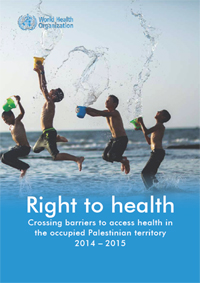 29 November 2016, Gaza – On the occasion of International Day of Solidarity with the Palestinian People, marked by the UN since 1977[1], WHO launched a 2-year report on health access today at an event in Gaza to highlight how the Israeli permit system and physical barriers obstruct health access for Palestinian patients, ambulances and health workers. The study “Right to health: crossing barriers to access health in the occupied Palestinian territory, 2014 – 2015,” was based on data provided by Palestinian Authority ministries and non-profit health providers, as well as patient interviews and field studies.
“Access is a fundamental element of the right to health. Every mother and child has the right to be together during a child’s cancer treatment,” said Dr. Gerald Rockenschaub, the WHO head of the office in the West Bank and Gaza. “Yet the data indicates substantial restrictions for thousands of patients and their companions who are trying to travel to their places of referral.” The 48-page report also presents information on the impact of attacks on health facilities, patients and health personnel, and the health access situation in “Area C” in the West Bank, where Israel retains full security and civil authority.
The Palestinian Ministry of Health refers patients to other facilities if the recommended medical treatment is unavailable in Ministry hospitals. 86% of the 162 300 referrals issued by the Ministry in 2014 and 2015 were to Palestinian medical centers, the majority located in East Jerusalem and inaccessible to patients without an Israeli-issued permit. The complex permit regime can result in delays and denial of care for patients which can impact their health; permit restrictions for health personnel can also disrupt medical services. Israeli security services also request certain patients to appear for interviews and deny permits for security reasons.
Denials and delays in responding to health permit applications noticeably increased for Gaza patients who have faced tightened security procedures since 2012 and particularly over the past two years. The number of patients seeking access permits through Erez checkpoint has more than doubled to 21 899 in 2015, while the permit approval rates have steadily dropped: from 92.5% in 2012 to 88.7% in 2013, 82.4% in 2014 and 77.5% in 2015. (Since the writing of the report, the situation further worsened in Gaza: by October 2016, the approval rate had fallen to 44%.)
The closure of the Rafah border crossing between the Gaza Strip and Egypt in July 2013 limited the number of patients able to exit: in 2014 to 3 117 and in 2015 to less than half that, owing to the closed borders.
The permit approval rate for West Bank patients also dropped from 79.4% in 2013 to 77.3% in 2014, but improved to 83.1% in 2015, when Israeli authorities no longer required permits for men over 55 years and women over 50 years.
“This is about freedom of movement at its most raw level – the right to access, literally, life-saving services for you, or an elderly parent or perhaps an infant child” said the UN Coordinator for Humanitarian Aid and Development Activities Mr. Piper at the report launch. “The very idea that a fence, a wall, a security guard, a bureaucrat could stand between you and such life-saving services should fill us all with a shared sense of dread.”
WHO, the Swiss Agency for Cooperation and Development and the Ministry of Health also focused on the importance of advocacy to ensure protection for health and human rights. The Palestinian Ministry of Health and other ministries, UN agencies, donor governments and humanitarian health and human rights organizations attended the event. The report made recommendations to Israel as the occupying power and main legal duty bearer, and to Egypt, to remove restrictions on patients and facilitate access to health services.
Related link
Right to health: Crossing barriers to access health in the occupied Palestinian territory, 2014–2015
Read the News Release in Arabic
[1] To mark the day, in 1947, when the UN General Assembly adopted the resolution on the partition of Palestine (Resolution 181 (II)), which had provided for the establishment in Palestine of a “Jewish State” and an “Arab State”, with Jerusalem as a corpus separatum under a special international regime.
Two years after the 2014 Gaza hostilities, 16 heads of UN agencies in Palestine call for greater flow of material and funding to reverse Gaza’s de-development spiral, August 2016
Jerusalem, 26 August 2016 – On the day marking 2 years since the 26 August 2014 ceasefire which ended the most devastating round of hostilities in Gaza since the beginning of the occupation in 1967, 16 heads of United Nations agencies in Palestine call for the uninterrupted and predictable flow of material and increased funding to address humanitarian needs and boost economic prospects for Gaza’s 1.9 million residents.
In a report released today, United Nations agencies document collective progress made in the last 2 years, as well as some of the remaining challenges in the recovery and reconstruction effort following the 2014 hostilities, which left at least 1400 Palestinian and six Israelis civilians dead, 11 200 Palestinians injured and an estimated 100 000 people homeless. Children and women accounted for over 60% of all fatalities and injuries in Gaza.
The United Nations estimates that to date, half of the homes which suffered partial damages and a third of destroyed homes have been rebuilt; thanks to ongoing efforts by the Palestinian government, United Nations agencies, nongovernment organizations, the international donor community, the private sector and above all, the households themselves. All of the 78 hospitals, clinics and the 252 schools damaged have been repaired, while the reconstruction of health and education infrastructure that were fully destroyed is ongoing.
“While progress is unequivocally underway, repairing the damages from the 51-day hostilities cannot be our only measure of success, given that humanitarian and socioeconomic indicators were already so dire before 2014,” warned Robert Piper, the UN Coordinator for Humanitarian Aid and Development Activities. “We must reverse Gaza’s de-development trajectory and address the needs of a population that has gone through 3 rounds of conflict, 9 years of an Israeli blockade and the consequences of the Palestinian internal divide which, combined, have affected every aspect of their daily lives. Accountability for violations of international law by duty bearers on both sides during the war also remains elusive, denying victims and survivors the justice and redress they deserve.”
The vast majority of people living in Gaza were affected by the large-scale damage to infrastructure super-imposed on an already frail economic situation. Progress remains particularly slow in the productive sectors including agriculture, owing to funding gaps and restrictions of movement on persons and goods. “Addressing economic recovery requires much greater financial investments and serious policy changes, including a lifting of restrictions on both imports and exports”, Robert Piper noted. “Improved cooperation between Ramallah and Gaza City is also a pre-requisite to get greater momentum while the operating space for aid actors working inside Gaza must be protected and respected at all costs” he added.
In October 2014, donors pledged US$ 3.5 billion to support Gaza. According to the World Bank, only an estimated 40% had been disbursed by April this year. Funding for the remaining reconstruction work and serious investments in the productive sector is crucially lacking, further hindering people’s ability to lift themselves out of crisis. There are particular concerns for the 65 000 people who remain displaced and in temporary shelter awaiting their homes to be rebuilt.
“The stakes are high if we are to prevent hopelessness and a re-escalation of violence”, Piper warned on behalf of the UN Country Team in Palestine. “All parties must come together to chart a clear course towards a just and final peace, including achieving a full lifting of the blockade, while ensuring Israel’s legitimate security concerns, and establishing two States living side by side in peace and security,” Piper noted, recalling the words of the UN Secretary-General at the October 2014 Cairo international conference on Gaza’s reconstruction.
Note to editors
The UN Country Team (UNCT) includes all UN operational agencies working in Palestine. The UNCT operates under the leadership of the UN Coordinator for Humanitarian Aid and Development Activities in the occupied Palestinian Territory, Robert Piper.
The report referenced in this statement is accessible at: http://bit.ly/GazaUNReport. A summary infographic of reconstruction progress and remaining needs is available at: http://bit.ly/GazaGraphics.
WHO video highlights how social determinants affect health in Gaza, June 2016
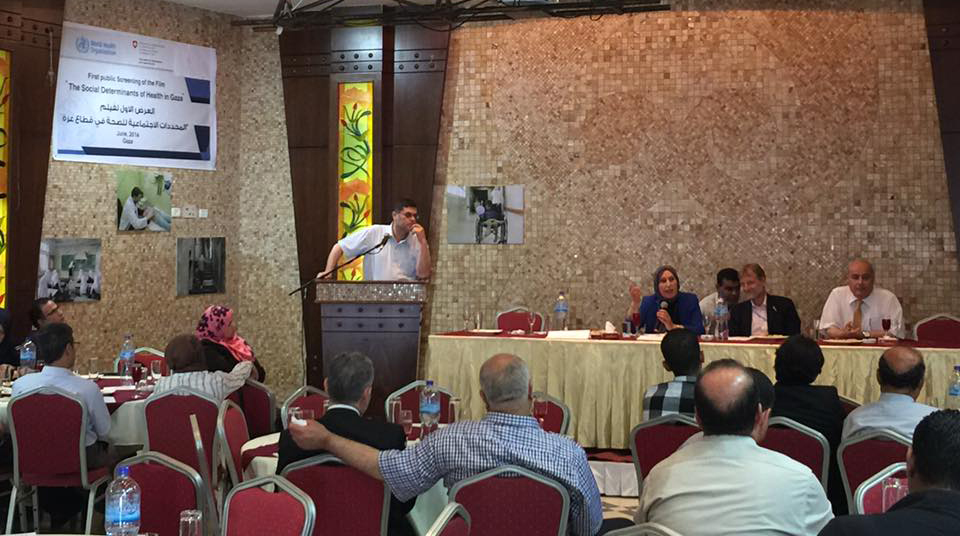 5 June 2016, Gaza Strip – WHO has drawn attention to the social determinants of health of Palestinians living in the Gaza Strip, through the launch of a 12-minute video. The video was shown to a public assembly of health and other service providers in Gaza city on 1 June. More than 150 people attended the WHO advocacy event, including staff from the Ministry of Health, Ministry of Education and Higher Education, academics, civil society and international nongovernmental organizations, as well as UN agencies, UNRWA, donors and media. The video showed how the health and life course of 1.8 million Palestinians in the isolated and besieged Gaza Strip are shaped by the political, social and economic circumstances of daily conditions. It showed families living with poor housing, education and water infrastructure, high unemployment and poverty, poor nutrition and the impact of violence.
Dr Gerald Rockenschaub, WHO Head of Office in the West Bank and Gaza, addressed the group, along with Dr Fouad Issawi, the head of primary health care in the Ministry of Health, and Dr Ghada Al-Gadba, Chief of the Field Health Programme at UNRWA. “Without a political solution, the health system is limited in its ability to positively affect population health,” pointed out Dr Rockenschaub. “This video gives us an opportunity to raise issues with a key audience. But we need to broaden efforts and deepen our engagement.”
“The world looks to Gaza only during war,” said UNRWA’s Dr Al-Gadba, “but when there is no increase in services to meet population demand, then the situation deteriorates.” Dr Issawi stated that, “the film reflects the difficult situation in Gaza, and the need for adequate responses.”
Following the screening, Dr Mahmoud Daher, Head of WHO Gaza sub-office, facilitated an open discussion with audience members. The audience expressed the importance of addressing the broader causes of social determinants of health in the Gaza Strip, and the need for a strategy and recommendations to improve the situation to enable people to enjoy health to its full potential.
Related links: