

Select your language
Diarrhoeal treatment capacity increasing in Pakistan, but sustained support needed
Diarrhoeal treatment capacity increasing in Pakistan, but sustained support needed
30 August, 2010 ¦ ISLAMABAD -- The World Health Organization is establishing diarrhoeal treatment centres throughout flood-ravaged Pakistan, a key intervention by the humanitarian health sector as it strives to protect people against epidemic-prone acute water-borne diseases, reduce excess deaths and restore routine health care services.
According to new data issued 29 August, 500 635 people are recorded as having been treated for the various forms of diarrhoeal disease, ranging from acute watery diarrhoea and bloody diarrhoea (Shigella) to milder variations. This number represents 13% of the 3.7 million people recorded as having been treated between 29 July and 26 August. On 26 August alone, 19 178 cases of acute diarrhoea were reported.
Dr Hussein Gezairy, WHO Regional Director for the Eastern Mediterranean has warned against the increased risk of diarrhoeal diseases in the flood-stricken areas. He pointed out that this increase is due to the lack or absence of access to safe water for the people affected by the floods, as well as to the poor sanitation and to the compromised hygiene and living conditions in which the millions displaced by the floods are forced to live. "More than 60 diarrhoeal treatment centres (DTCs) are operational or are in the process of being established in 46 of the most affected districts. USAID and the Office of US Foreign Disaster Assistance are funding the establishment of these centres, which are being operated by nongovernmental organization partners and Pakistani health authorities", he added
"The terrible scale of this disaster has shocked the entire world, and the increasing trend in diarrhoeal diseases remains a grave concern to the humanitarian community", said Dr Guido Sabatinelli, WHO Representative in Pakistan. "The current situation remains a major threat to public health. If the current poor environmental and hygiene situation in affected areas does not improve, together with availability of safe drinking-water and access to health services, then the risk is that we may see more potentially fatal cases if diarrhoeal and other acute water-borne diseases in the coming days".
Diarrhoeal diseases are not the only public health risks facing Pakistan's flood-affected people. Acute respiratory infections, hepatitis A and E, malaria and skin infections are among multiple health threats that have already affected hundreds of thousands of people.
The combination of challenges preventing many people reaching health care is worrying, requiring health providers to intensify efforts, both to deliver health services directly to those who need it, and to find alternative means, such as by air, to reach communities isolated by floodwaters.
"More than 400 hospitals and clinics have been damaged by this disaster, destroying in the blink of an eye services that have been built up over 60 years. And the worst is not over yet", said Dr Sabatinelli. "The waters could remain for weeks, and the damage caused will remain even longer. The humanitarian community has a monumental task to protect the health of so many vulnerable people. And this will require sustained international support."
WHO and Health Cluster partners have sought US$ 56.2 million to conduct life-saving health programmes in the Pakistan Initial Floods Emergency Response Plan 2010 launched 9 August. So far, just 43% has been covered by pledges or commitments for the plan, which covers relief efforts for the first 90 days of the emergency. Since the crisis started, WHO has delivered to health care providers supplies capable of treating 2.6 million people for a range of illnesses, including diarrhoea.
"More funding is urgently needed to deliver health services to extremely vulnerable communities now, and sustained support will also be needed in the months ahead as Pakistan tries to rebuild its health system for the future", said Dr Sabatinelli.
57th Session of the WHO Regional Committee for the Eastern Mediterranean
The opening session of the 57th WHO Regional Committee for the Eastern Mediterranean will begin at 9.00 a.m. on Sunday 3 October 2010 at the WHO Regional Office in Cairo. During the meeting Regional Committee members"”the ministers of health of Member States of the Region"”and experts from WHO headquarters, will review, discuss and take appropriate decisions on a range of crucial health issues.
One item for discussion is infection prevention and control in health care settings. The risk of infection during health care delivery is 2"“20 times higher in developing countries than in developed countries and infection rates among patients can exceed 25%. A set of easily-implementable interventions will be proposed to reduce nosocomial infections without major resource implications.
Another item will address improvements in health care financing in the Region. Currently, many patients incur high out-of-pocket health expenditure exposing households to the risk of financial catastrophe and impoverishment. A number of strategic directions will be discussed to expedite the move towards universal health care coverage.
The public health problem of maternal, child and adolescent mental disorders will also be discussed. The estimated prevalence of 15-36% for maternal mental disorders and 10-36% for child and adolescent mental disorders in the Region is significantly higher than the estimates for developed countries. Mental disorders are associated with adverse reproductive health outcomes, as well as adverse child and adolescent development outcomes. Committee members will review strategic directions and propose actions to relieve the burden of mental ill-health for these vulnerable sections of society.
The HIV epidemic continues. An estimated 50 000 to 100 000 new infections occurred last year. Despite efforts to prevent further spread of the disease, gaps still exist. The Regional Committee will consider a draft resolution addressing ways to improve knowledge about the epidemic, to reinforce commitment and to address persisting challenges more effectively.
The Committee will also consider a draft resolution on the adoption of a regional strategy on nutrition for the period 2010"“2019 to support countries in establishing and implementing actions to improve the nutritional status of people throughout their life cycle.
Health topics for which resolutions were adopted in the previous session will also be discussed, including tobacco use. Several countries have been developing and strengthening their national tobacco control legislation. Tobacco control constitutes one of the most complicated challenges facing the Region due to the lack of a systematic approach for its control.
The report on primary health care-based systems examines countries' increasing commitment to primary health care since the signing of the Qatar Declaration in 2008, whether by promoting the family practice approach or strengthening health systems to achieve universal coverage for those in need.
The issue of polio eradication will also be reviewed. Nineteen countries have maintained their polio-free status and most are close to obtaining certification of poliomyelitis eradication. Afghanistan and Pakistan, however, are still endemic. In Sudan, no imported cases have been reported for several months.
The status of countries' progress in achieving the 2015 targets of the Millennium Development Goals will also be examined. Ten countries are unlikely to achieve these set targets if efforts in this direction are not accelerated.
The Regional Director's annual report on the work of WHO in 2009 and resolutions and decisions of regional interest adopted by the World Health Assembly and Executive Board for World Health Organization will also be reviewed.
A special session on the WHO Framework Convention of Tobacco Control (FCTC) will be held in the afternoon of the first day to mark the fifth anniversary of the Convention. This special session will be chaired by Dr Hussein A. Gezairy, WHO Regional Director for the Eastern Mediterranean, and the main speaker will be Dr Haik Nikogosian, Head of the WHO Framework Convention on Tobacco Control. Ministers of health from Member States of the Region will attend the session.
Invitation is hereby extended to all media personnel to cover both the opening and special sessions of this 57th Regional Committee meeting.
UN Decade of Action for Road Safety 2011-2020
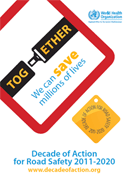 The United Nations Decade of Action for Road Safety will be formally launched in countries around the world on Wednesday 11 May 2011. The launch of the Decade of Action for Road Safety marks the beginning of a 10-year journey, in which vigilant and concerted actions are required by different stakeholders, from governments to communities, and from national to international settings, to improve road safety.
In the Eastern Mediterranean Region, launch events will be undertaken in many countries, including Djibouti, Egypt, Iraq, Islamic Republic of Iran, Jordan, Lebanon, Morocco, Oman, Qatar, Saudi Arabia and the United Arab Emirates.