

Select your language
COVID-19 Weekly updates
About our reports
WHO Special Situation Reports focus on the current emergency in oPt and WHO's response
Health Cluster Bulletins are a summary update of the Health Cluster's humanitarian response in Gaza, led by WHO and coordinated with more than 70 cluster partners
2021
oPt COVID-19 Email Updates:
- WHO Coronavirus disease (COVID-19) Situation Report 71, issued April 8, 2021
- WHO Coronavirus disease (COVID-19) Situation Report 70, issued April 1, 2021
- WHO Coronavirus disease (COVID-19) Situation Report 69, issued March 25, 2021
- WHO Coronavirus disease (COVID-19) Situation Report 68, issued March 18, 2021
- WHO Coronavirus disease (COVID-19) Situation Report 67, issued March 11, 2021
- WHO Coronavirus disease (COVID-19) Situation Report 66, issued March 4, 2021
- WHO Coronavirus disease (COVID-19) Situation Report 65, issued February 25, 2021
- WHO Coronavirus disease (COVID-19) Situation Report 64, issued February 18, 2021
- WHO Coronavirus disease (COVID-19) Situation Report 63, issued February 11, 2021
- WHO Coronavirus disease (COVID-19) Situation Report 62, issued February 4, 2021
- WHO Coronavirus disease (COVID-19) Situation Report 61, issued January 28, 2021
- WHO Coronavirus disease (COVID-19) Situation Report 60, issued January 20, 2021
- WHO Coronavirus disease (COVID-19) Situation Report 59, issued January 14, 2021
- WHO Coronavirus disease (COVID-19) Situation Report 58, issued January 6, 2021
- December 2020
- WHO Coronavirus disease (COVID-19) Situation Report 57, issued December 23 2020
- WHO Coronavirus disease (COVID-19) Situation Report 56, issued December 17 2020
- WHO Coronavirus disease (COVID-19) Situation Report 55, issued December 10 2020
- WHO Coronavirus disease (COVID-19) Situation Report 54, issued December 3 2020
- October 2020
- WHO Coronavirus disease (COVID-19) Situation Report 50, issued October 29 2020
- WHO Coronavirus disease (COVID-19) Situation Report 49, issued October 22 2020
- WHO Coronavirus disease (COVID-19) Situation Report 48, issued October 15 2020
- WHO Coronavirus disease (COVID-19) Situation Report 47, issued October 8 2020
- WHO Coronavirus disease (COVID-19) Situation Report 46, issued October 1 2020
- September 2020
- WHO Coronavirus disease (COVID-19) Situation Report 45, issued September 24 2020
- WHO Coronavirus disease (COVID-19) Situation Report 44, issued September 17 2020
- WHO Coronavirus disease (COVID-19) Situation Report 43, issued September 10 2020
- WHO Coronavirus disease (COVID-19) Situation Report 42, issued September 03 2020
- July 2020
- WHO Coronavirus disease (COVID-19) Situation Report 38, issued July 30 2020
- WHO Coronavirus disease (COVID-19) Situation Report 37, issued July 23 2020
- WHO Coronavirus disease (COVID-19) Situation Report 36, issued July 16 2020
- WHO Coronavirus disease (COVID-19) Situation Report 35, issued July 9 2020
- WHO Coronavirus disease (COVID-19) Situation Report 34, issued July 2 2020
- May 2020
- WHO Coronavirus disease (COVID-19) Situation Report 31, issued May 28 2020
- WHO Coronavirus disease (COVID-19) Situation Report 30, issued May 21 2020
- WHO Coronavirus disease (COVID-19) Situation Report 29, issued May 14 2020
- WHO Coronavirus disease (COVID-19) Situation Report 28, issued May 7 2020
- WHO Coronavirus disease (COVID-19) Situation Report 27, issued May 3 2020
- April 2020
- WHO Coronavirus disease (COVID-19) Situation Update 26, issued April 30 2020
- WHO Coronavirus disease (COVID-19) Update 25, issued April 26 2020
- WHO Coronavirus disease (COVID-19) Update 24, issued April 23 2020
- WHO Coronavirus disease (COVID-19) Update 23, issued April 19 2020
- WHO Coronavirus disease (COVID-19) Update 22, issued April 16 2020
- WHO Coronavirus disease (COVID-19) Update 21, issued April 12 2020
- WHO Coronavirus disease (COVID-19) Update 20, issued April 9 2020
- WHO Coronavirus disease (COVID-19) Update 19, issued April 5 2020
- WHO Coronavirus disease (COVID-19) Update 18, issued April 3 2020
- WHO Coronavirus disease (COVID-19) Update 17, issued April 1 2020
- March 2020
- WHO Coronavirus disease (COVID-19) Update 16, issued March 30 2020
- WHO Coronavirus disease (COVID-19) Update 15, issued March 28 2020
- WHO Coronavirus disease (COVID-19) Update 14, issued March 26 2020
- WHO Coronavirus disease (COVID-19) Update 13, issued March 24 2020
- WHO Coronavirus disease (COVID-19) Update 12, issued March 22 2020
- WHO Coronavirus disease (COVID-19) Update 11, issued March 20 2020
- WHO Coronavirus disease (COVID-19) Update 10, issued March 18 2020
- WHO Coronavirus disease (COVID-19) Update 9, issued March 16 2020
- WHO Coronavirus disease (COVID-19) Update 8, issued March 13 2020
- WHO Coronavirus disease (COVID-19) Update 7, issued March 11 2020
- WHO Coronavirus disease (COVID-19) Update 6, issued March 9 2020
- WHO Coronavirus disease (COVID-19) Update 5, issued March 7 2020
- WHO Coronavirus disease (COVID-19) Update 4, issued March 5 2020
- WHO Coronavirus disease (COVID-19) Update 3, issued March 3 2020
Health Cluster Bulletin, 1 April -30 April, 2020
Health Cluster Bulletin, Gaza, 5 March -31 March, 2020
WHO Special Situation Report 2, Novel Coronavirus, 11 February 2020
WHO Special Situation Report 1, Novel Coronavirus, 4 February 2020
2019
Health Cluster Bulletin, Gaza, 1 November - 31 December, 2019
WHO Special Situation Report, Gaza, oPt, 12-14 November 2019
WHO Special Situation Report, Gaza, oPt, 1-31 August 2019
WHO Special Situation Report, Gaza, oPt, 1-31 July 2019
WHO Special Situation Report, Gaza, oPt, 1-30 June 2019
WHO Special Situation Report, Gaza, oPt, 1-31 May 2019
WHO Special Situation Report, Gaza, oPt, 1-30 April 2019
WHO Special Situation Report, Gaza, oPt, 1-31 March 2019
WHO Special Situation Report, Gaza, oPt, 28 March 2019
WHO Special Situation Report, Gaza, oPt, 1-28 February 2019
WHO Special Situation Report, Gaza, oPt, 20 - 31 January 2019
WHO Special Situation Report, Gaza, oPt, 1 - 19 January 2019
2018
WHO Special Situation Report, Gaza, oPt, 17-31 December 2018
WHO Special Situation Report, oPt, 4-17 December 2018
WHO Special Situation Report, Gaza, oPt, 18 November–3 December 2018
WHO Special Situation Report, Gaza, oPt, 4–17 November 2018
WHO Special Situation Report Gaza oPt 21 October - 3 November 2018
WHO Special Sitiuation Report, Gaza, oPt, 7th - 20th October 2018
WHO Special Sitiuation Report, Gaza, oPt, 23rd September - 6th October 2018
WHO Special Sitiuation Report, Gaza, oPt, 10th-22nd September 2018
WHO Special Sitiuation Report, Gaza, oPt, 28th August - 9th September 2018
WHO Special Sitiuation Report, Gaza, oPt, 14th-27th August 2018
WHO Special Sitiuation Report, Gaza, oPt, 7-13th August 2018
WHO Special Sitiuation Report, Gaza, oPt, 31th July -6th August 2018
WHO Special Sitiuation Report, Gaza, oPt, 24th-30th July 2018
WHO Special Sitiuation Report, Gaza, oPt, 17th-23th July 2018
WHO Special Sitiuation Report, Gaza, oPt, 12th-16th July 2018
WHO Special Sitiuation Report, Gaza, oPt, 3rd-11th July 2018
WHO Special Sitiuation Report, Gaza, oPt, 23rd June - 4th July 2018
WHO Special Sitiuation Report, Gaza, oPt, 12th-26th June 2018
WHO Special Sitiuation Report, Gaza, oPt, 4th-11th June 2018
WHO Special Sitiuation Report, Gaza, oPt, 30th May- 3ed June 2018
WHO Special Sitiuation Report, Gaza, oPt, 23th May-29nd May 2018
WHO Special Sitiuation Report, Gaza, oPt, 13th May-22nd May 2018
WHO Special Situation Report, Gaza, oPt, 14th May- 15th May 2018
WHO Special Situation Report, Gaza, oPt, 5th May- 11th May 2018
WHO Special Situation Report, Gaza, oPt, 29thApril - 4th May 2018
WHO Special Situation Report, Gaza, oPt, 21th -28th April 2018
WHO Special Situation Report, Gaza, oPt, 15th -20th April 2018
WHO Special Situation Report, Gaza, oPt, 9th - 14th April 2018
WHO Special Situation Report, Gaza, oPt, 6th - 8th April 2018
WHO Special Situation Report, Gaza, oPt, 30th March 2018
WHO Special Situation Report, Gaza, oPt, February 2018
WHO Special Situation Report, Gaza, oPt, December to January 2018| WHO donor alert
2017
WHO Special Situation Report, Gaza, oPt, October to November 2017| Factsheet
WHO Special Situation Report, Gaza, oPt, July to August 2017
WHO Special Situation Report, Gaza, oPt, May to June 2017
2015
oPt situation report, 27 December 2015
oPt situation report, 19 October 2015
2014
Gaza situation report update #11, 29 August–5 September 2014
Gaza situation report update #10, 23–28 August 2014
Gaza situation report update #9, 14–21 August 2014
Gaza situation report update #8, 7–13 August
Gaza situation update #7, 6 August
Gaza situation report update #6, 1 August 2014
Gaza situation report #5, 28 July 2014
Gaza situation report #4, 23 July 2014
Gaza situation report update #3, 21 July
Gaza situation report update #2, 15 July 2014
Gaza situation report update, 12 July 2014
Gaza health crisis: situation report update, 11 July, 2014
Gaza’s health sector faces fuel and electricity crisis
1 May 2017 - The unstable power supply and lengthening power cuts of 12-20 hours per day in Gaza disrupt daily life for households but a sudden increase in power cuts is causing an impending crisis for Gaza’s health sector, with fuel supplies in hospitals becoming depleted. Gaza’s 14 public hospitals and 16 health facilities[1] face partial or complete closure of essential services, putting patient lives at risk. The 14 public hospitals are the main providers of secondary healthcare to Gaza’s population of over 2 million. Whilst some funding has been secured, at best, this will only keep the most critical emergency services running for a maximum of eight weeks, until the end of June.
Gaza has energy demands estimated at 450MW but a maximum of only 240MW is met: 60MW from within Gaza and 150 MW purchased from Israel and Egypt, although power lines can be unstable due to frequent line faults. Gaza’s single power plant produces maximum 60MW, less than half its potential output, primarily due to inadequate fuel supplies. On April 16, the Gaza Power Plant (GPP) was forced to shut down due to political disagreements over continued subsidies, increasing blackouts and precipitating the current crisis.
During the daily outages, Gaza hospitals have relied on back-up diesel-powered generators to maintain critical operations, a costly and high-maintenance alternative. Fuel for hospital reserves had been provided most recently by emergency funding through the Islamic Development Bank and implemented by UNRWA in close coordination with WHO. In 2016, a one-time emergency donation was also received from Turkey.
According to a Ministry of Health statement issued 18 April, a number of coping mechanisms have already been adopted to conserve power, such as limiting sterilization and laundry services to periods served by direct electricity. But without fuel, 40 surgical operation theatres, 11 obstetric operation theatres, 5 haemodialysis centres and hospital emergency departments with almost 4,000 daily patients will be forced to stop critical services. The situation will be immediately life-threatening for 113 ne-borns in neonatal intensive care units, 100 patients in intensive care and 658 patients requiring haemodialysis twice a week, including 23 children. Refrigeration for blood and vaccine storage will also be at risk.
Non-governmental health service providers, who usually have greater access to private procurement, have also been affected by the reduced power supplies and several have contacted WHO for assistance with fuel procurement.
Electricity cuts are scheduled for each neighbourhood depending on the available power sources, and usually follow a 6-hour power and 12-hour cut pattern, but depend on existing power supplies. Major hospitals have two lines to different power sources, but still face outages of 6 to 9 hours per day. Overuse of hospital generators and challenges in procuring additional generators and spare parts, some of which Israel classifies as ‘dual-use’ items, are additional constraints.
Whilst the health system in Palestine is confronted with multiple challenges related to delivering health care under occupation and closure, the situation is exacerbated by the internal Palestinian political divide. On the 27 April, the Palestinian Authority announced that it would terminate its responsibility to pay for electricity in Gaza and furthermore, that it intends to reduce the budget for healthcare in Gaza - if this takes place, this will trigger dire humanitarian health consequences.
Needs
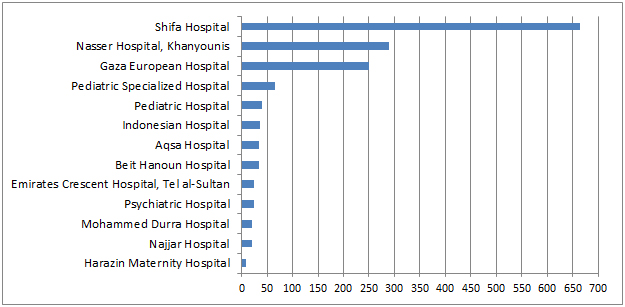
The amount of needed fuel reserves varies, depending on the size of the hospital, the capacity of each hospital’s generator and reserve tanks and the number of hours generator power is needed per day. Total consumption per hour for all Ministry of Health hospitals is approximately 1,500 litres[2], with 75% of consumption by Shifa Hospital, Nasser Hospital and Gaza European Hospital. Current fuel reserves are adequate for an average of only 8 weeks for the most critical services.
Figure1. Gaza Ministry of Health hospitals’ diesel fuel consumption per hour (litres)
WHO’s Response
The World Health Organization has been working with health partners, the Office for the Coordination of Humanitarian Affairs, and the Humanitarian Coordinator to identify potential solutions, including raising funds. The Health Cluster has supported UNRWA to secure USD $500,000 for emergency fuel for Gaza’s hospitals, through the oPt Humanitarian Fund, led by the Humanitarian Coordinator. This fuel will be used to sustain critical services for up to 8 weeks. However, if Israel were to cut electricity supply to Gaza over the discontinued payments from the PA and if no sustainable solution is found, then this may only be enough fuel for two weeks.
Response from the International Community
Whilst the hospitals continue to implement coping mechanisms for conserving power, small scale in kind donations have helped to prevent the complete closure of public hospitals, these have included; 70,000 liter donation from the private sector and $ 50,000 USD contribution from an Emirate humanitarian group.
These small scale contributions combined with the grant from the oPt Humanitarian Fund is estimated to sustain the critical services for two months, whilst non-critical health services will still face closure.
Request for Support
The 14 Gaza Ministry of Health hospitals require 430,000 litres per month and 20 NGO hospitals require 32,000 litres per month to maintain operations. For maintaining only the most critical services in the health sector, the total amount required is 450,000 litres. However, if the GPP continues to remain closed, the monthly need for sustaining only the critical services will increase to 650 000 litres.
The cost of supplying fuel to ensure critical health services at current rates of consumption varies between USD 1[3] per litre if procured by the UN, to USD2 per litre at local prices.
Table 1 outlines the cost estimates of supplying emergency fuel needs for Gaza health sector assuming that the GPP will be partially running again, and Table 2 outlines the cost estimates of supplying emergency fuel needs for Gaza health sector assuming without the GPP functioning.
Table 1. Cost estimates of supplying emergency fuel needs for Gaza’s health sector with the GPP partially functioning
|
|
Litres (average) |
1 month cost |
3 months cost |
I2 months cost |
|
UN procurement (@$1) |
450,000 |
$450,000 |
$1,350,000 |
$5,400,000 |
|
Local procurement(@$2) |
450,000 |
$900,000 |
$2,700,000 |
$10,800,000 |
Table 2. Cost estimates of supplying emergency fuel needs for Gaza’s health sector without the functioning GPP
|
|
Litres (average) |
1 month cost |
3 months cost |
I2 months cost |
|
UN procurement (@$1) |
650,000 |
$650,000 |
$1,950,000 |
$7,800,000 |
|
Local procurement(@$2) |
650,000 |
$1,300,000 |
$3,900,000 |
$15,600,000 |
For further information contact:
Gerald Rockenschaub
Head of oPt office, WHO
Mahmoud Daher
Head of Gaza sub-office, WHO
Sara Halimah
Health Cluster and Health Information, WHO
Abdelnaser Soboh
Health Cluster, WHO
[1] 14 NGO hospitals, 1 central blood bank, 1 referral abroad department.
[2] 1,423 litres from the 1st of May 2017.
[3] The price for fuel may fluctuate from USD $0.6 to $1
Pdf file: Gaza’s health sector faces fuel and electricity crisis
Vacancy announcement for security guard
WHO in the occupied Palestinian territory is seeking to recruit a Security guard in its Jerusalem office. Details of the position are available from the following link:
Applications must be submitted by 27 April 2017 to United Nations Development Programme
Applications must be in English and include your CV.
Only Palestinians are eligible to apply.
WHO has a smoke-free environment and does not recruit smokers or users of any form of tobacco.