


Select your language
Peer-reviewed articles
Influenza pandemic preparedness in the WHO Eastern Mediterranean Region
Thematic issue of EMHJ on influenza and other emerging respiratory infections in the Eastern Mediterranean Region
Clinical management guidelines for pandemic (H1N1) 2009 virus infection in the Eastern Mediterranean Region: technical basis and overview
Al Hajjar S, Malik MR, Hallaj Z, El-Bushra H, Opoka M, Mafi AR.
The challenges of global case reporting during pandemic A (H1N1) 2009
Stephanie Williams, Julia Fitzner, Angela Merianos, Anthony Mounts, and for the Case-based Surveillance Evaluation Group
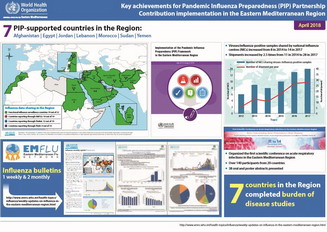
Infographics
Videos
EMARIS 2017 – Interviews and informational videos
Flyers
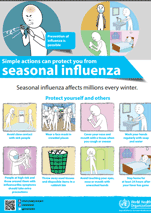
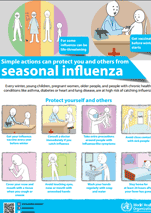
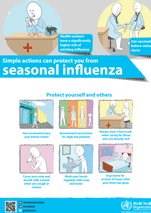
Simple actions can protect you from seasonal influenza
|
|
|
|
Prevention is better than cure
|
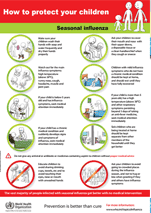
How to protect your children [pdf 390kb] - English | French | Arabic |
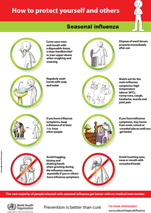
How to protect yourself and others [pdf 427kb] - English | French | Arabic |
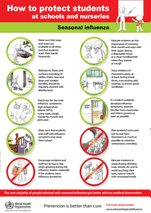
How to protect students at schools and nurseries [pdf 484kb] - English | French | Arabic |
|
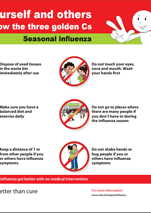
How to protect yourself and others: follow the three golden Cs [pdf 237kb] - English | French | Arabic |
Data
Global influenza strategy 2019-2030
FluID – a global influenza epidemiological data sharing platform
GISRS – Global influenza surveillance and response System
FluNet – a tool for global influenza virological surveillance
Technical guidance
WHO Global Epidemiological Surveillance Standards for Influenza
WHO checklist for influenza pandemic preparedness planning
WHO collaborating centres and essential regulatory laboratories
Tool for influenza pandemic risk assessment (TIPRA)
Public health measures during the influenza A(H1N1) 2009 pandemic Meeting report
WHO activities in avian influenza and pandemic influenza preparedness January - December 2006
Training materials
Community case management during an influenza outbreak
A training package for community health workers
Meeting reports
Meeting on influenza at the human-animal interface Cairo, Egypt 19–21 March 2013
 Influenza laboratory training in Rabat (Photo: WHO).
Seasonal influenza is a viral respiratory infection that affects the nose, throat, bronchi and, occasionally, the lungs. Infection usually lasts for about a week and is characterized by sudden onset of high fever, aching muscles and joints, headache and severe malaise, non-productive cough, sore throat and rhinitis.
Seasonal influenza is caused by human types of influenza viruses – influenza B, C and few sub-types of A – which circulate worldwide and can affect people in any age group. They are transmitted easily from person to person via droplets and small particles produced when infected people cough or sneeze.
The time from infection to illness is about 2 days. Most infected people recover within 1 to 2 weeks without requiring medical treatment. However, in high risk groups, including the very young, the elderly, and those with serious medical conditions, infection can lead to severe complications of the underlying condition, pneumonia and death. To prevent transmission, people should cover their mouth and nose when coughing and wash their hands regularly.
Influenza tends to spread rapidly in seasonal epidemics. Influenza epidemics can take an economic toll through lost workforce productivity and strained health services.
The most effective way to prevent influenza is vaccination. Safe and effective vaccines are available, and have been used for more than 60 years. Antiviral drugs are available for treatment, and may reduce severe complications and deaths. Ideally they need to be administered within 48 hours of the onset of symptoms although influenza viruses can develop resistance to the drugs.
Seasonal influenza is a viral respiratory infection that circulates in all parts of the world. It causes illnesses that range in severity from mild to severe. Influenza can cause major complications or death, particularly among high-risk groups including young children (6-59 months old), older adults (above 65 years), pregnant women, health workers and those with chronic medical conditions.
To support Member States in preparing for this winter season 2021-2022, the WHO Regional Office for the Eastern Mediterranean is providing these information resources for the benefit of high-risk groups and the general public. They include updated information on the disease, its modes of transmission and preventive measures that can be followed including the influenza vaccine. These materials are available in different formats including posters, Q&As, and videos. While the materials are available in Arabic, English and French, Member States can translate them into other local languages as needed.
Latest updates

Information resources