WHO EMRO
  • Regions
WHO EMRO
WHO Regional websites
Africa Africa
Americas Americas
Asie du Sud-Est Asie du Sud-Est
Europe Europe
Méditerranée orientale Méditerranée orientale
Pacifique occidental Pacifique occidental
  • Home
  • Health topics
  • Health topics
  • Data and statistics
  • Media centre
  • Information resources
  • Countries
  • Programmes
  • About Us
Search Search

Search

- All words: Returns only documents that match all words.
- Any word: Returns documents that match any word.
- Exact Phrase: Returns only documents that match the exact phrase entered.
- Phrase Prefix: Works like the Exact Phrase mode, except that it allows for prefix matches on the last term in the text.
- Wildcard: Returns documents that match a wildcard expression.
- Fuzzy query: Returns documents that contain terms similar to the search term. For example: If you search for Kolumbia. It will return search results that contain Columbia or Colombia.
  • Global
  • Regions
    WHO Regional websites
    Africa Africa
    Americas Americas
    Asie du Sud-Est Asie du Sud-Est
    Europe Europe
    Méditerranée orientale Méditerranée orientale
    Pacifique occidental Pacifique occidental
Search Search

Search

- All words: Returns only documents that match all words.
- Any word: Returns documents that match any word.
- Exact Phrase: Returns only documents that match the exact phrase entered.
- Phrase Prefix: Works like the Exact Phrase mode, except that it allows for prefix matches on the last term in the text.
- Wildcard: Returns documents that match a wildcard expression.
- Fuzzy query: Returns documents that contain terms similar to the search term. For example: If you search for Kolumbia. It will return search results that contain Columbia or Colombia.

Select your language

  • اللغة العربية
  • Français
WHO EMRO WHO EMRO
  • Home
  • Health topics
    • All Topics »
    • A
    • B
    • C
    • D
    • E
    • F
    • G
    • H
    • I
    • J
    • K
    • L
    • M
    • N
    • O
    • P
    • Q
    • R
    • S
    • T
    • U
    • V
    • W
    • X
    • Y
    • Z
  • Health topics
  • Data and statistics
  • Media centre
  • Information resources
  • Countries
  • Programmes
  • About Us

Many of the influenza symptoms are similar to those that are present for COVID-19. For example, symptoms such as fever, headache, muscle ache, sneezing and coughing. For COVID-19, additionally, there are specific symptoms such as anosmia, which is a lack of smell or taste of food. Many people, especially young people, have experienced these additional and specific symptoms for COVID-19.

COVID-19 vaccinationThe presence of these symptoms, whether they are for influenza or for COVID-19, varies in people depending on their level of immunity. It is important to note that the prevention measures, such as washing hands, wearing masks, and maintaining physical distancing are very effective for both diseases. Both seasonal influenza and COVID-19 are preventable through following these measures.

Vaccination is effective for preventing seasonal influenza, in particular, preventing severe disease outcomes in older adults, people with serious health conditions and pregnant women. Infants may be protected by passively acquired immunity from their mother for the first 6–9 months of age. COVID-19 vaccines provide strong protection against serious illness, hospitalization and death from COVID-19. There is also some evidence that being vaccinated will make it less likely that you will pass the virus on to others, which means your decision to get the vaccine also protects those around you. 

The viruses

Influenza virus is a respiratory virus that is part of the Orthomyxoviridae family. There are 4 types of seasonal influenza viruses, types A, B, C and D. Influenza A and B viruses circulate and cause seasonal epidemics of disease. They can be further broken down into subtypes depending on the combination of the proteins on their surface (e.g. influenza A) or different lineages (e.g. influenza B). Infection with influenza viruses causes influenza disease.

COVID-19 is an infectious disease caused by a respiratory virus called the severe acute respiratory syndrome coronavirus 2 (SARS-CoV-2). SARS-CoV-2 is part of the coronavirus family and can be further classified into variants and subvariants.

Signs and symptoms
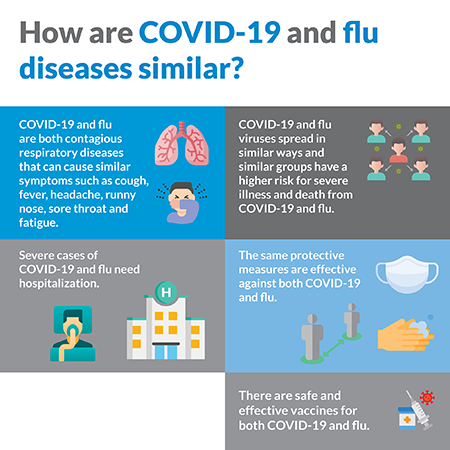
Similarities between COVID-19 and influenzaBoth COVID-19 and influenza disease share similar symptoms, including cough, runny nose, sore throat, fever, headache and fatigue. People infected with either virus can have varying levels of illness; some having no symptoms, mild symptoms or severe disease. People with mild symptoms of both COVID-19 and influenza can usually be cared for safely at home. Both diseases can be fatal, with certain people at higher risk for severe disease and death.

You cannot tell the difference between flu and COVID-19 from symptoms. Testing for the virus is the only way you can know which virus you have or reveal if someone has both influenza and COVID-19 at the same time.

Prevention

Both COVID-19 and influenza can spread from person to person, mainly in those who are in close contact with each other. Both are spread primarily by large and small particles containing virus when people with either virus cough, sneeze or talk. It is also possible to get infected by touching another person or a surface that has virus on it and then subsequently touching their own mouth, nose or eyes. Therefore, personal protective measures like:

    • Regular hand washing with proper drying of the hands
    • Good respiratory hygiene – Cough or sneeze into a bent elbow or tissue and throw the tissue into a closed bin
    • Early self-isolation of those feeling unwell, feverish and having other symptoms of influenza
    • Avoiding close contact with sick people
    • Avoiding touching your eyes, nose or mouth

Can help to protect you and others from infection. Other protective measures to protect from infection also include:

  • Maintain at least a 1-metre distance from others and wear a well-fitted mask
  • Avoid crowded and poorly ventilated places and settings;
  • Open windows or doors to keep rooms well ventilated;

In addition to these measures there are safe and effective vaccines for both COVID-19 and influenza. Vaccination is an important part of preventing severe disease and death for both COVID-19 and influenza. The vaccines for COVID-19 and influenza are not cross-protective. Influenza vaccines are different to COVID-19 vaccines so you must get both to protect yourself from each disease.

Treatment
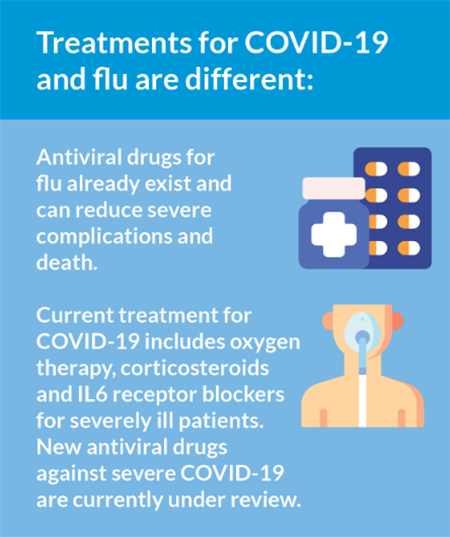
COVID-19 vs influenza treatmentDifferent treatments are available for both influenza and COVID-19, but both in the initial stages are treated by addressing symptoms such as fever. Both viruses can cause severe disease, leading to hospitalization where more supportive treatment is needed such as a ventilator. For some patients, medications may help lessen the symptoms, severity and shorten the duration of COVID-19 or influenza illness.

For influenza, there are oral antiviral medications available that can be used to supplement symptomatic treatment. Patients that are known to be in a group at high risk for developing severe or complicated illness should be treated with antivirals in addition to symptomatic treatment as soon as possible. Patients with severe or progressive clinical illness associated with suspected or confirmed influenza virus infection (i.e. clinical syndromes of pneumonia, sepsis or exacerbation of chronic underling diseases) should be treated with antiviral drug as soon as possible.

For COVID-19 those with milder illness, resting at home and taking medicine to reduce fever or other symptoms is usually enough. However more severe cases that require hospitalization may be treated with both novel treatments (e.g. monoclonal antibody therapy) and provided with supportive care. Optimal supportive care includes oxygen for severely ill patients and those who are at risk for severe disease and more advanced respiratory support such as ventilation for patients who are critically ill. Dexamethasone is a corticosteroid that can help reduce the length of time on a ventilator and save lives of patients with severe and critical illness. Results from the WHO’s Solidarity Trial indicated that remdesivir, hydroxychloroquine, lopinavir/ritonavir and interferon regimens appear to have little or no effect on 28-day mortality or the in-hospital course of COVID-19 among hospitalized patients. Hydroxychloroquine has not been shown to offer any benefit for treatment of COVID-19. WHO does not recommend self-medication with any medicines, including antibiotics, as a prevention or cure for COVID-19. WHO is coordinating efforts to develop treatments for COVID-19 and will continue to provide new information as it becomes available.
Respiratory virus activity - weekly update: week 33, 2025

Respiratory virus activity week 33

Respiratory viruses weekly updates

2025

  • Week 33 2025
  • Week 32 2025
  • Week 31 2025
  • Week 30 2025
  • Week 29 2025
  • Week 28 2025
  • Week 28 2025
  • Week 27 2025
  • Week 26 2025
  • Week 25 2025
  • Week 24 2025
  • Week 23 2025
  • Week 21 2025
  • Week 20 2025
  • Week 19 2025
  • Week 17 2025
  • Week 16 2025
  • Week 15 2025
  • Week 14 2025
  • Week 13 2025
  • Week 12 2025
  • Week 11 2025
  • Week 10 2025
  • Week 9 2025
  • Week 8 2025
  • Week 7 2025
  • Week 6 2025
  • Week 5 2025
  • Week 4 2025

Week 3 2025

Week 2 2025

Week 1 2025

2024

Week 53 2024

Week 52 2024

Week 51 2024

Week 50 2024

Week 49 2024

Week 48 2024

Week 47 2024

Week 46 2024

Week 45 2024

Week 44 2024

Week 43 2024

Week 42 2024

Week 41 2024

Week 40 2024

Week 39 2024

Week 38 2024

Week 37 2024

Week 36 2024

Influenza updates

» Weekly updates

2024

Influenza update, epidemiological week 9, 2024

Influenza update, epidemiological week 8, 2024

Influenza update, epidemiological week 7, 2024

Influenza update, epidemiological week 6, 2024

Influenza update, epidemiological week 5, 2024

Influenza update, epidemiological week 4, 2024

Influenza update, epidemiological week 3, 2024

Influenza update, epidemiological week 2, 2024

Influenza update, epidemiological week 1, 2024

2023

Influenza update, epidemiological week 52, 2023

Influenza update, epidemiological week 51, 2023

Influenza update, epidemiological week 50, 2023

Influenza update, epidemiological week 49, 2023

Influenza update, epidemiological week 48, 2023

Influenza update, epidemiological week 47, 2023

Influenza update, epidemiological week 46, 2023

Influenza update, epidemiological week 45, 2023

Influenza update, epidemiological week 44, 2023

Influenza update, epidemiological week 43, 2023

Influenza update, epidemiological week 42, 2023

Influenza update, epidemiological week 41, 2023

Influenza update, epidemiological week 40, 2023

Influenza update, epidemiological week 39, 2023

2023

Influenza update, epidemiological week 52, 2023

Influenza update, epidemiological week 51, 2023

Influenza update, epidemiological week 50, 2023

Influenza update, epidemiological week 49, 2023

Influenza update, epidemiological week 48, 2023

Influenza update, epidemiological week 47, 2023

Influenza update, epidemiological week 46, 2023

Influenza update, epidemiological week 45, 2023

Influenza update, epidemiological week 44, 2023

Influenza update, epidemiological week 43, 2023

Influenza update, epidemiological week 42, 2023

Influenza update, epidemiological week 41, 2023

Influenza update, epidemiological week 40, 2023

Influenza update, epidemiological week 39, 2023

Influenza update, epidemiological week 38, 2023

Influenza update, epidemiological week 37, 2023

Influenza update, epidemiological week 36, 2023

Influenza update, epidemiological week 35, 2023

Influenza update, epidemiological weel 34, 2023

Influenza update, epidemiological week 33, 2023

Influenza update, epidemiological week 32, 2023

Influenza update, epidemiological week 31, 2023

Influenza update, epidemiological week 30, 2023

Influenza update, epidemiological week 29, 2023

Influenza update, epidemiological week 28, 2023

Influenza update, epidemiological week 27, 2023

Influenza update, epidemiological week 13, 2023

Influenza update, epidemiological week 12, 2023

Influenza update, epidemiological week 11, 2023

Influenza update, epidemiological week 10, 2023

Influenza update, epidemiological week 9, 2023

Influenza update, epidemiological week 8, 2023

Influenza update, epidemiological week 7, 2023

Influenza update, epidemiological week 6, 2023

Influenza update, epidemiological week 5, 2023

Influenza update, epidemiological week 4, 2023

Influenza update, epidemiological week 3, 2023

Influenza update, epidemiological week 2, 2023

Influenza update, epidemiological week 1, 2023

2022

Influenza update, epidemiological week 52, 2022

Influenza update, epidemiological week 51, 2022

Influenza update, epidemiological week 50, 2022

Influenza update, epidemiological week 49, 2022

Influenza update, epidemiological week 48, 2022

Influenza update, epidemiological week 47, 2022

Influenza update, epidemiological week 46, 2022

Influenza update, epidemiological week 45, 2022

Influenza update, epidemiological week 44, 2022

Influenza update, epidemiological week 43, 2022

Influenza update, epidemiological week 42, 2022

Influenza update, epidemiological week 41, 2022

Influenza update, epidemiological week 40, 2022

Influenza update, epidemiological week 39, 2022

Influenza update, epidemiological week 38, 2022

Influenza update, epidemiological week 37, 2022

Influenza update, epidemiological week 36, 2022

Influenza update, epidemiological week 35, 2022

Influenza update, epidemiological week 34, 2022

Influenza update, epidemiological week 33, 2022

Influenza update, epidemiological week 32, 2022

Influenza update, epidemiological week 31, 2022

Influenza update, epidemiological week 30, 2022

Influenza update, epidemiological week 29, 2022

Influenza update, epidemiological week 28, 2022

Influenza update, epidemiological week 27, 2022

Influenza update, epidemiological week 26, 2022

Influenza update, epidemiological week 25, 2022

Influenza update, epidemiological week 24, 2022

Influenza update, epidemiological week 23, 2022

Influenza update, epidemiological week 22, 2022

Influenza update, epidemiological week 21, 2022

Influenza update, epidemiological week 20, 2022

Influenza update, epidemiological week 19, 2022

Influenza update, epidemiological week 18, 2022

Influenza update, epidemiological week 17, 2022

Influenza update, epidemiological week 16, 2022

Influenza update, epidemiological week 15, 2022

Influenza update, epidemiological week 14, 2022

Influenza update, epidemiological week 13, 2022

Influenza update, epidemiological week 12, 2022

Influenza update, epidemiological week 11, 2022

Influenza update, epidemiological week 10, 2022

Influenza update, epidemiological week 09, 2022

Influenza update, epidemiological week 08, 2022

Influenza update, epidemiological week 07, 2022

Influenza update, epidemiological week 06, 2022

Influenza update, epidemiological week 05, 2022

Influenza update, epidemiological week 04, 2022

Influenza update, epidemiological week 03, 2022

Influenza update, epidemiological week 02, 2022

Influenza update, epidemiological week 01, 2022

2021

Influenza update, epidemiological week 52, 2021

Influenza update, epidemiological week 51, 2021

Influenza update, epidemiological week 50, 2021

Influenza update, epidemiological week 49, 2021

Influenza update, epidemiological week 48, 2021

Influenza update, epidemiological week 47, 2021

Influenza update, epidemiological week 46, 2021

Influenza update, epidemiological week 45, 2021

Influenza update, epidemiological week 44, 2021

Influenza update, epidemiological week 43, 2021

Influenza update, epidemiological week 42, 2021

Influenza update, epidemiological week 41, 2021

Influenza update, epidemiological week 40, 2021

Influenza update, epidemiological week 39, 2021

Influenza update, epidemiological week 38, 2021

Influenza update, epidemiological week 37, 2021

Influenza update, epidemiological week 36, 2021

Influenza update, epidemiological week 35, 2021

Influenza update, epidemiological week 34, 2021

Influenza update, epidemiological week 33, 2021

Influenza update, epidemiological week 32, 2021

Influenza update, epidemiological week 31, 2021

Influenza update, epidemiological week 30, 2021

Influenza update, epidemiological week 29, 2021

Influenza update, epidemiological week 28, 2021

Influenza update, epidemiological week 27, 2021

Influenza update, epidemiological week 26, 2021

Influenza update, epidemiological week 25, 2021

Influenza update, epidemiological week 24, 2021

Influenza update, epidemiological week 23, 2021

Influenza update, epidemiological week 22, 2021

Influenza update, epidemiological week 21, 2021

Influenza update, epidemiological week 20, 2021

Influenza update, epidemiological week 19, 2021

Influenza update, epidemiological week 18, 2021

Influenza update, epidemiological week 17, 2021

Influenza update, epidemiological week 16, 2021

Influenza update, epidemiological week 15, 2021

Influenza update, epidemiological week 14, 2021

Influenza update, epidemiological week 13, 2021

Influenza update, epidemiological week 12, 2021

Influenza update, epidemiological week 11, 2021

Influenza update, epidemiological week 10, 2021

Influenza update, epidemiological week 09, 2021

Influenza update, epidemiological week 08, 2021

Influenza update, epidemiological week 07, 2021

Influenza update, epidemiological week 06, 2021

Influenza update, epidemiological week 05, 2021

Influenza update, epidemiological week 04, 2021

Influenza update, epidemiological week 03, 2021

Influenza update, epidemiological week 02, 2021

Influenza update, epidemiological week 01, 2021

2020

Influenza update, epidemiological week 53, 2020

Influenza update, epidemiological week 52, 2020

Influenza update, epidemiological week 51, 2020

Influenza update, epidemiological week 50, 2020

Influenza update, epidemiological week 49, 2020

Influenza update, epidemiological week 48, 2020

Influenza update, epidemiological week 47, 2020

Influenza update, epidemiological week 46, 2020

Influenza update, epidemiological week 45, 2020

Influenza update, epidemiological week 44, 2020

Influenza update, epidemiological week 43, 2020

Influenza update, epidemiological week 42, 2020

Influenza update, epidemiological week 41, 2020

Influenza update, epidemiological week 40, 2020

Influenza update, epidemiological week 39, 2020

Influenza update, epidemiological week 38, 2020

Influenza update, epidemiological week 37, 2020

Influenza update, epidemiological week 36, 2020

Influenza update, epidemiological week 35, 2020

Influenza update, epidemiological week 34, 2020

Influenza update, epidemiological week 33, 2020

Influenza update, epidemiological week 32, 2020

Influenza update, epidemiological week 31, 2020

Influenza update, epidemiological week 30, 2020

Influenza update, epidemiological week 29, 2020

Influenza update, epidemiological week 28, 2020

Influenza update, epidemiological week 27, 2020

Influenza update, epidemiological week 26, 2020

Influenza update, epidemiological week 25, 2020

Influenza update, epidemiological week 24, 2020

Influenza update, epidemiological week 23, 2020

Influenza update, epidemiological week 22, 2020

Influenza update, epidemiological week 21, 2020

Influenza update, epidemiological week 20, 2020

Influenza update, epidemiological week 19, 2020

Influenza update, epidemiological week 18, 2020

Influenza update, epidemiological week 17, 2020

Influenza update, epidemiological week 16, 2020

Influenza update, epidemiological week 15, 2020

Influenza update, epidemiological week 14, 2020

Influenza update, epidemiological week 13, 2020

Influenza update, epidemiological week 12, 2020

Influenza update, epidemiological week 11, 2020

Influenza update, epidemiological week 10, 2020

Influenza update, epidemiological week 09, 2020

Influenza update, epidemiological week 08, 2020

Influenza update, epidemiological week 07, 2020

Influenza update, epidemiological week 06, 2020

Influenza update, epidemiological week 05, 2020

Influenza update, epidemiological week 04, 2020

Influenza update, epidemiological week 03, 2020

Influenza update, epidemiological week 02, 2020

Influenza update, epidemiological week 01, 2020

2019

Influenza update, epidemiological week 52, 2019

Influenza update, epidemiological week 51, 2019

Influenza update, epidemiological week 50, 2019

Influenza update, epidemiological week 49, 2019

Influenza update, epidemiological week 48, 2019

Influenza update, epidemiological week 47, 2019

Influenza update, epidemiological week 46, 2019

Influenza update, epidemiological week 45, 2019

Influenza update, epidemiological week 44, 2019

Influenza update, epidemiological week 43, 2019

Influenza update, epidemiological week 42, 2019

Influenza update, epidemiological week 41, 2019

Influenza update, epidemiological week 40, 2019

Influenza update, epidemiological week 39, 2019

Influenza update, epidemiological week 38, 2019

Influenza update, epidemiological week 37, 2019

Influenza update, epidemiological week 36, 2019

Influenza update, epidemiological week 35, 2019

Influenza update, epidemiological week 34, 2019

Influenza update, epidemiological week 33, 2019

Influenza update, epidemiological week 32, 2019

Influenza update, epidemiological week 31, 2019

Influenza update, epidemiological week 30, 2019

Influenza update, epidemiological week 29, 2019

Influenza update, epidemiological week 28, 2019

Influenza update, epidemiological week 27, 2019

Influenza update, epidemiological week 26, 2019

Influenza update, epidemiological week 25, 2019

Influenza update, epidemiological week 24, 2019

Influenza update, epidemiological week 23, 2019

Influenza update, epidemiological week 22, 2019

Influenza update, epidemiological week 21, 2019

Influenza update, epidemiological week 20, 2019

Influenza update, epidemiological week 19, 2019

Influenza update, epidemiological week 18, 2019

Influenza update, epidemiological week 17, 2019

Influenza update, epidemiological week 16, 2019

Influenza update, epidemiological week 15, 2019

Influenza update, epidemiological week 14, 2019

Influenza update, epidemiological week 13, 2019

Influenza update, epidemiological week 12, 2019

Influenza update, epidemiological week 11, 2019

Influenza update, epidemiological week 10, 2019

Influenza update, epidemiological week 09, 2019

Influenza update, epidemiological week 08, 2019

Influenza update, epidemiological week 07, 2019

Influenza update, epidemiological week 06, 2019

Influenza update, epidemiological week 05, 2019

Influenza update, epidemiological week 04, 2019

Influenza update, epidemiological week 03, 2019

Influenza update, epidemiological week 02, 2019

Influenza update, epidemiological week 01, 2019

2018

Influenza update, epidemiological week 52, 2018

Influenza update, epidemiological week 51, 2018

Influenza update, epidemiological week 50, 2018

Influenza update, epidemiological week 49, 2018

Influenza update, epidemiological week 48, 2018

Influenza update, epidemiological week 47, 2018

Influenza update, epidemiological week 46, 2018

Influenza update, epidemiological week 45, 2018

Influenza update, epidemiological week 44, 2018

Influenza update, epidemiological week 43, 2018

Influenza update, epidemiological week 42, 2018

Influenza update, epidemiological week 41, 2018

Influenza update, epidemiological week 40, 2018

Influenza update, epidemiological week 39, 2018

Influenza update, epidemiological week 38, 2018

Influenza update, epidemiological week 37, 2018

Influenza update, epidemiological week 36, 2018

Influenza update, epidemiological week 35, 2018

Influenza update, epidemiological week 34, 2018

Influenza update, epidemiological week 33, 2018

Influenza update, epidemiological week 32, 2018

Influenza update, epidemiological week 31, 2018

Influenza update, epidemiological week 30, 2018

Influenza update, epidemiological week 29, 2018

Influenza update, epidemiological week 28, 2018

Influenza update, epidemiological week 27, 2018

Influenza update, epidemiological week 26, 2018

Influenza update, epidemiological week 25, 2018

Influenza update, epidemiological week 24, 2018

Influenza update, epidemiological week 23, 2018

Influenza update, epidemiological week 22, 2018

Influenza update, epidemiological week 21, 2018

Influenza update, epidemiological week 20, 2018

Influenza update, epidemiological week 19, 2018

Influenza update, epidemiological week 18, 2018

Influenza update, epidemiological week 17, 2018

Influenza update, epidemiological week 16, 2018

Influenza update, epidemiological week 15, 2018

Influenza update, epidemiological week 14, 2018

Influenza update, epidemiological week 13, 2018

Influenza update, epidemiological week 12, 2018

Influenza update, epidemiological week 11, 2018

Influenza update, epidemiological week 10, 2018

Influenza update, epidemiological week 09, 2018

Influenza update, epidemiological week 08, 2018

Influenza update, epidemiological week 07, 2018

Influenza update, epidemiological week 06, 2018

Influenza update, epidemiological week 05, 2018

Influenza update, epidemiological week 04, 2018

» Monthly updates

2024

Influenza monthly update, July 2024

Influenza monthly update, June 2024

Influenza monthly update, May 2024

Influenza monthly update, April 2024

Influenza monthly update, March 2024

Influenza monthly update, Febreuary 2024

Influenza monthly update, January 2024

2023

Influenza monthly update, December 2023

Influenza monthly update, November 2023

Influenza monthly update, October 2023

Influenza monthly update, September 2023

Influenza monthly update, August 2023

Influenza monthly update, July 2023

Influenza monthly update, June 2023

Influenza monthly update, May 2023

Influenza monthly update, April 2023

Influenza monthly update, March 2023

Influenza monthly update, February 2023

Influenza monthly update, January 2023

2022

Influenza monthly update, December 2022

Influenza monthly update, November 2022

Influenza monthly update, October 2022

Influenza monthly update, September 2022

Influenza monthly update, August 2022

Influenza monthly update, July 2022

Influenza monthly update, June 2022

Influenza monthly update, May 2022

Influenza monthly update, April 2022

Influenza monthly update, March 2022

Influenza monthly update, February 2022

Influenza monthly update, January 2022

2021

Influenza monthly update, December 2021

Influenza monthly update, November 2021

Influenza monthly update, October 2021

Influenza monthly update, September 2021

Influenza monthly update, August 2021

Influenza monthly update, July 2021

Influenza monthly update, June 2021

Influenza monthly update, May 2021

Influenza monthly update, April 2021

Influenza monthly update, March 2021

Influenza monthly update, February 2021

Influenza monthly update, January 2021

2020

Influenza monthly update, October–December 2020

Influenza monthly update, July–September 2020

Influenza monthly update, April–June 2020

2019

Influenza monthly update, March 2020

Influenza monthly update, February 2020

Influenza monthly update, January 2020

Influenza monthly update, December 2019

Influenza monthly update, November 2019

Influenza monthly update, October 2019

Influenza monthly update, September 2019

Influenza monthly update, August 2019

Influenza monthly update, July 2019

Influenza monthly update, June 2019

Influenza monthly update, May 2019

Influenza monthly update, April 2019

Influenza monthly update, March 2019

Influenza monthly update, February 2019

Influenza monthly update, January 2019

2018

Influenza monthly update, March 2020

Influenza monthly update, February 2020

Influenza monthly update, January 2020

Influenza monthly update, December 2019

Influenza monthly update, November 2019

Influenza monthly update, October 2019

Influenza monthly update, September 2019

Influenza monthly update, August 2019

Influenza monthly update, July 2019

Influenza monthly update, June 2019

Influenza monthly update, May 2019

Influenza monthly update, April 2019

Influenza monthly update, March 2019

Influenza monthly update, February 2019

Influenza monthly update, January 2019

Influenza monthly update, December 2018

Influenza monthly update, November 2018

Influenza monthly update, October 2018

Influenza monthly update, September 2018

Influenza monthly update, August 2018

Influenza monthly update, July 2018

Influenza monthly update, June 2018

Influenza monthly update, May 2018

Influenza monthly update, April 2018

Influenza monthly update, March 2018

Influenza monthly update, February 2018

Influenza monthly update, January 2018

2017

Influenza update, December 2017

Influenza monthly update, November 2017

Influenza monthly update, October 2017

Influenza monthly update, September 2017

Influenza monthly update, August 2017

Influenza monthly update, July 2017

Influenza monthly update, June 2017

Influenza monthly update, May 2017

Influenza monthly update, April 2017

Influenza update, March 2017

Influenza update – February 2017

Influenza update: January 2017

Infographics

Flyers

Videos

Factsheet

Data

Technical guidance

Flu vaccination toolbox

Infographics

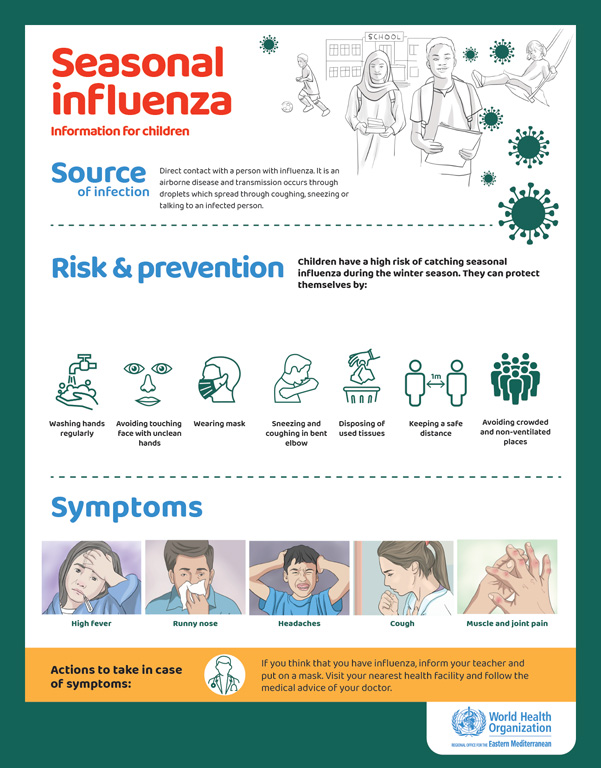
Information for children
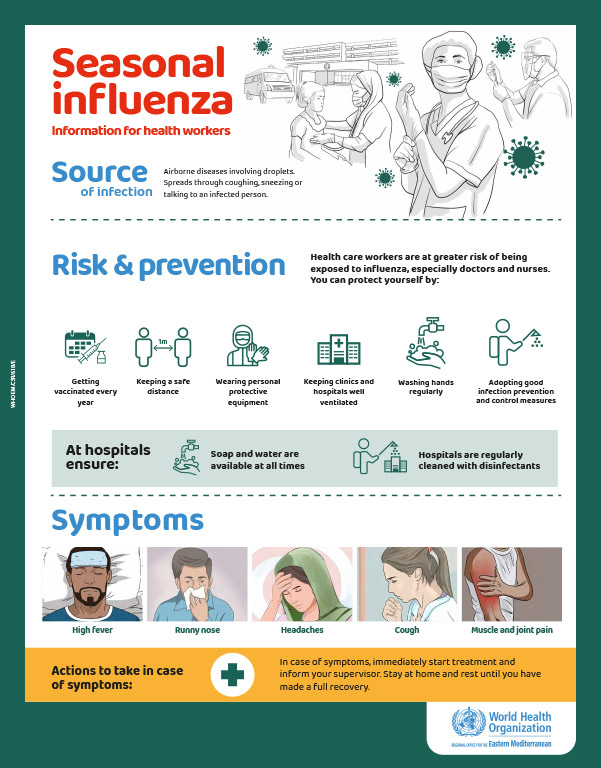
Information for health care workers
Information for children
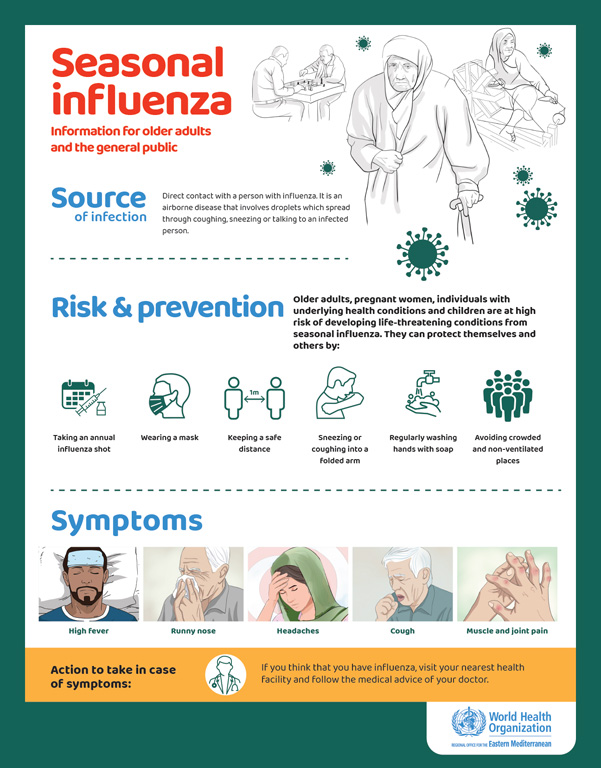
Information for older adults and general public
COVID-19 & flu: Are you caring for children under the age of 5?

Arabic | French

COVID-19 & flu: Are you a health worker?

Arabic | French

COVID-19 & flu: Are you pregnant?

Arabic | French

COVID-19 & flu: Are you 60 or older?

Arabic | French

COVID-19 & flu: Do you have chronic health conditions?

Arabic | French

COVID-19 & flu: Do you live in an area with other infectious diseases?

Arabic | French

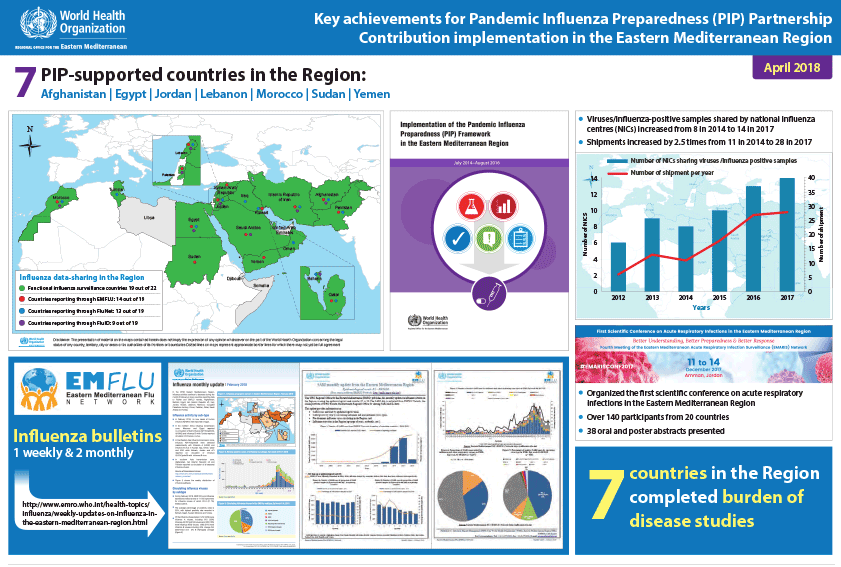
Key achievements of the Pandemic Influenza Preparedness (PIP) Partnership Contribution implementation in the Eastern Mediterranean Region
Key achievements of the Pandemic Influenza Preparedness (PIP) Partnership Contribution implementation in the Region

Flyers

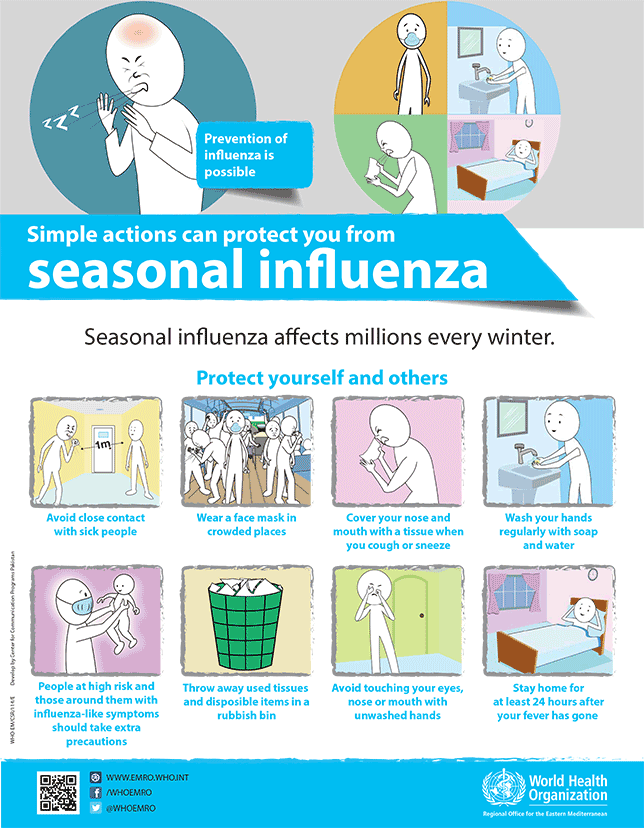
Simple actions can protect you from seasonal influenza

Advice for the protection of yourself and others
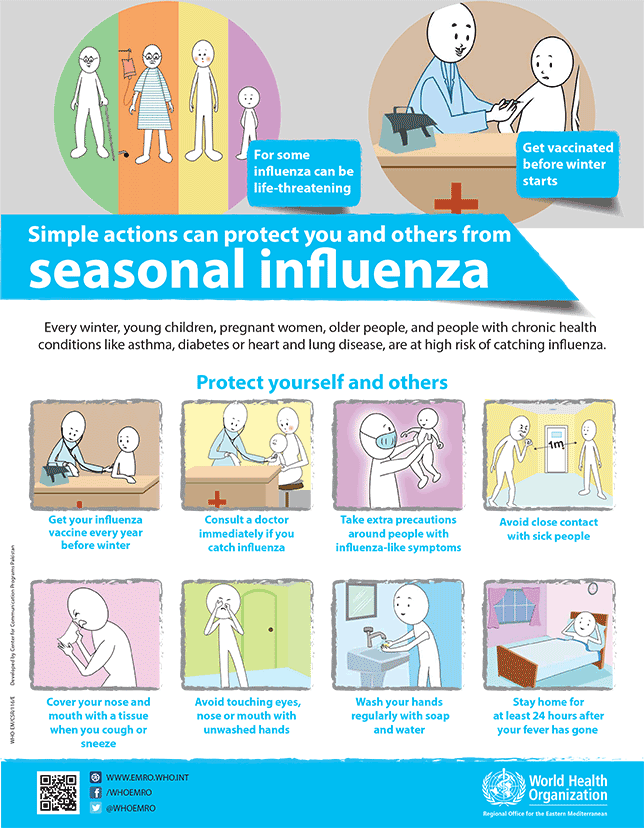
Advice for the protection of vulnerable groups
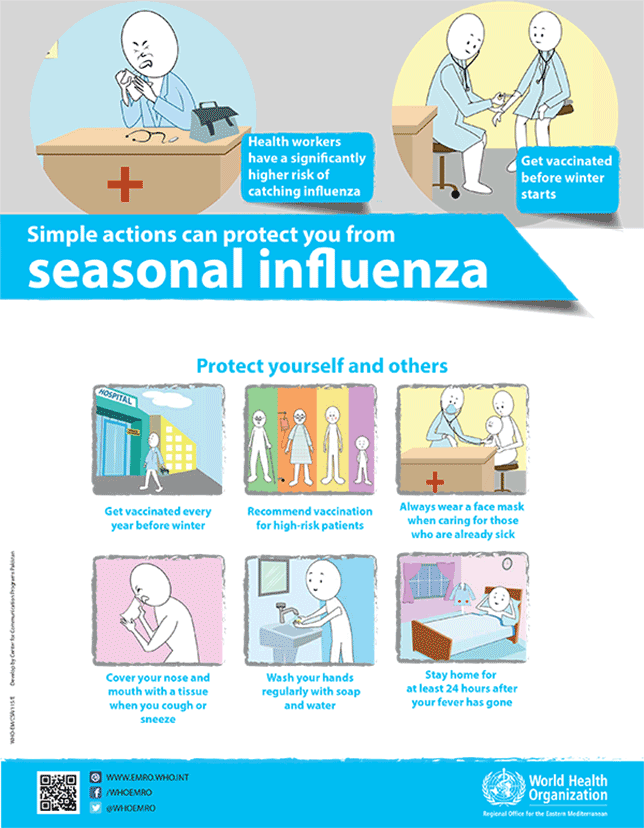
Advice for the protection of health care workers

Prevention is better than cure

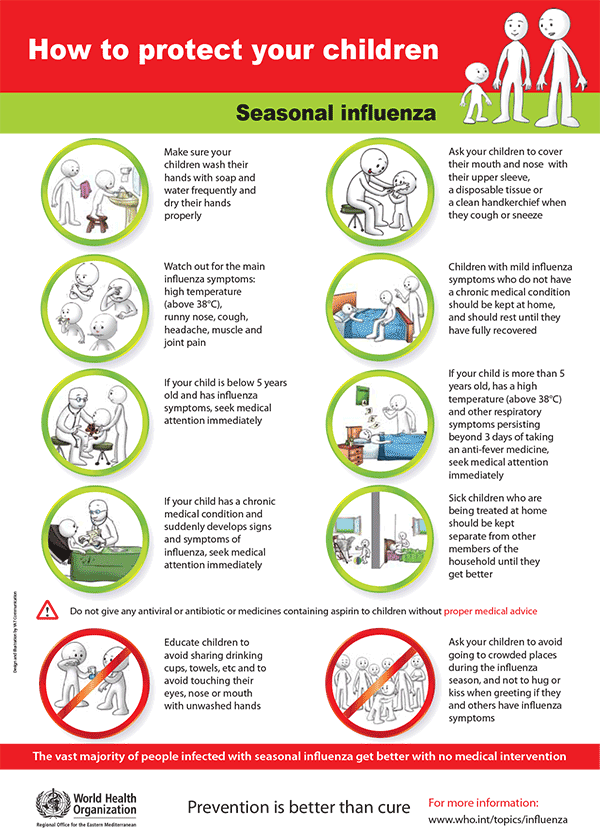
How to protect your children

Arabic | French

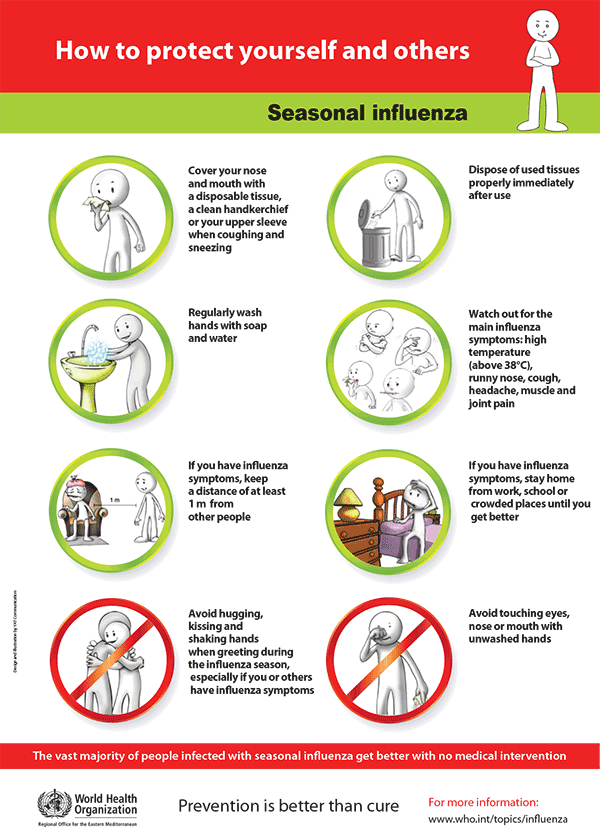
How to protect yourself and others

Arabic | French

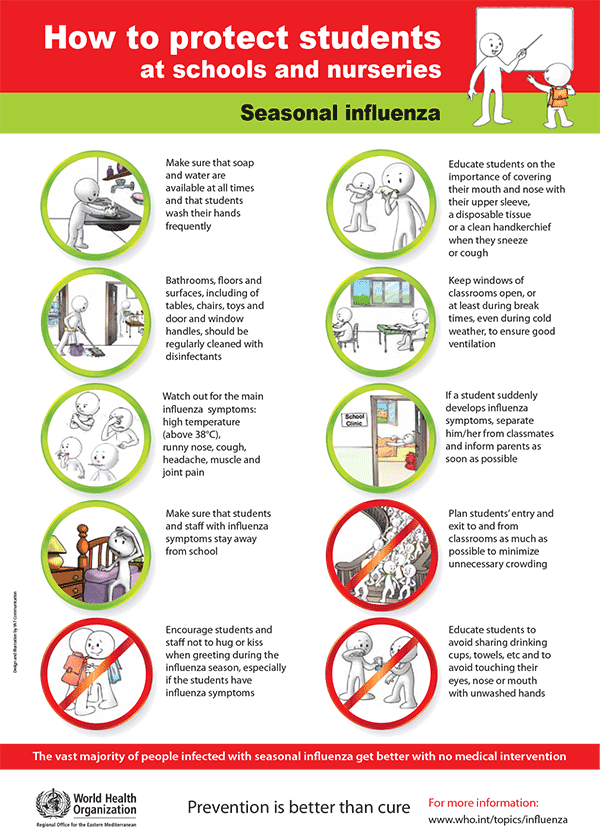
How to protect students at schools and nurseries

Arabic | French

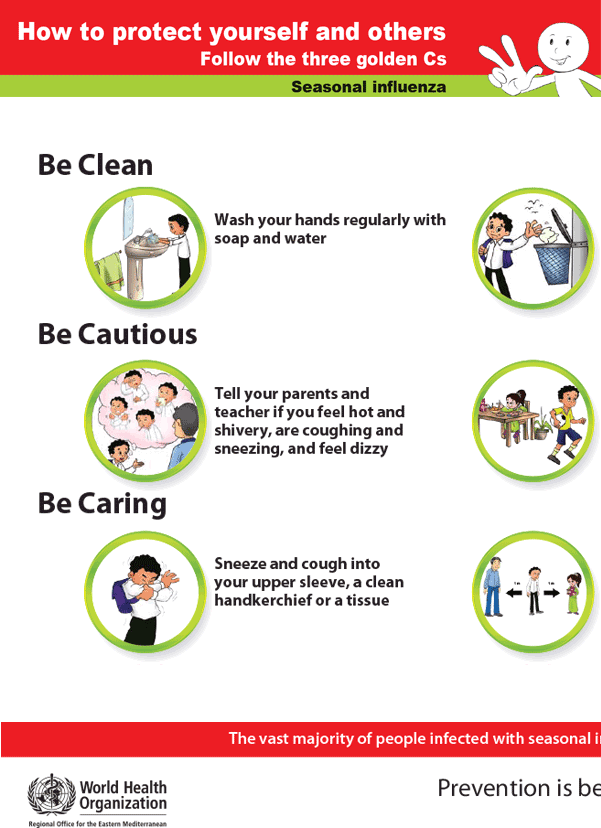
How to protect yourself and others: follow the three golden Cs

Arabic | French

Videos

Influenza vaccine questions and answers | Arabic

EMARIS 2019: enhancing pandemic influenza preparedness

Improve influenza surveillance with laboratory skills training

EMARIS 2017 – Interviews and informational videos

Factsheet

Seasonal influenza is an acute respiratory infection caused by influenza viruses which circulate in all parts of the world.

The influenza virus

There are 4 types of seasonal influenza viruses, types A, B, C and D. Influenza A and B viruses are the most common and cause seasonal epidemics of disease globally (1). In temperate regions, both influenza A and B cause winter epidemics, with sporadic cases and outbreaks occurring out of season. In tropical regions such as the Eastern Mediterranean Region, the circulation of influenza viruses ranges from a seasonal peak from October to May to sporadic cases throughout the year.

Influenza A viruses are further classified into subtypes according to the combinations of the hemagglutinin (HA) and the neuraminidase (NA), the proteins on the surface of the virus. Currently circulating in humans are subtype A(H1N1) and A(H3N2) influenza viruses. The A(H1N1) is also written as A(H1N1)pdm09 as it caused the pandemic in 2009 and subsequently replaced the seasonal influenza A(H1N1) virus which had circulated prior to 2009. Only influenza type A viruses are known to have caused pandemics.

Influenza B viruses are not classified into subtypes but can be broken down into lineages. Currently circulating influenza type B viruses belong to either B/Yamagata or B/Victoria lineage.

Influenza C virus is detected less frequently and usually causes mild infections, thus does not present public health importance.

Influenza D viruses primarily affect cattle and are not known to infect or cause illness in people.

Signs and symptoms

Seasonal influenza is characterized by a sudden onset of fever, cough (usually dry), headache, muscle and joint pain, severe malaise (feeling unwell), sore throat, and a runny nose. The cough can be severe and can last 2 or more weeks. Most people recover from fever and other symptoms within a week without requiring medical attention. But influenza can cause severe illness or death, especially in people at high risk.

Illnesses range from mild to severe and even death. Hospitalization and death occur mainly among high-risk groups. Worldwide, these annual epidemics are estimated to result in about 3 to 5 million cases of severe illness, and about 290 000 to 650 000 respiratory deaths.

The effects of seasonal influenza epidemics in developing countries are not fully known, but research estimates that 99% of deaths in children under 5 years of age with influenza-related lower respiratory tract infections are found in developing countries (2).

Diagnosis

The majority of cases of human influenza are clinically diagnosed. However, during periods of low influenza activity and outside of epidemics situations, the infection of other respiratory viruses e.g. rhinovirus, respiratory syncytial virus, parainfluenza and adenovirus can also present as Influenza-like Illness (ILI) which makes the clinical differentiation of influenza from other pathogens difficult.

Collection of appropriate respiratory samples and the application of a laboratory diagnostic test is required to establish a definitive diagnosis. Proper collection, storage and transport of respiratory specimens is the essential first step for laboratory detection of influenza virus infections. Laboratory confirmation of influenza virus from throat, nasal and nasopharyngeal secretions or tracheal aspirate or washings is commonly performed using direct antigen detection, virus isolation, or detection of influenza-specific RNA by reverse transcriptase-polymerase chain reaction (RT-PCR).

Various guidance on laboratory techniques is published and updated by WHO (3). Rapid influenza diagnostic tests (RIDTs) are used in clinical settings, but they have lower sensitivity compared to RT-PCR methods and their reliability depends largely on the conditions under which they are used.

Treatment

Patients that are not from a high-risk group should be managed with symptomatic treatment and are advised, if symptomatic, to stay home in order to minimize the risk of infecting others in the community. Treatment focuses on relieving symptoms of influenza such as fever. Patients should monitor themselves to detect if their condition deteriorates and seek medical attention Patients that are known to be in a group at high risk for developing severe or complicated illness, should be treated with antivirals in addition to symptomatic treatment as soon as possible.

Patients with severe or progressive clinical illness associated with suspected or confirmed influenza virus infection (i.e. clinical syndromes of pneumonia, sepsis or exacerbation of chronic underling diseases) should be treated with antiviral drug as soon as possible.

Neuraminidase inhibitors (i.e. oseltamivir) should be prescribed as soon as possible (ideally, within 48 hours following symptom onset) to maximize therapeutic benefits. Administration of the drug should also be considered in patients presenting later in the course of illness.

Treatment is recommended for a minimum of 5 days but can be extended until there is satisfactory clinical improvement.

Corticosteroids should not be used routinely, unless indicated for other reasons (eg: asthma and other specific conditions); as it has been associated with prolonged viral clearance, immunosuppression leading to bacterial or fungal superinfection.

All currently circulating influenza viruses are resistant to adamantane antiviral drugs (such as amantadine and rimantadine), and these are therefore not recommended for monotherapy.

WHO Global Influenza Surveillance and Response System (GISRS) monitors resistance to antivirals among circulating influenza viruses to provide timely guidance for antiviral use in clinical management and potential chemoprophylaxis.

Epidemiology

People of all age groups can be affected but there are groups that are more at risk than others.

People at greater risk of severe disease or complications when infected are: pregnant women, children under 59 months, older adults (aged more than 65 years), individuals with chronic medical conditions (such as chronic cardiac, pulmonary, renal, metabolic, neurodevelopmental, liver or hematologic diseases) and individuals with immunosuppressive conditions (such as HIV/AIDS, receiving chemotherapy or steroids, or malignancy).

Health care workers are at high risk acquiring influenza virus infection due to increased exposure to the patients and risk further spread particularly to vulnerable individuals.

In terms of transmission, seasonal influenza spreads easily, with rapid transmission in crowded areas including schools and nursing homes. When an infected person coughs or sneezes, droplets containing viruses (infectious droplets) are dispersed into the air and can spread up to one meter, and infect persons in close proximity who breathe these droplets in. The virus can also be spread by hands contaminated with influenza viruses. The time from infection to illness, known as the incubation period, is about 2 days, but ranges from 1 to 4 days. Shedding of virus in infants and young children often starts shortly before symptoms and can continue into the second week of symptoms, while in adults, shedding of virus may only last a few days. To prevent transmission, people should cover their mouth and nose with a tissue when coughing and wash their hands regularly.

Prevention

The most effective way to prevent the disease is vaccination. Flu vaccination prevents tens of thousands of severe cases and flu-related hospitalizations globally every year. Safe and effective vaccines are available and have been used for more than 60 years. Immunity from vaccination wanes over time and circulating strains change, so annual vaccination is recommended to protect against influenza. Injected inactivated influenza vaccines are most used throughout the world.

Among healthy adults, influenza vaccine provides protection, even when circulating viruses do not exactly match the vaccine viruses. However, among the elderly, influenza vaccination may be less effective in preventing illness but reduces the severity of the disease and the incidence of complications and deaths. Vaccination is especially important for people at high risk of influenza complications and for people who live with or care for the people at high risk.

WHO recommends annual vaccination for:

pregnant women at any stage of pregnancy

children aged between 6 months to 5 years

older adults (aged more than 65 years)

individuals with chronic medical conditions

health-care workers.

Influenza vaccine is most effective when circulating viruses are well-matched with viruses contained in vaccines.

For many years, WHO has updated its recommendation on the composition of the vaccine (trivalent) that targets the 3 most representative virus types in circulation (2 subtypes of influenza A viruses and one influenza B virus). Starting with the 2013–2014 northern hemisphere influenza season, a fourth component is recommended to support quadrivalent vaccine development. Quadrivalent vaccines include a 2nd influenza B virus in addition to the viruses in trivalent vaccines and are expected to provide wider protection against influenza B virus infections. A number of inactivated influenza vaccines and recombinant influenza vaccines are available in injectable form. Live attenuated influenza vaccine is available as a nasal spray.

Pre-exposure or post-exposure prophylaxis with antivirals is possible but depends on several factors e.g. individual factors, type of exposure, and risk associated with the exposure.

Apart from vaccination and antiviral treatment, the public health management includes personal protective measures like:

Regular hand washing with proper drying of the hands

Good respiratory hygiene – covering mouth and nose when coughing or sneezing, using tissues and disposing of them correctly

Early self-isolation of those feeling unwell, feverish and having other symptoms of influenza

Avoiding close contact with sick people

Avoiding touching one’s eyes, nose or mouth

Wearing masks in crowded indoor or outdoor settings where physical distancing is not possible

Staying home from work or school if feeling sick.

WHO support to countries for influenza management

WHO, through the WHO Global Influenza Surveillance and Response System (GISRS) system, in collaboration with other partners, monitors influenza activity globally, recommends seasonal influenza vaccine compositions twice a year for the northern and southern hemisphere influenza seasons, guides countries in tropical and subtropical areas to choose vaccine formulations (northern hemisphere versus southern hemisphere), to support decisions for timing of vaccination campaigns, and to support countries to develop prevention and control strategies.

WHO works to strengthen national, regional and global influenza response capacities including diagnostics, antiviral susceptibility monitoring, disease surveillance and outbreak responses, and to increase vaccine coverage among high-risk groups and prepare for the next influenza pandemic.

(1) Estimates of US influenza-associated deaths made using four different methods. Thompson WW, Weintraub E, Dhankhar P, Cheng OY, Brammer L, Meltzer MI, et al. Influenza Other Respi Viruses. 2009;3:37-49.

(2) Global burden of respiratory infections due to seasonal influenza in young children: a systematic review and meta-analysis. (Nair H, Abdullah Brooks W, Katz M et al. Lancet 2011; 378: 1917–3.

(3) WHO recommended surveillance standards, Second edition.

Data

Global influenza strategy 2019-2030

FluID – a global influenza epidemiological data sharing platform

GISRS – Global influenza surveillance and response System

FluNet – a tool for global influenza virological surveillance

Technical guidance

  1. Progress report: implementation plan of the pandemic influenza preparedness framework's partnership contribution 2022-2023
  2. Global influenza strategy 2019-2030
  3. WHO Position Paper for use of influenza vaccines (May 2022)
  4. Manual for estimating economic burden of seasonal influenza and training
  5. Guidance on the economic evaluation of influenza vaccination
  6. WHO Flutool plus – seasonal influenza immunization costing tool (SIICT) and training
  7. OpenWHO influenza courses
  8. List of WHO List of WHO prequalified vaccines
  9. WHO Vaccine Product, Price and WHO Vaccine Product, Price and Procurement (V3P) Platform
  10. Overview of seasonal influenza vaccines
  11. How to implement seasonal influenza vaccination of health workers
  12. How to implement influenza vaccination of pregnant women
  13. Principles and considerations for adding a vaccine to a national immunization programme
  14. Pandemic Influenza Preparedness (PIP) Framework
  15. Revision of clinical case definitions: influenza-like illness and severe acute respiratory infection (2018)
  16. Global Influenza Surveillance and Response System (GISRS)

  • 1
  • 2
  • 3
  • 4
  • 5
  • 6
  • Site map
    • Home
    • Data and statistics
    • Health Topics
    • Media centre
    • Information Resources
    • Countries
    • Programmes
    • About Us
  • Help and services
    • Careers
    • Copyright
    • Privacy
    • Contact us
  • WHO Offices
    • WHO Headquarters
    • WHO African Region
    • WHO Region of the Americas
    • WHO European Region
    • WHO South-East Asia Region
    • WHO Western Pacific Region
WHO EMRO

Privacy policy

© WHO 2026