


Select your language
National consultation on WHO safe childbirth checklist
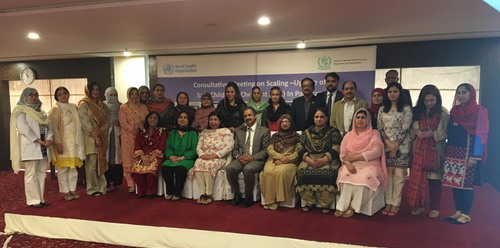
8 November 2018 – A national level expert consultation on WHO's safe childbirth checklist was organized in Islamabad on 1 November 2018, led by the Ministry of National Health Services, Regulation and Coordination, with support from the WHO country office in Pakistan. The key objective was to explore the potential of adapting the SCC tool and scaling up its implementation in our healthcare practices for mothers and newborns. The consultation brought technical experts on one page regarding significance of SCC as a quality of care tool and provided opportunity deliberate upon feasible mechanism of implementing SCC in clinical settings including use of technology for ease of reporting. The participants were also expected to explore opportunities for integrating SCC into pre-service and in-service training packages.
The experts included representation from the Society of Obstetricians and Gynecologists of Pakistan, Midwifery Association of Pakistan, Pakistan Medical and Dental Council, Pakistan Nursing Council, Academia (Health Services Academy) and development partners including United Nations Population Fund, UNICEF, GIZ and Jhpiego. Dr Safi Malik, Director Programmes from Ministry welcomed the participants and reiterated the government’s commitments towards improving maternal and newborn health status in the country. He highlighted that provision of life-saving interventions alone is not enough to reduce maternal and neonatal mortality; coverage needs to be matched with improvements in the quality of care. Global WHO tools on quality of care must be implemented in its true letter and spirit to support frontline, facility-based health-care workers to prevent avoidable childbirth-related mortality and morbidity.
The experts at the meeting thoroughly reviewed the checklist and provided technical inputs to contextualize it for implementation at large scale in the country. Use of software application to replace paper-based reporting was also endorsed especially at primary and secondary level health care facilities. The participants proposed that official communication from the Ministry should be issued recommending addition of the SCC tool into curriculum and examination for both medical and paramedical institutions through the respective regulatory bodies. The tool was highly appreciated by all participants and they committed to support its implementation for preventing the avoidable morbidity and mortality among women and newborns of Pakistan.
Adil’s story: Giving hope for better lives to people with polio
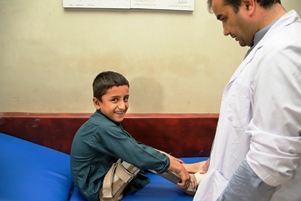 Adil Khan is getting his orthotic device replaced at PIPOS, Peshawar. ©NEOC/PAK2017/Faran Tanveer10 December 2017 – Nine-year old Adil Khan comes from Peshawar, Pakistan’s sixth largest city and capital of Khyber Pakhtunkhwa province. He is the oldest of the 4 children of Shami Ullah, a local laborer who often struggles to make ends meet. Together with his wife and 4 children, he lives in Wahid Ghari, a poor area of Peshawar, where many other underprivileged families reside.
If Shami Ullah’s life wasn’t difficult enough already, Adil was diagnosed with polio in 2008, only 5 months after he was born. After a couple of days of high fever followed by weakness in his left leg, Shami Ullah rushed his baby to the hospital where Adil was tested for polio. Unfortunately, the test came back positive. “We had heard about polio before, so when we learnt our son had it, we were very worried,” Shami Ullahsaid. “I just didn’t want to accept that Adil would not be able to walk his entire life.”
Pakistan’s health leaders mark World AIDS Day by committing to turn the tide
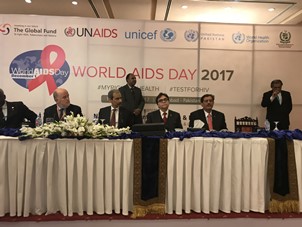 World AIDS Day 2017: HIV is treatable, test for HIV
The focus of World AIDS Day 2017 is to advocate for HIV testing with the aim of encouraging the general public to seek HIV testing, urge people living with HIV to be aware of their infection and therefore seek treatment, support country efforts in scaling up demand and to promote the different approaches to HIV testing that are recommended by WHO.
The World AIDS Day slogan is: HIV is treatable, test for HIV. It is being marked this year in the Eastern Mediterranean Region by the progress towards ending AIDS by 2030 as one of the targets of the Sustainable Development Goals that countries have endorsed and to which they have committed regionally and across the world.
“The Eastern Mediterranean Region has witnessed progress in HIV surveillance, prevention, treatment and care,” noted Dr Jaouad Mahjour, acting WHO Regional Director for the Eastern Mediterranean. “Between 2012 and 2016 the number of people living with HIV (PLHIV) receiving antiretroviral treatment increased steadily to more than double in number. In spite of this progress, the epidemic is still growing in the Region. Our Region features the lowest coverage of HIV prevention, diagnosis, treatment and care services in the world,” he elaborated.
Eighty-five per cent (85%) of people living with HIV in the Region who need life-saving antiretroviral therapy do not receive it. This is attributed partially to the fact that about 70% of PLHIV in our Region are not aware of their infection and, consequently, do not demand antiretroviral therapy though they need it to save their lives. However, HIV testing in countries of the Region is available mostly through public health facilities and nongovernmental organizations. Encouragingly, community-based testing programmes are operating in an increasing number in some countries. Pakistan, Egypt, the Islamic Republic of Iran, Morocco and Sudan have been working on increasing testing services through running community testing services for key populations and in locations where the HIV risk is high. In Morocco, the application of diverse approaches has resulted in 63% of PLHIV knowing their HIV status. In Sudan, focusing HIV testing in health care settings has contributed to increasing the efficiency of testing.
On the occasion of the World AIDS Day, WHO calls on individuals to seek HIV testing.
WHO’s key messages
• HIV testing is for your own benefit. When you know your HIV status you can make informed decisions regarding prevention and treatment.
• HIV is treatable. A HIV-positive test result is no longer a death sentence. People living with HIV can live long healthy lives with the appropriate treatment.
To take an HIV test, you can use a wide range of services. You might be offered the test by your health care provider or you may seek testing yourself in health facilities, in mobile testing services or in community organizations that offer HIV prevention and diagnosis services. Recently, HIV self-tests have become available for those who would like to test in their own privacy at their convenience. If you use a self-test and test HIV negative, most likely you are HIV negative. If your result is positive, don’t panic: go to the nearest health facility and ask for a HIV test to confirm your result.
We hope that our campaign for this year and advocating for HIV testing will encourage more people to do the test. Test for HIV and seek your treatment.
UNAIDS
UNAIDS and WHO applaud the commitment shown by the National AIDS Control Programme and the Ministry of National Health Services, Regulation and Coordination to join hands to eliminate HIV/AIDS, which is becoming a fast-growing epidemic
Pakistan’s federal and provincial health ministers have thrown their weight behind a declaration, committing to bold strategies, which aim to end AIDS as a public health threat by 2030. The health leaders signed the declaration at a World AIDS Day 2017 event in Islamabad. It is the first time that such a declaration has been signed by the health ministers of Pakistan. The declaration comes at a crucial time when the newly released HIV/AIDS treatment figures indicate the country has the highest treatment gap in Asia and the Pacific and the country experiences a significant expansion in its epidemic.
During the event on 30 November, Mrs Saira Afzal Tarar, Federal Minister, Ministry of National Health Services, Regulation and Coordination , Naveed Kamran Baloch, Federal Secretary, Ministry of National Health Services, Regulation and Coordination, and representatives of provincial health departments signed the declaration on HIV/AIDS. The event was attended by United Nations agencies, government representatives, people living with HIV, key populations and a large number of representatives of media.
The signing of the declaration was followed by a panel discussion.
The declaration states the following:
We the undersigned hereby reaffirm our support to the 2016 Political Declaration by the UN General Assembly on HIV and AIDS. The government of Pakistan commits bold strategies, aimed at ending the AIDS epidemic as a public health threat by 2030. The Ministry reaffirms its support on the eve of World AIDS Day 2017 to end AIDS by 2030, end stigma and discrimination attached to this epidemic and commit our full support towards Zero AIDS-related death. We recognize the potentially devastating consequences of the rapid spread of HIV and AIDS on social, cultural, economic and developmental prospects in the context of Sustainable Development Goals. Government pledges to continue prioritizing the implementation of the Pakistan AIDS Strategy 2017-2021 and also expand Anti-Retroviral Treatment (ART) coverage, with an emphasis on testing and treatment of the key population, and elimination of Mother to Child Transmission"
Pakistan continues to have concentrated HIV epidemic with an estimated prevalence among general population at less than 0.1 %. The epidemic is concentrated among key populations chief among which is people who inject drugs. PWIDs accounts for 33% of PLHIV and have an estimated prevalence rate of 38.4%. The AIDS epidemic modelling suggests that if the level of interventions stays the same as at present the primary driver of the epidemic will come to be sexual transmission among MSM and the estimated number of PLHIV will increase from 130,000 to 193,000 over the next few years. Between 2010 and 2016 annual new HIV infections climbed 39%, the second fastest growing epidemic in the Asia-Pacific region after the Philippines. This suggests that now is the time to increase the investments in prevention programming for key populations in Pakistan.
The treatment coverage is low than 10% of estimated people living with HIV and even lower for PLHIV from the key populations (4%) who accounts for an estimated 61% of those infected. Prevention programmes coverage for key populations is also very low ranges from 3.5% to 17.6%. This reflects the fact that combination prevention programme needs to be implemented at scale in 35 nationally prioritized cities for each key population of which 20 are in Punjab, 08 in Sindh 05 in Khyber Pakhtunkhwa and 02 in Baluchistan. Scientific research has also shown that a person living with HIV who is adhering to an effective regime of ARVs is up to 97% less likely to transmit HIV. In order for Pakistan to expand its treatment coverage, it is crucial that people get an HIV test as if they are HIV positive, they can then access life-saving treatment, remain healthy and prevent the onward transmission of HIV.
This World AIDS Day 2017, partners along with UNAID, WHO, NACP, UNFPA and Association of People Living with HIV and AIDS, are shining the light on the right to health and the challenges people around the world face in exercising their rights. If a person’s right to health is compromised, they are often unable to effectively prevent disease and ill health, including HIV, or to gain access to treatment and care. The most marginalized people in society, including sex workers, people who inject drugs, men who have sex with men, people in prisons and migrants, are often the least able to access their right to health.
A walk was organized to commemorate the World AIDS Day 2017. The walk began from the Country Office of WHO and culminated at NACP. A large number of people and students participated in the walk. People were holding banners, posters and placards bearing awareness raising messages on HIV/AIDS. The speakers highlighted the need to raise awareness on HIV/AIDS among masses, its available treatment and on its prevention and control.
The week long activities commemorating World AIDS Day ended on a theatrical performance by a local theater group, highlighting the importance of raising awareness among public, especially in the high risk groups including transgenders emphasizing on using disposable syringes, screened blood and practicing safe sex.
The Joint United Nations Programme on HIV/AIDS (UNAIDS) leads and inspires the world to achieve its shared vision of zero new HIV infections, zero discrimination and zero AIDS-related deaths. UNAIDS unites the efforts of 11 UN organizations—UNHCR, UNICEF, WFP, UNDP, UNFPA, UNODC, UN Women, ILO, UNESCO, WHO and the World Bank—and works closely with global and national partners towards ending the AIDS epidemic by 2030 as part of the Sustainable Development Goals. Learn more at unaids.org and connect with us on Facebook, Twitter, Instagram and YouTube.
National AIDS Control Programme
The National AIDS Control Programme is spearheading the HIV response in the country with 26 HIV treatment centres and 21 community home-based care sites. These centres provide free of cost HIV treatment, testing, counselling as well as social support to people living with HIV (PLHIV). The national programme with the support of UN partners, WHO, community representatives and civil society has commemorated the World AIDS Day 2017 with a series of awareness raising sessions held ta educational institutions andhealthcare hospitals. The media has been as active partner in NACP’s crusade against HIV/AIDS for disseminating important facts and figures rekated to the HIV epidemic in the country, information regarding free of cost HIV testing and treatment services being provided by the Government of Pakistan and promoting HIV awareness in the country.
The Government of Pakistan is committed to ending HIV in the country.